







February, 2000, HONOLULU, HI - January began with the gentle waves of the Caribbean rolling onto a sunny beach in Cancun, Mexico. And the month is ending with another idyllic beach scene -- this time with the waves of the Pacific rolling on to the beach at Waikiki in Honolulu, Hawaii. But it wasn't all play.
I am the newly elected Chairman of the Board of the Japanese American National Museum. Our first meeting of the year was scheduled to be held in Honolulu. But to make our confinement indoors in the Halekulani Hotel conference room bearable, the Hawaiian weather kindly obliged us with dreary, drizzly skies. Throughout our two-day meeting, it was showery and gray. It was still raining when I adjourned our board meeting.
The next morning, with the runways still wet with early morning drizzle, Irene Hirano, the Japanese American National Museum's executive director, along with several trustees and staff members, joined me on a flight to the city of Hilo on the big island of Hawaii. We were going there for the opening of one of our traveling exhibits, "From Bento to Mixed Plate," at the Lyman House Museum. This was the exhibit that had enjoyed a hugely successful six-month run at the Smithsonian Museum in Washington, D.C.
We landed at the Hilo airport in a downpour. Our shuttle van valiantly struggled against the famously rainy welcome of Hilo. When we arrived at the museum, I saw what looked like an enormous convention of umbrellas gathered at the front entrance. As we stepped out, we were greeted by smiling faces under huge outspread umbrellas and quickly hustled through the crowd. We had arrived just in the nick of time for the 9 a.m. beginning of the opening ceremony.
It is a Japanese tradition to begin ceremonial occasions with a concert of drumming on enormous drums called Taiko. When the first thunderous "boom" sounded, as if pre-planned by some special effects man, the rain miraculously stopped, the clouds parted and golden rays of sunshine began to stream down on the gathering. If that is an omen for the "From Bento to Mixed Plate" exhibit's run at the Lyman House Museum, then it bodes very well for its success. After the ceremony, as expected, the event turned into something not unlike a Star Trek convention. I sat and signed autographs for the crowd of first day museum-goers. In the evening, legendary U.S. Senator Dan Inouye spoke eloquently about the exhibit at a lovely Hawaiian reception for the exhibit's generous supporters. And there I signed more autographs.
 Although I have been to the state of Hawaii many times -- mainly to Honolulu -- this was my first visit to the "big island" of Hawaii. I'd heard and read about the beauty of this island, but the dramatic variety and contrasts in its scenery astonished me. Hilo, on the eastern side of the island, is a tropical rain forest matching our image of Hawaii.
The morning after the museum opening, I drove from Hilo to spend a few days of "R&R" at a resort in Kona on the opposite, west side of the island. Driving north, I left the rain forest jungles to a landscape of rolling green pasturelands that reminded me more of Wisconsin than any picture I had of Hawaii. There were herds of cattle grazing alongside white fences. I drove past a sign that announced "Parker Ranch," the biggest cattle ranch in the U.S. I stopped at a town called Waimea for lunch at a recommended place named the Paniolo Café. "Paniolo," I had been told, meant "cowboy" in Hawaiian. The waiter urged me to order the restaurant's famous paniolo hamburger. So I did. It tasted like hamburger - good, but no different than any other hamburger I've had on the mainland. I suppose that is what makes it famous in Hawaii.
About half an hour out of Waimea, the scenery changed again. This time, it became Arizona. Arid, scrubby desert landscape with occasional cactus plants trying to maintain themselves in the sandy soil. Even the sun seemed to get hotter.
Another half an hour and suddenly, the scene changed dramatically. It became a moonscape -- mile after barren mile of rocky, lifeless, unearthly vista. This was an ancient lava flow. Not a blade of grass could exist on this hot, forbidding terrain. I got off the highway on the road to the Orchid at Mauna Lani resort. The smooth roadway that cut through the jagged, rock-strewn topography seemed jarringly unnatural. What kind of god-forsaken resort did I get myself booked into, I wondered. Then, like a mirage, I saw graceful coconut palms swaying off in the distance. As I drove closer, bright splashes of crimson from Jacaranda bushes accosted me. Velvety green lawns appeared in sharp contrast to the jagged lava rocks. An elegant sign read, "Welcome to the Orchid at Mauna Lani." I drove up a curving drive to a grand porte cochere where a smiling group of stylishly clad bellmen was lined up to greet me. I had arrived at an unearthly oasis called the Orchid carved out of the stony crust of a lava flow.
The three days of rest and recuperation were heaven. But I must confess that the environmentalist in me did feel a slight twinge of guilt in this unnatural lap of luxury.
The other trustees of the Japanese American National Museum had returned home by the time I checked out of the Orchid. But I had another speaking engagement at a conference of the Pacific Telecommunications Council a few days later in Honolulu. So it was back to Honolulu and the beach at Waikiki for me. An onerous burden - to have to kill a few days at Waikiki.
At the Kona Airport for the return flight to Honolulu, Kona resident Midori Fujimoto showed me a wonderful museum, a memorial to Ellison Onizuka, the astronaut who died in the explosion of the Challenger Space Shuttle. Midori, whose late husband Fred spearheaded creation of the museum, told me that Ellison was a native son of Kona and took great interest in motivating young Hawaiians. I had met Ellison Onizuka in Los Angeles shortly before he flew off to Cape Canaveral for his ill-fated mission. I remember joking with him then that he was the 20thcentury ancestor of the character I play in Star Trek and thanked him for being one of the builders of the launching pad for the world of Star Trek. He modestly demurred and told me that Star Trek was one of his favorite shows and Sulu his inspiration. I thought of our mutual flattery with poignance as I walked through the Ellison Onizuka Space Center at Kona Airport, a most fitting tribute to the spirit of a space adventurer of our times.
Back in Honolulu, Hoyt Zia, executive director of the Pacific Telecommunications Council, had invited me to speak at his conference, where I met contemporary adventurers of a different kind. This was the annual gathering of high tech communications engineers, executives and entrepreneurs from the Pacific Rim countries from Asia to north and south Americas. Their great challenge is to connect people and nations through telecommunications. They are the explorers of today, linking up not just people, but ideas - sharing ideas, bringing ideas together to spark new ideas. They are the builders of our future in ways not unlike Gene Roddenberry's ideas that he shared through the telecommunications medium of television.
And, as it turned out, these conference delegates were eager Star Trek fans from way back in their college and university days. Star Trek was vibrantly alive even on the beaches of Waikiki. As the soft trade winds caressed us, the coconut palms swayed and the sound of the rolling waves serenaded us, we talked Star Trek and telecommunications.


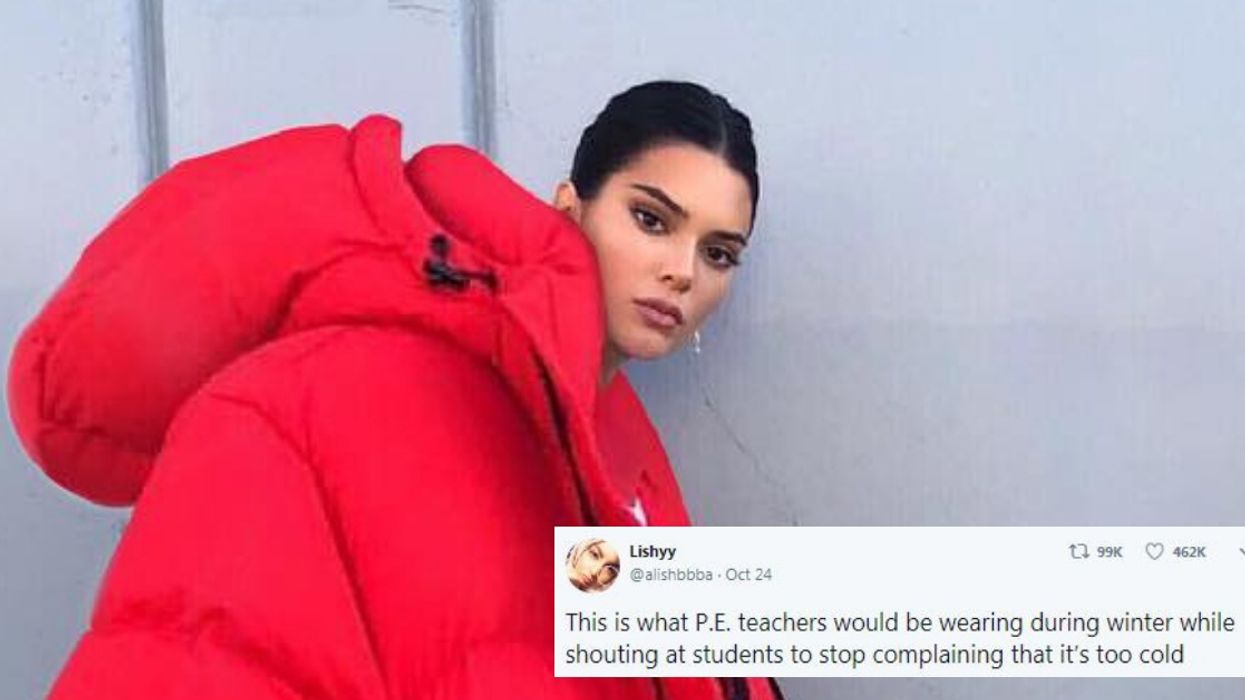
We all love a good meme, and the best memes often imitate life. Model Kendall Jenner is the latest target of the Instagram account @itsmaysmemes, which photoshops celebrities in hilariously oversized outerwear.
At least it looks cozy...
Soon, Vogue France tweeted the image and all hell broke loose.
The caption reads:
"Winter is coming !"
Indeed.

People made their own versions.
Some compared it to other strange fashion choices we've seen over the years.
And there were those who had some pretty interesting ideas about what this looked like.
Perhaps we loved it because it did seem just avant garde enough for Jenner to actually wear. Turns out we all can! Well, sort of. The jacket is a digitally enlarged version of The Super Puff jacket at Aritzia. Even the non-Photoshopped version looks pretty cozy!
H/T: Huffington Post, Twitter