





February, 2002, SACRAMENTO, CA - As the plane began descending toward the Sacramento airport, the green patterns of the farm fields below shifted to suburban housing developments, then to a scattering of rectangular high rise buildings surrounding the golden dome of the state capitol. I tried to locate the Victorian structure of the Crocker Art Museum but the plane quickly flew past the downtown area and was again descending over farm fields. I could now see the airport approaching. I was arriving for the opening of one of the Japanese American National Museum's traveling exhibits, "Henry Sugimoto: Painting An American Experience" at the Crocker Art Museum of Sacramento.
This trip, however, was more than my fulfilling my duties as the Chairman of the Japanese American National Museum. Sacramento is a special place to me. It was to this land, one hundred years ago, that my grandparents came from Hiroshima, Japan. It was here that my grandfather began farming, growing strawberries, plums, and hops. It was here, in an old Victorian farmhouse that my mother was born. It was here in the soil of Sacramento, the capital city of California, that my American roots were first planted.
 The exhibit of Henry Sugimoto's paintings is also very personal to me. When World War II began, this gifted artist was among the 120,000 Japanese Americans who were rounded up by the U.S. military and incarcerated in American internment camps. He painted scenes of his imprisonment in the two camps in Arkansas -- Rohwer and Jerome. Rohwer was the camp to which my family was sent from our home in Los Angeles. I look at Sugimoto's paintings of the camp landscape and they remind me of the swampy creek where I used to play by the barbed wire fence. I remember the scenes he painted of the communal hubbub in the washroom, where babies were bathed as well as the laundry done. I recognize the picture in his painting of the long line at the mess hall where we queued up three times a day for our meals. I look at these paintings by Henry Sugimoto and I'm reminded of the fear and anxiety of fellow Americans that sent us into that barbed wire imprisonment. I hear from these images on canvas, the resonance of the fear and anxiety felt today toward people of Middle Eastern descent. These paintings of sixty years ago are profoundly relevant to our times today.
We live in a time of terror. When in public places, when in congested places, certainly when we're at the airport, we feel an indefinable sense of anxiety.
 A dark, bearded person might fill us with some unease. That nervousness is not irrational. We are responding to what we have read, heard, or seen. That sense of unease might be called experiential "racial profiling." But race has to be just one part of the whole picture. That dark, bearded person might be a student or a dentist or a salesman -- nothing more. Simple racial profiling is an inadequate rationale for anxiety. Indeed, a terrorist can look like the all-American boy next door - like Timothy McVeigh.
We are Americans, the most diverse people on this planet. We look like the people of the world - every race in every shape and form. We are also a people who subscribe to the rule of law - not of racial discrimination. We believe in a system of due process where a person cannot be detained without charges, due cause or right to counsel. That is what makes our system of justice so great. Yet, at times of stress, our government can react hastily and without clear thinking. In the aftermath of September 11th, Middle Eastern immigrant men have been detained without charges and without counsel, their families uninformed of where the men had been taken or when they might be released. It was exactly the same with Japanese immigrant men immediately after Pearl Harbor. This kind of racial profiling ultimately resulted in a most egregious violation of the U.S. Constitution - the wholesale removal and incarceration of all Japanese Americans from the West Coast. There was no due process - no charges, no trial, just imprisonment by race. The scenes that Henry Sugimoto painted from his "American Experience" have this profoundly important cautionary message for our times today.
The opening of the exhibit of Henry Sugimoto's works in Sacramento was a great success. I'm told that this was the biggest opening in the history of the Crocker Art Museum. In my mother's hometown, in my state capital, where my roots go down deep, my own American experience was hugely well received. The exhibit will be in Sacramento until March 24, 2002.

Twitter user @Rich_Cooper stated:
"Dear feminists. You either get equality or chivalry. You can't have both."
One user responded:
"I'll take equality. I don't need special treatment."
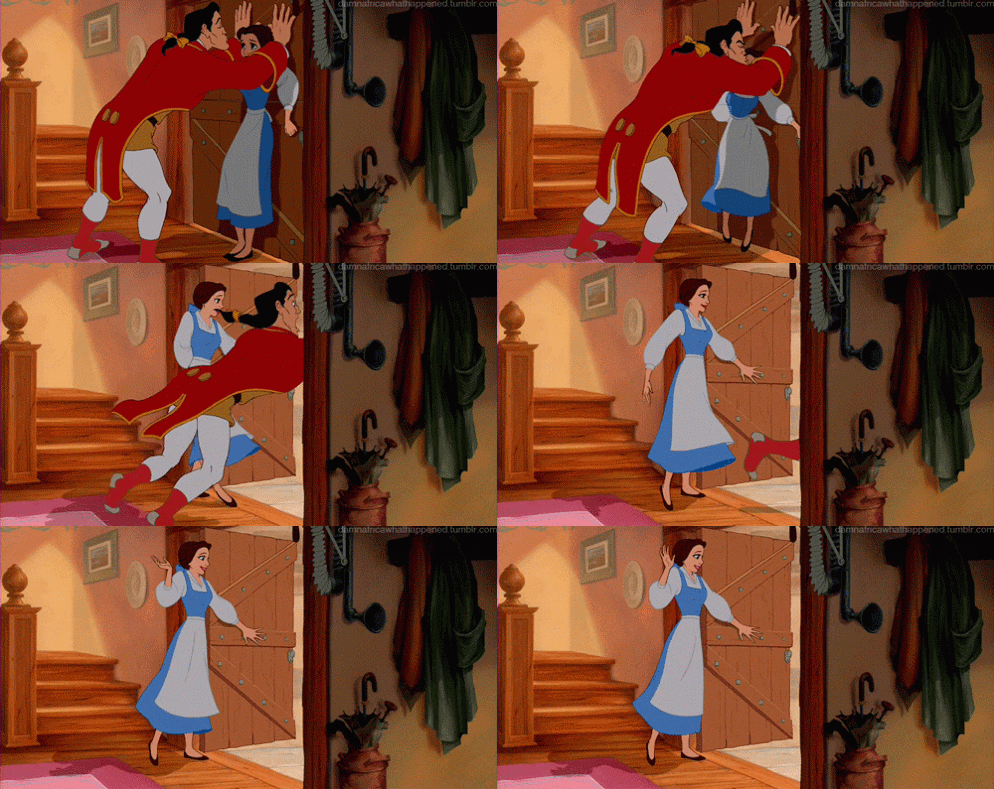
Cooper's rhetorical question did not go over so well. Both women and men expressed their disdain for his message.
One male user observed that chivalry was irrelevant and treating everyone with kindness and respect was compulsory.
"What people care about is caring, empathic [sic], considerate, thoughtful people, NOT whether THEIR door is held for them or THEIR meal is paid for them."
"Are there gender stereotypes in het[erosexual] dating? Sure. But that's separate from being a warm, giving, caring, grounded person."
Some women got right down to the point.
The notion of chivalry and equality are mutually exclusive and not a lot of people thought it was a major priority for feminists.
Common courtesy is not chivalry.
This user pointed out the fact that chivalry stems from a history of men outdoing other men. The concept had very little to do with women.
"Chivalry is a medieval concept of men dressing to impress other men. It has little to do with equality."
"Some men were on top, other men were beneath them. Historically, women were rarely invited into the process."
Neil Bradley described the outdated concept of chivalry as one that implies men being superior to women in a September 8, 2017, article for Medium publications.
"Examples: opening the door for a woman, paying for a woman's meal, gesturing for a woman to go first. The justification is either that women are not physically as strong (to open the door), able to provide (pay for their own meal), or are more deserving of compassion than men (allowing women to go first)."
Bradley also added that he wants to treat others the way he wants to be treated and asked if that approach should be motivated by chivalry or equality.
"If the genders are to be considered equal and treated equally, how a man treats a woman will essentially be the same as how a man treats a man."
"The obligation to open the door, pay for the meal, and let women go first vanishes. Men do not do this to other men, therefore why do it for women?"
His final take was that the two concepts can't co-exist. Either one is chivalrous or treats everyone as equals.
At the end of the day, people were happy to show chivalry the door.
H/T - GettyImages, Twitter, Indy100, Medium

Hundreds of artists have signed a letter threatening a boycott if SiriusXM's parent company, Liberty Media, doesn't back down from opposing the Music Modernization Act.
The act, which was expected to pass through Congress, streamlines royalty payments in the new age of digital technology, but it seems SiriusXM is objecting to a small section that would have the satellite radio company paying royalties on recordings dating before 1972.
That's a whole lot of songs and a whole lot of money the company is hoping to skip out on paying, but not if stars like Paul McCartney, P!nk, Stevie Nicks, Sia, Carly Simon, Gloria Estefan, Mick Fleetwood, Don Henley, Max Martin, and Katy Perry can help it.
The letter read, in part:
I'm writing you with grave concern about SiriusXM's opposition to the Music Modernization Act (Classics Act included).
We are all aware of your company's objections and trepidation but let me say that this is an opportunity for SiriusXM to take a leadership position. As you are aware, 415 Representatives and 76 Senators have already cosponsored the MMA along with industry consensus. It's SiriusXM vs all of us. We can either fight to the bitter end or celebrate this victory together. Rather than watch bad press and ill will pile up against SiriusXM, why not come out supporting the most consequential music legislation in 109 years? We do not want to fight and boycott your company but we will as we have other opponents. Stand with us! Be brave and take credit for being the heroes who helped the MMA become historic law! Momentum is building against SiriusXM and you still have an opportunity to come out on the right side of history. We look forward to your endorsement but the fire is burning and only you can put this out.
SiriusXM resoponded with a letter of their own:
Over the past several weeks, we have been the subject of some stinging attacks from the music community and artists regarding our views on the Music Modernization Act. Contrary to new reports and letters, this is really not about a SiriusXM victory, but implementing some simple, reasonable and straightforward amendments to MMA. There is nothing in our "asks" that gut the MMA or kills the Act. So let's talk about the substance of the amendments we propose, because we truly do not understand the objections or why these concepts have incited such a holy war.ontrary to the accusations, SiriusXM has proposed three simple amendments to the MMA.
First, SiriusXM has asked that the CLASSICS Act recognize that it has already licensed all of the pre-1972 works it uses. This amendment would ensure that artists – the people who are supposed to be at the heart of the MMA – receive 50% of the monies under those existing licenses. Is that unfair? Just today, Neil Diamond wrote in the LA Times that: "I receive a small amount of songwriting royalties, but no royalties as the recording artist." How can that happen? To date, SiriusXM has paid nearly $250 million dollars in pre-'72 royalties to the record labels. We want to make sure that a fair share of the monies we have paid, and will pay, under these licenses gets to performers. Without this provision, artists may never see any of the money SiriusXM paid, and will pay, for the use of pre-1972 works. Artists not getting paid hurts our business!
Second, Sirius XM thinks that the fair standard to use in rate setting proceedings is the standard that Congress chose in 1995 and confirmed again in 1998 – which is called the 801(b) standard. However, we are willing to move the "willing buyer/willing seller" standard contained in the MMA. In exchange, we have asked for the same concession that the MMA grants to other digital music services, but we were left out of — simply that the rates that were set last year for five years now apply for ten years. We thought this was a fair compromise when we read the "new" MMA that was released this weekend by the Senate, and are willing to live by that compromise.
Third, SiriusXM is asking the simple question: "Why are we changing the rate court evidence standard for musical compositions in this legislation so that it gives another advantage to broadcasters over satellite radio and streaming services?" There is no policy rationale for this change to tilt the playing field further in their favor, and frankly no one has been able to explain it to us. It is only fair that we debate why the change to Section 114(i) is in the MMA.
Did you all catch that? It sounds like lawyer speak for "we don't really want to say where we stand."

It seems all the letters were for naught. The Music Modernization Act passed in the U.S. Senate.
It was time to celebrate and dance in the streets.
As the saying goes, honest pay for honest work.