



September, 2002, LOS ANGELES - Movies are historic documents. They chronicle the times in which they were filmed. Oscar-winning movies in particular, beyond their acknowledged cinema artistry and box office popularity, can illuminate the temper of the country at a point in time. They capture the styles, the social values, and a sense of the political climate of the year in which they won the Academy Award.
This year is the 75th anniversary of the Oscars. The Academy of Motion Picture Arts and Sciences has been celebrating this Diamond Anniversary by screening all of the Academy Award winning Best Pictures in sequence most Monday nights at its Samuel Goldwyn Theater in Beverly Hills. This past month, the Oscar winners from the 1940s have been screened. These award-winning films gave me a good sense of the spirit of this country during those turbulent times.
The 1940 winner was director Alfred Hitchcock's "Rebecca," starring Laurence Olivier, Joan Fontaine, and Judith Anderson. The country was just emerging from the Great Depression and hungering for escape. The people wanted a break from the lingering gloom. Their romantic fantasy was the notion of happiness prevailing over adversity, come what may. Joan Fontaine played a beautiful but poor young housekeeper in a great manorial estate owned by Laurence Olivier, whose wife had recently died. She falls in love with the dashing young owner in spite of the relentless intrusions of a stern and mysterious head housekeeper played by Judith Anderson.
The film would be seen today as a piece of high-class soap opera. But it well captured the escapist appetite of a nation just shaking off the dreary dust of economic hard times. "Rebecca" is an entertaining, but transparently corny gauge of the period. This movie won for Best Picture over a much more substantial film that depicted the true hardships of the period with powerful realism, "The Grapes of Wrath." If I were voting then, this would have been my pick. The Best Direction award, aptly, went to the director of "The Grapes of Wrath," the great master, John Ford.
An added bit of fun with "Rebecca," on the other hand, was watching a young Judith Anderson as the sinister head housekeeper. Her career-capping movie was "Star Trek III: The Search for Spock" in which she portrayed the stern ancient Vulcan priestess. She seemed pretty stern in real life as well when we worked on that film. For her role in "Rebecca" she won the Best Supporting Actress Oscar.
 The 14th Best Picture Academy Award winner, "How Green Was My Valley," was released in 1941. The Oscar ceremony honoring it was nearly canceled. The award presentation took place on February 26, 1942 - two months after Pearl Harbor. The governors had been thinking of canceling the show after the surprise attack. But, after much debate, they decided to go ahead with a modified version. The tone was subdued, formal attire was banned, and there were no searchlights fanning the skies outside Los Angeles' Biltmore Hotel, where the ceremony was held.
The winning film still reflected the economic struggles of the nation rather than the now-raging world conflict. "How Green Was My Valley" is about the struggles of a Welsh coal mining family at the turn of the century. Parallel to the trials and tribulations of a tight-knit family gradually breaking up were the economic issues of unionization, labor versus capital, and class divisions. It was still a "fighting through hard times" movie. The film's director, John Ford, won his second Oscar, thus becoming the first director to win two in a row. He had won the previous year for "The Grapes of Wrath."
The Fifteenth Oscar presentation was on March 3, 1943, in the Coconut Grove of the Ambassador Hotel. This time, the Academy Awards ceremony radiated patriotism. Jeannette MacDonald sang the National Anthem. Marine private Tyrone Power and Air Force private Alan Ladd unfurled an industry flag announcing that over 26,000 members of the motion picture business were in uniform. For the first time, the bronze-filled, gold-plated Oscar statuettes were made of plaster due to wartime shortages. And the Best Picture of the year award went to "Mrs. Miniver," a film unabashedly glorifying the courage of an English family under wartime Nazi assault.
 The Mrs. Miniver character, played by Greer Garson, personified heroic British spirit and resilience. The downed German pilot spouted Hitler's master race slogans like a robot. The devastation of war was heartbreakingly depicted. British Prime Minister Winston Churchill called the film "propaganda worth a hundred battleships." I noted an interesting bit of the moral code of the times in the separate beds occupied by the loving wife and husband in their own bedroom. Greer Garson received the Best Actress and Teresa Wright the Best Supporting Actress Oscars. The director, William Wyler, won for his work on the film but could not attend the ceremony because he was stationed in England at the time. The world was engulfed in war and so, too, was the Academy Awards ceremony.
The Oscar ceremony of 1945 was moved back onto Hollywood Boulevard to the legendary Grauman's Chinese Theater. The news from Europe was looking hopeful
Within two months, Germany would surrender. The Japanese would follow suit in August. The country was feeling optimistic.
The Best Picture Oscar winner was the bright and sentimental Paramount Studios film, "Going My Way," starring Bing Crosby. It was also the first Best Picture to include the Best Song. Crosby, as the idealistic, easy going, crooner priest Father O'Malley, won as Best Actor and Barry Fitzgerald as the charmingly cantankerous Father Fitzgibbon, won as Best Supporting Actor. America had struggled through more than a decade of economic misery and now seemed victorious in a world conflict. We were feeling good. We felt upbeat about the future. "Going My Way" was a precise picture of the country.
This Academy series on the Best Picture Oscar winners set me to thinking on the films that might reflect the temper of our times.
 Today, we could be said to be living in a time prickly with uncertainty. The air is filled with insecurity whether it is in the wild gyrations of the stock market or the fear of some startling terrorism in our land. News of rising unemployment is accompanied by conflicting reports of possible attack on Iraq. The air is tense with a vague anxiety. I saw a film earlier this year at the Sundance Film Festival that I think brilliantly captures this societal unease. It is "One Hour Photo" starring Robin Williams in a chillingly fine performance. The film was recently released nationwide. "One Hour Photo" is one of the best pictures I have seen this year and a good candidate for Best Picture consideration.
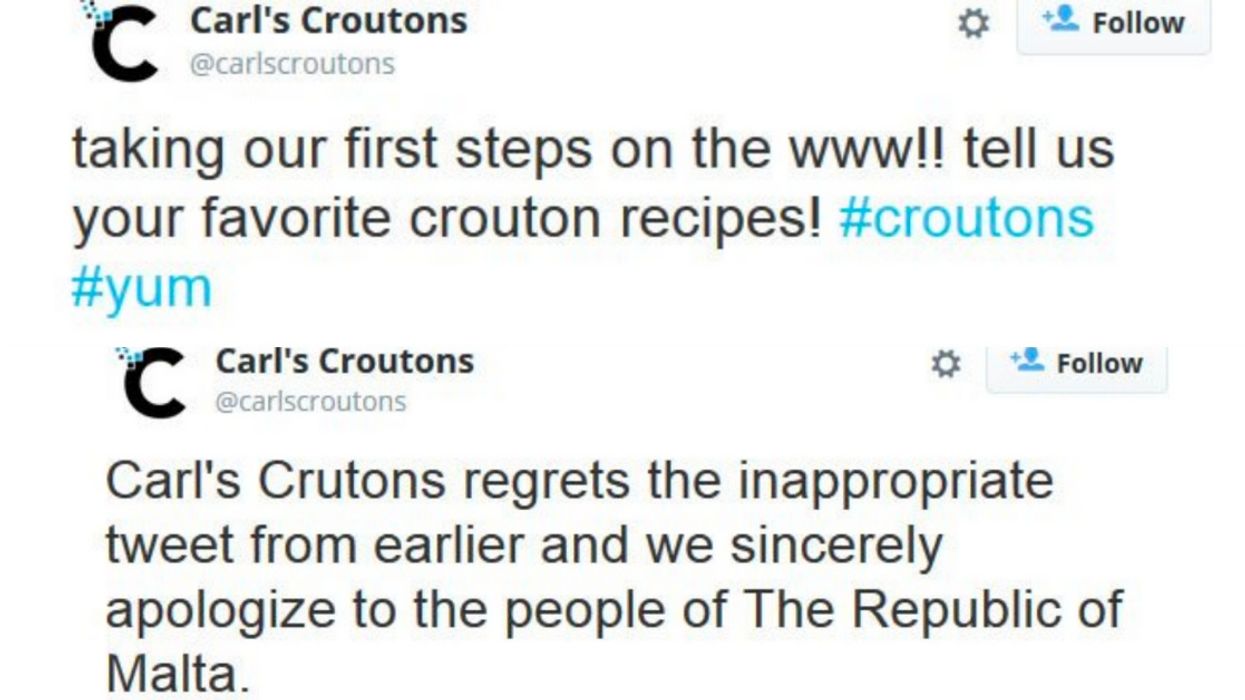
@topherflorence captured highlights from the thread that received over three thousand retweets for its zaniness alone.
Can you follow?
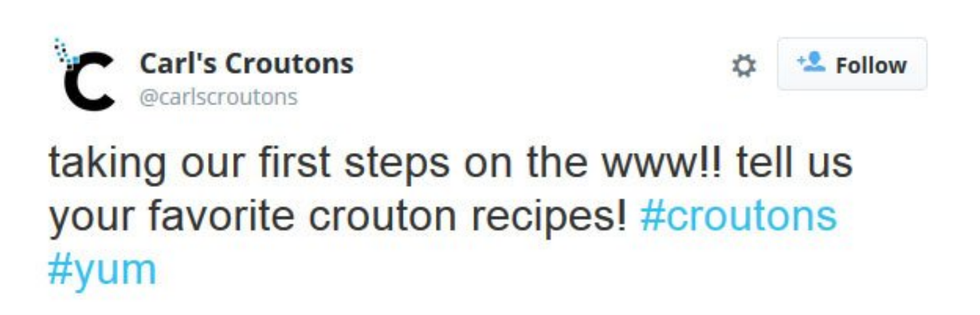
The bread crumbs company endeavored to stir excitement for the brand by encouraging participation with the following tweet:
"Taking our first steps on the www!! tell us your favorite crouton recipes! #croutons #yum"
Harmless, right?
But somewhere along the way, the brand mixed business with politics. @religiousgames noticed that Carl's Croutons issued a one-word directive: vote.
The Twitter user asked, "What does it mean?"
Did the Carl's Croutons account manager get his social media account wires crossed? Possibly. But then we're not sure.
@topherflorence responded by saying, "lol that wasn't me i would posted something way dumber."
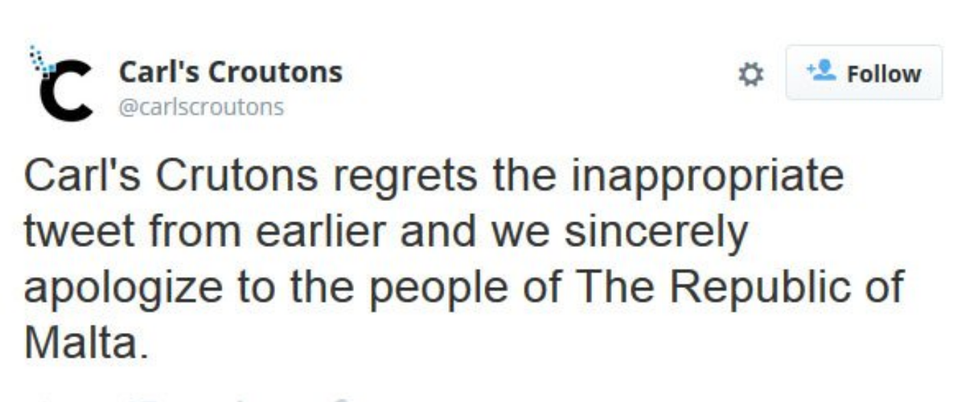
The following tweet from Carl's Croutons attempted damage control:
"Carl's Crutons [sic] regrets the inappropriate tweet from earlier and we sincerely apologize to the people of The Republic of Malta."
So how did Carl's Croutons insult the Republic of Malta?
@Bestorb shed some light on why the Southern European island country may have been insulted by sharing a YouTube clip of episode 1008, "Final Justice," from Mystery Science Theater 3000.
Did it have something to do with the country's dominant population of women?
The thread spun off in all different directions.
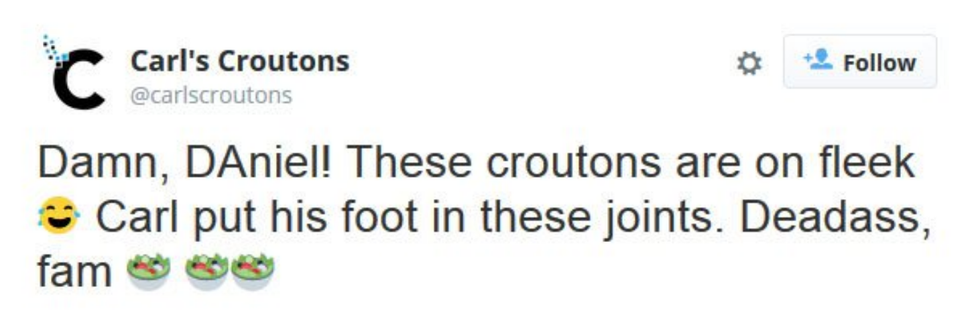
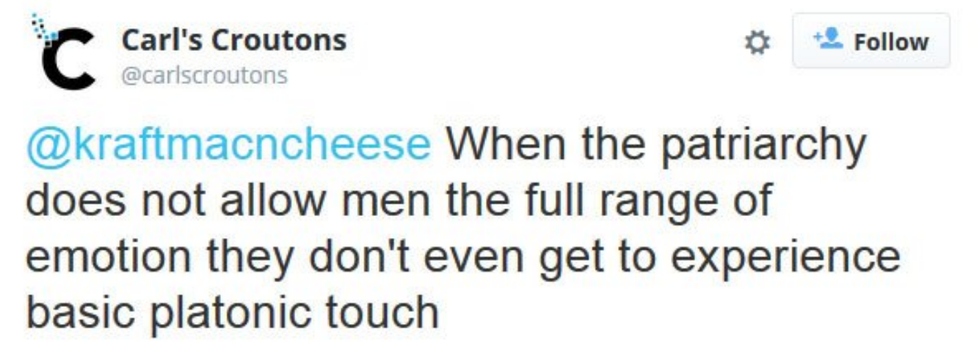
There were many takeaways from the esoteric thread, but the one directive really stood out.
There's still an unanswered question.
So who is Carl's Croutons anyway? Nobody knows. Just vote.
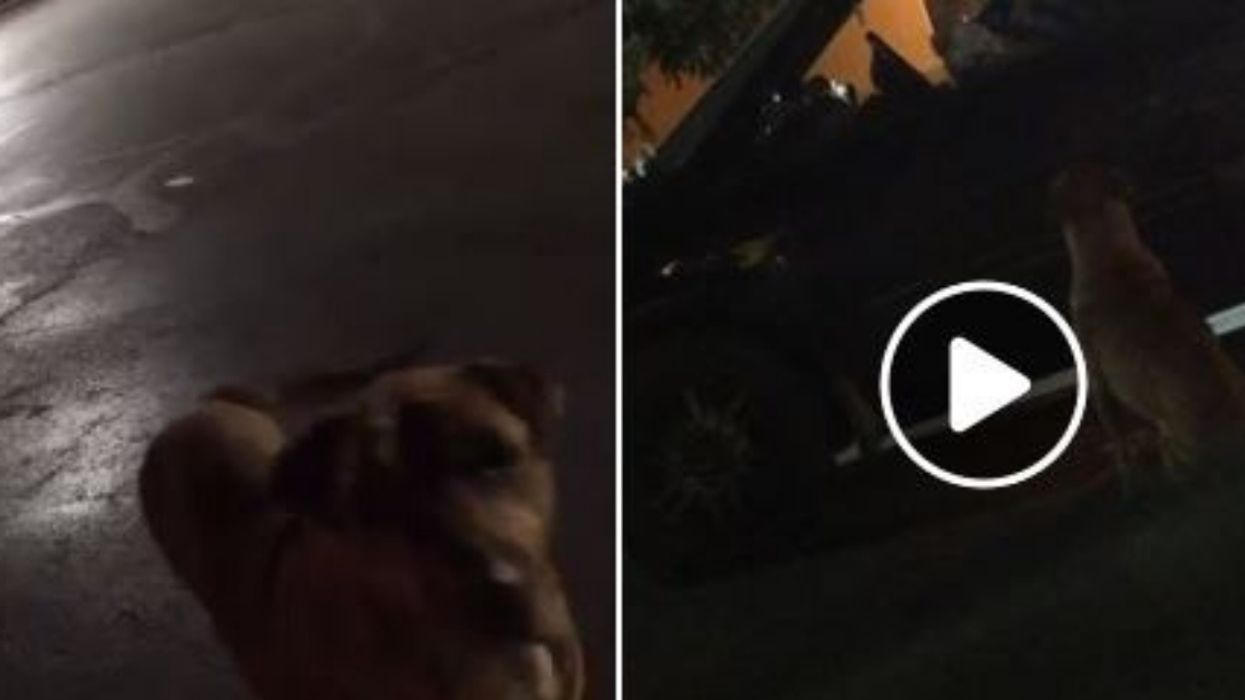
Facebook user Betsy Reyes busted her dog Princess who was out moonlighting as a stray in order to play on the sympathies of strangers. It seems Princess likes to wander off to her favorite hangout, the local McDonald's, and work the drive through lane like a pro.
And that's what she did right up until Reyes busted her scam. Reyes, who lives in Oklahoma City, took to Facebook and outed Princess in the most hysterical way, saying:
"If you see my dog @ the McDonald's on shields, quit feeding her fat ass bc she don't know how to act & be leaving the house all the time to go walking to McDonald's at night. She's not even a stray dog. She's just a gold diggin ass bitch that be acting like she's a stray so people will feel bad for her & feed her burgers."
Lots of scammers out there.
It's an adorable story, but maybe get the dog a collar with identification?
Not everyone thought the story was cute.
Of course, when a girl's gotta eat, a girl's gotta eat.
Let's hope Princess has learned her lesson and stays home.
H/T: Huffington Post, Mashable

The MobiLimb was created by researchers in France and is made up of "five servo motors, an Arduino microcontroller and a sensor, and it can do a number of unsettling things that are straight out of nightmares," according to Engadget.
Marc Teyssier, a PhD student and one of the researchers behind the project for the dismembered limb, legitimized its existence.
"In the spirit of human augmentation, which aims at overcoming human body limitations by using robotic devices, our approach aims at overcoming mobile device limitations (static, passive, motionless) by using a robotic limb."
Th MobiLimb can prop itself up so you can watch a video, or provide an alternate way to grip your device.
But there's one function that is really disturbing.
The articulated digit can be skinned to resemble a human finger, and it can stroke your wrist while you're using your phone.

Someone implied that single people could benefit from this invention as a companion.
What would the next-generation MobiLimb offer consumers?
The attachment could come in handy should an unfortunate life-changing incident were to occur.
But the gadget is still giving people goosebumps.
Others saw a more erotic potential.
Now here's a function not advertised by MobiLimb's creators.
Feelings are mixed. But the jury is in.
As to why such a creepy gadget was invented, we can't quite put our finger on it. But then, when it comes to consumers' needs, these guys may be out of touch.
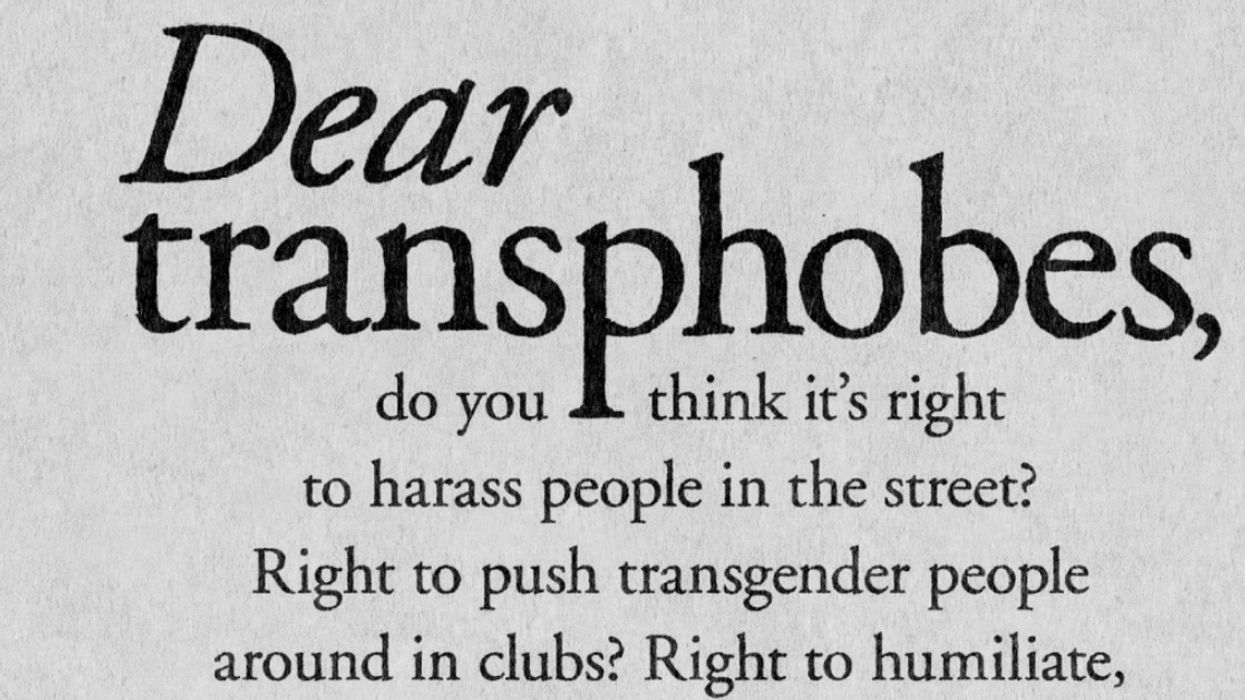
The campaign is part of the Scottish government's One Scotland project in an effort to reduce hate crime.
One letter reads:
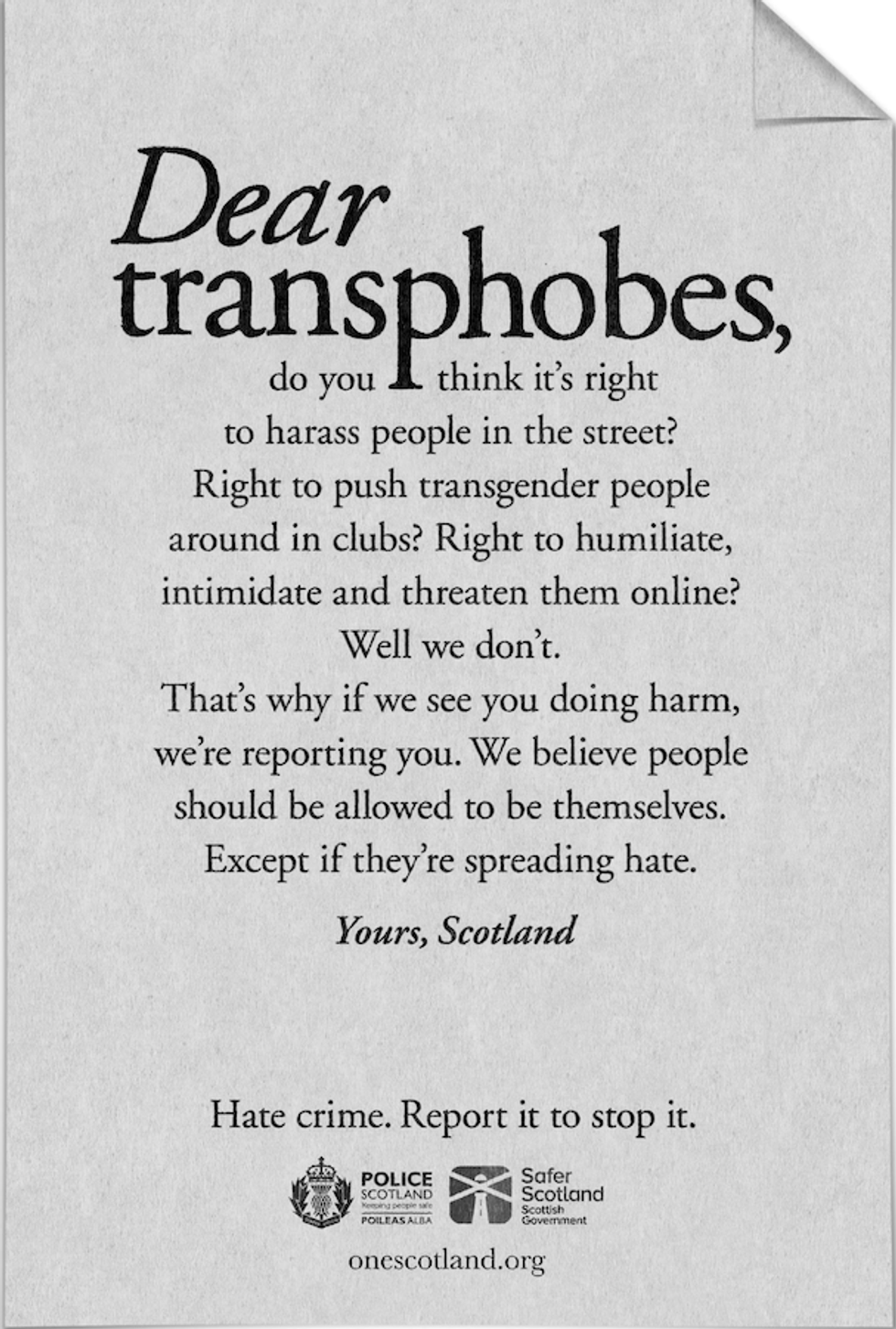
"Dear transphobes, do you think it's right to harass people in the street? Right to push transgender people around in clubs? Right to humiliate, intimidate and threaten them online? Well we don't."
"That's why if we see you doing harm, we're reporting you. We believe people should be allowed to be themselves. Except if they're spreading hate."
"Yours, Scotland."
 (
(In another letter, the country says it has a "phobia" of homophobic behavior.
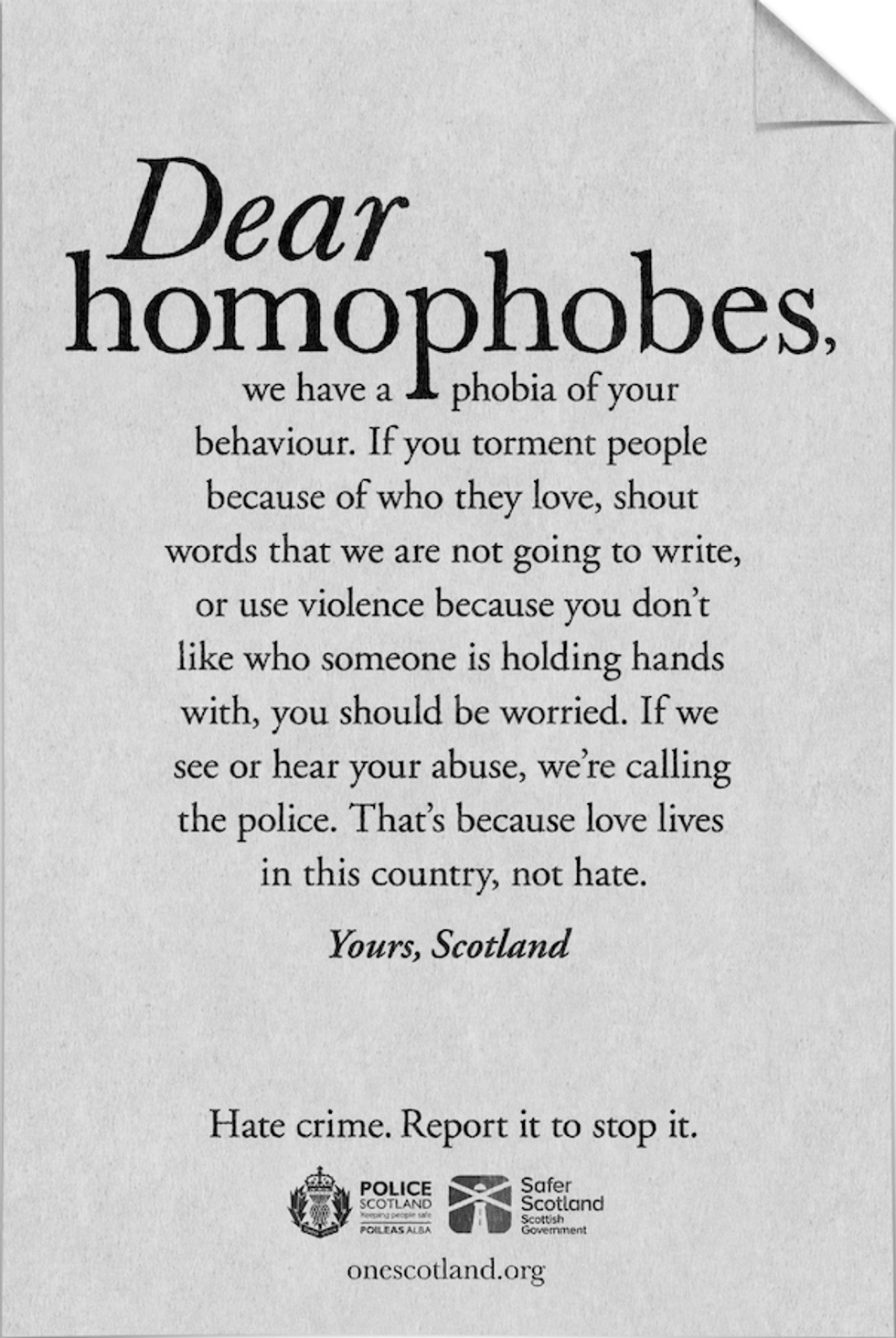
"If you torment people because of who they love, shout word that we are not going to write, or use violence because you don't like who someone is holding hands with, you should be worried."
"If we see or hear your abuse, we're calling the police. That's because love lives in this country, not hate."
"Yours, Scotland."
 (
(One Scotland's website describes the organization as one that aims to continue building an inclusive society while recognizing the significant strides made so far towards equality.
"One Scotland embodies the inclusive society we want in Scotland, where equality and human rights are respected and every individual and minority group feels valued."
The website defines hate crimes as abuse that "can be verbal or physical and has hugely damaging effects on the victims, their families and communities, and we all must play our part to challenge it."
"Police Scotland takes hate crime very seriously. In the last year there were over 5,300 charges of hate crime reported to the Procurator Fiscal in Scotland1."
"However, there are many more incidents that go unreported. We all have a responsibility to report hate crime if we witness it – it's the only way we can challenge it, and put an end to it for good."
Justice minister Humza Yousaf is familiar with being a victim of a bigotry and is encouraging people to call out and report any incidents involving harassment.
"As somebody who has faced Islamaphobic and racial abuse over the years, I know how upsetting being a victim of hate can be. Hate crime and prejudice are completely unacceptable and we are absolutely committed to tackling it."
"We all have a role to play in stamping out prejudice and I would ask anyone who witnesses a hate crime to play their part and report it. Justice agencies such the police and Crown Office will deal sensitively with reports made and people should have confidence in how they will be treated. Last year there were over 5,300 charges of hate crime reported to the Procurator Fiscal in Scotland but there are still many incidents that are going unreported."
Henrietta Mochrie identifies as transgender and has been the victim of repeated harassment and abuse. She emphasized the importance of speaking out against the hatred.
"I'll often get street harassment, sometimes this has escalated to the point where I've been followed by people shouting abuse at me, just because of who I am."
"It makes me feel really down and scared to leave the house. It's important that if you witness hate crime that you report it to take a stand against hate."
One Scotland's ad campaign officially launched on Wednesday.
Hopefully, it won't take too long before other nations follow suit in this bold, yet necessary fight for equality.
H/T - OneScotland, PinkNews, Twitter