






January, 2001, LOS ANGELES - The 20th century is now history and we begin a new century and a bright new millennium. What this millennial turn might portend is both tantalizing, and, at the same time, just a bit daunting. The last century gave us astronauts on the moon as well as the atomic bomb; the reading of the human genome and the Holocaust; the darkest of evils and some of the most magnificent advances to come from the human mind. If history is any guide, the years ahead will likely move us forward with even more dazzling new advances wrought from the genius of our minds, as we at the same time struggle to avert another plunge into some horrific new depravity. I am an optimist hopeful that wisdom would prevail over our darker aspects but mindful of the infinite range of the human animal. We have the capacity for nobility and depravity as well as vacillation. The United States now has a new President who lost the popular vote and was appointed by a partisan U.S. Supreme Court. We begin the millennium on an ambiguous but nevertheless hopeful note.
I finished the last month of the last year with my traditional shopping trek to London. I love London. I love its theaters. I love its museums. I love its people. I love its ever-changing, ever-unchanging appeal.
"Cats" is still playing in London as New York brought the final curtain down on the record-breaking run of its Broadway version. Of course, the eternal "The Mousetrap" is still playing. Theater in London is eternal. They do great American plays as masterfully as they do Shakespeare. I saw a moving production of Eugene O'Neill's masterpiece, "Long Days Journey Into Night," with a deeply affecting performance by Jessica Lange. I saw Andrew Lloyd Webber's newest musical, "The Beautiful Game," a heartbreaking tale of the conflict in Northern Ireland that had some resonance of "West Side Story." My biggest theatrical disappointment was a much-lauded production of Stephen Sondheim's "Merrily We Roll Along." After fighting a rainstorm to get to the theater, we were told that the performance was cancelled because of an illness in the cast. They had no understudy. Our disappointment continued into the night with the restaurant that we decided on in lieu of the play. Service was poor, the food mediocre and the bill preposterous. I guess some evenings just are not meant to be.
Cultural London is wonderfully transforming itself without physically altering the urban landscape. Some of the most exciting new cultural institutions are in adaptively reused buildings or restoration of great classic structures.
The stunning Tate Modern, the new museum on the south bank of the Thames, is in a former powerhouse. The monstrous industrial space has been masterfully reshaped into a series of wonderful galleries. However, great works of modern art somehow seem to get upstaged by windows in some of the galleries that offer spectacular views of St. Paul's Cathedral across the river. Even Andy Warhol couldn't compete with that splendid city vista. And I recommend the top floor restaurant for a champagne lunch with a fabulous view.
I hadn't been to The British Museum in more than a decade. I'd read that a wonderful new improvement had been made there. The Great Court of The British Museum had been carved out of the clutter of ancillary buildings built over the years around the old British Library in the courtyard of the museum. We rushed to view this new addition to the London cultural scene two days after Queen Elizabeth II had inaugurated the space. Touted as the largest covered public space in Europe, I found it a bright, spacious and elegant expansion of a London treasure. The terrace restaurant there hadn't opened yet, so I will have to return there again soon.
The Royal Opera House in Covent Garden is legendary. In addition to its own storied history, George Bernard Shaw contributed to its fame by placing the opening scene of his play "Pygmalion" right in front of the Covent Garden Opera House, as does the play's musical version, "My Fair Lady." The opera house and the floral hall next to it had been under renovation for the past few years and had reopened in 1999 to great critical applause. The demand for tickets was so hot that I couldn't get in back then. This visit, I was determined and managed to get a pair of tickets for the ballet "Ondine." The performance was superb but the opera house itself was absolutely breathtaking. It was opera-going in the classic European tradition. Gilded tiers piled upon glittering tiers filled with elegantly dressed theatergoers. The new Covent Garden Opera House shone with a brilliance that only sensitive restoration combined with modern technology could produce. And the incorporation of the crystalline Floral Hall as an addition to the lobby with stylish new restaurants was great. Service efficient, food delightful, and prices varied.
The most controversial cultural addition to the London landscape was also its newest and most temporary -- the Millennium Dome. Looking like a giant desert tent or some extraterrestrial construction site on the Meridian Line at Greenwich, the Dome was a vast exposition hall with exhibits on the challenges and opportunities in the new millennium. Divided into 14 zones of diverse human activities such as work, play, learning, money and journey, it was much too much to experience in a day. We did the journey through a gigantic human body, walked through one million pounds in British sterling and went through the exhibit on future modes of travel. I should have been prepared for the inevitable -- floating luminously above us in the travel zone was a model of the Starship Enterprise. But, like Cinderella's coach, the Millennium Dome disappeared on December 31, 2000. A good number of British people felt that this attraction was much too much money spent for much too little. However, the Millennium Dome, with its subway line extension, the regeneration of the area and the Millennium Village, leaves a fine legacy of infrastructure for the future development of a formerly underused area. I thought it a good investment.
One millennium project that will remain on the London landscape is the giant Ferris wheel dubbed the Millennium Eye built on the south bank of the Thames across from Big Ben. On a clear, cold, blustery day, we headed out for a bird's eye view of London from the wheel. Alas, the day may have been bright and sunny but the strong wind made a ride on the delicately balanced attraction too chancy. They cancelled operation of the Ferris wheel. We now have another good reason to return to London.
The one inevitable joy on any of my travels is a gathering with Star Trek fans. Jackie Edwards, a former fan club president, had moved to Essex and had been urging me to visit that part of England. It was the driest part of England, she had told me. So, this being England, I had to travel through a driving rainstorm to reach Norwich in Norfolk. Hosted by Richard Stubbings, owner of a fantastical store called Kulture Shock, I spent a day as lively as it was wet with fans that have become good friends.
The millennium is off to a happy start. Let's all work to keep it that way.
Feminists Slam Man Telling Them They Can't Have Both Chivalry And Equality
A man on Twitter informed feminists they had to choose between chivalry and equality.
He was promptly raked over the coals for even assuming an antiquated concept would be considered as a viable option.
Twitter user @Rich_Cooper stated:
"Dear feminists. You either get equality or chivalry. You can't have both."
One user responded:
"I'll take equality. I don't need special treatment."
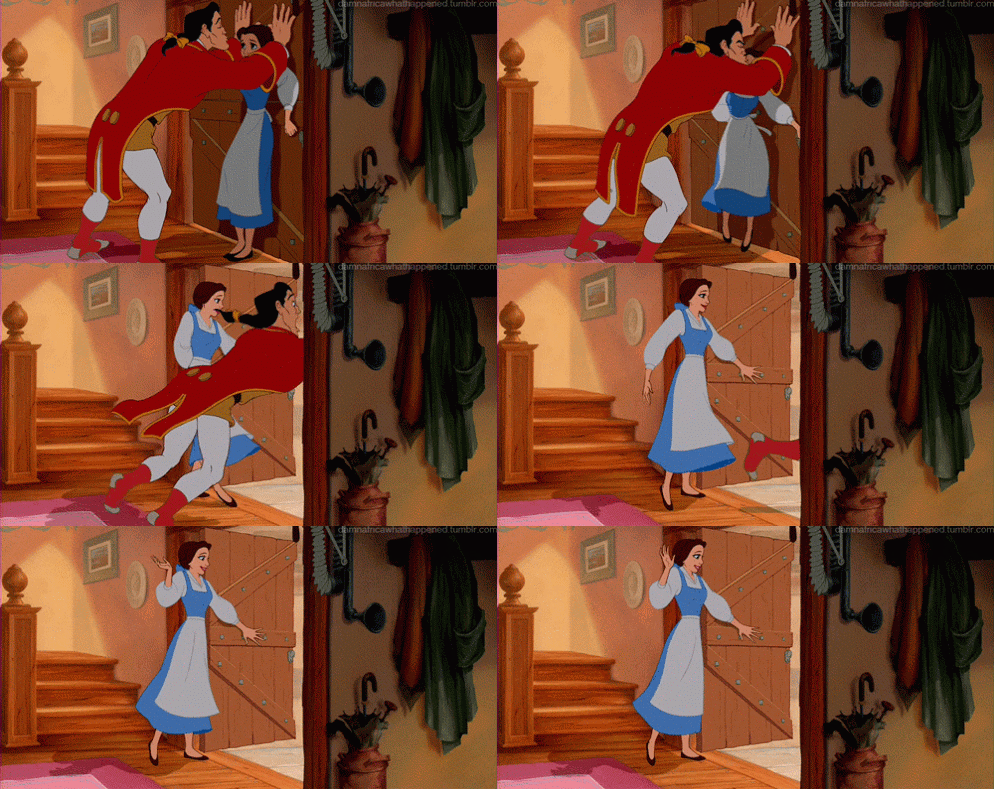
Cooper's rhetorical question did not go over so well. Both women and men expressed their disdain for his message.
One male user observed that chivalry was irrelevant and treating everyone with kindness and respect was compulsory.
"What people care about is caring, empathic [sic], considerate, thoughtful people, NOT whether THEIR door is held for them or THEIR meal is paid for them."
"Are there gender stereotypes in het[erosexual] dating? Sure. But that's separate from being a warm, giving, caring, grounded person."
Some women got right down to the point.
The notion of chivalry and equality are mutually exclusive and not a lot of people thought it was a major priority for feminists.
Common courtesy is not chivalry.
This user pointed out the fact that chivalry stems from a history of men outdoing other men. The concept had very little to do with women.
"Chivalry is a medieval concept of men dressing to impress other men. It has little to do with equality."
"Some men were on top, other men were beneath them. Historically, women were rarely invited into the process."
Neil Bradley described the outdated concept of chivalry as one that implies men being superior to women in a September 8, 2017, article for Medium publications.
"Examples: opening the door for a woman, paying for a woman's meal, gesturing for a woman to go first. The justification is either that women are not physically as strong (to open the door), able to provide (pay for their own meal), or are more deserving of compassion than men (allowing women to go first)."
Bradley also added that he wants to treat others the way he wants to be treated and asked if that approach should be motivated by chivalry or equality.
"If the genders are to be considered equal and treated equally, how a man treats a woman will essentially be the same as how a man treats a man."
"The obligation to open the door, pay for the meal, and let women go first vanishes. Men do not do this to other men, therefore why do it for women?"
His final take was that the two concepts can't co-exist. Either one is chivalrous or treats everyone as equals.
At the end of the day, people were happy to show chivalry the door.
H/T - GettyImages, Twitter, Indy100, Medium
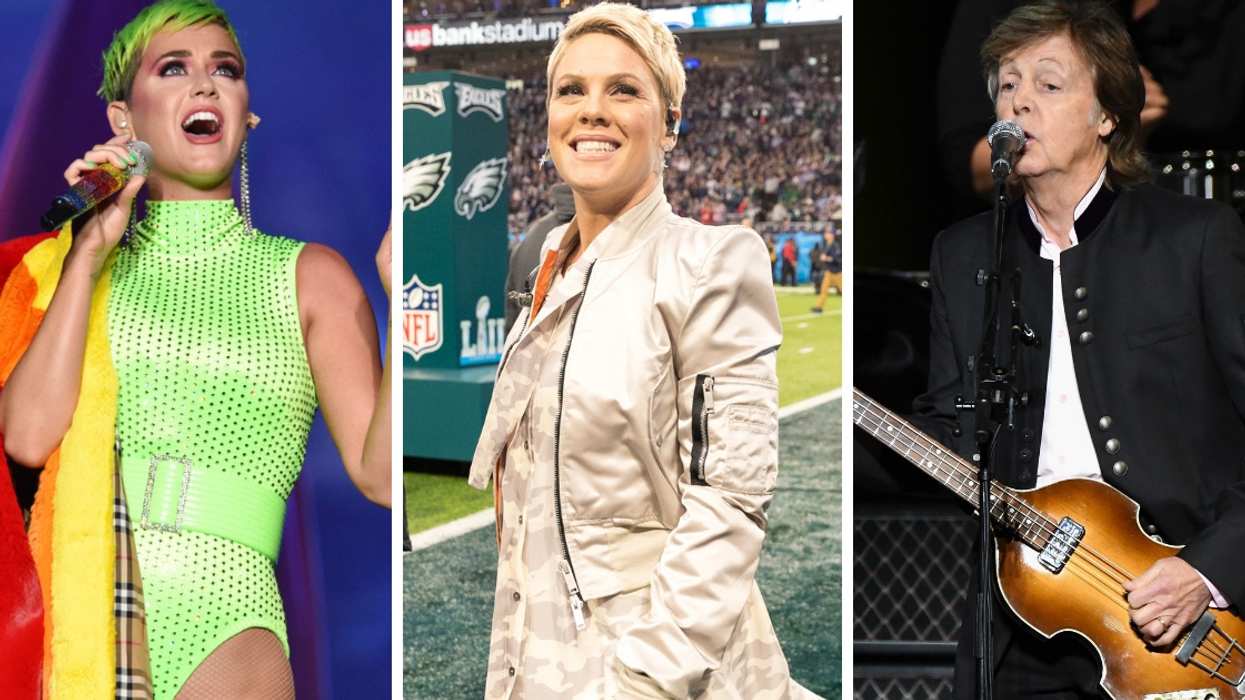
Katy Perry, P!nk, Paul McCartney And More Sign Letter Threatening To Boycott SiriusXM Radio
Hundreds of artists have signed a letter threatening a boycott if SiriusXM's parent company, Liberty Media, doesn't back down from opposing the Music Modernization Act.
The act, which was expected to pass through Congress, streamlines royalty payments in the new age of digital technology, but it seems SiriusXM is objecting to a small section that would have the satellite radio company paying royalties on recordings dating before 1972.
That's a whole lot of songs and a whole lot of money the company is hoping to skip out on paying, but not if stars like Paul McCartney, P!nk, Stevie Nicks, Sia, Carly Simon, Gloria Estefan, Mick Fleetwood, Don Henley, Max Martin, and Katy Perry can help it.
The letter read, in part:
I'm writing you with grave concern about SiriusXM's opposition to the Music Modernization Act (Classics Act included).
We are all aware of your company's objections and trepidation but let me say that this is an opportunity for SiriusXM to take a leadership position. As you are aware, 415 Representatives and 76 Senators have already cosponsored the MMA along with industry consensus. It's SiriusXM vs all of us. We can either fight to the bitter end or celebrate this victory together. Rather than watch bad press and ill will pile up against SiriusXM, why not come out supporting the most consequential music legislation in 109 years? We do not want to fight and boycott your company but we will as we have other opponents. Stand with us! Be brave and take credit for being the heroes who helped the MMA become historic law! Momentum is building against SiriusXM and you still have an opportunity to come out on the right side of history. We look forward to your endorsement but the fire is burning and only you can put this out.
SiriusXM resoponded with a letter of their own:
Over the past several weeks, we have been the subject of some stinging attacks from the music community and artists regarding our views on the Music Modernization Act. Contrary to new reports and letters, this is really not about a SiriusXM victory, but implementing some simple, reasonable and straightforward amendments to MMA. There is nothing in our "asks" that gut the MMA or kills the Act. So let's talk about the substance of the amendments we propose, because we truly do not understand the objections or why these concepts have incited such a holy war.ontrary to the accusations, SiriusXM has proposed three simple amendments to the MMA.
First, SiriusXM has asked that the CLASSICS Act recognize that it has already licensed all of the pre-1972 works it uses. This amendment would ensure that artists – the people who are supposed to be at the heart of the MMA – receive 50% of the monies under those existing licenses. Is that unfair? Just today, Neil Diamond wrote in the LA Times that: "I receive a small amount of songwriting royalties, but no royalties as the recording artist." How can that happen? To date, SiriusXM has paid nearly $250 million dollars in pre-'72 royalties to the record labels. We want to make sure that a fair share of the monies we have paid, and will pay, under these licenses gets to performers. Without this provision, artists may never see any of the money SiriusXM paid, and will pay, for the use of pre-1972 works. Artists not getting paid hurts our business!
Second, Sirius XM thinks that the fair standard to use in rate setting proceedings is the standard that Congress chose in 1995 and confirmed again in 1998 – which is called the 801(b) standard. However, we are willing to move the "willing buyer/willing seller" standard contained in the MMA. In exchange, we have asked for the same concession that the MMA grants to other digital music services, but we were left out of — simply that the rates that were set last year for five years now apply for ten years. We thought this was a fair compromise when we read the "new" MMA that was released this weekend by the Senate, and are willing to live by that compromise.
Third, SiriusXM is asking the simple question: "Why are we changing the rate court evidence standard for musical compositions in this legislation so that it gives another advantage to broadcasters over satellite radio and streaming services?" There is no policy rationale for this change to tilt the playing field further in their favor, and frankly no one has been able to explain it to us. It is only fair that we debate why the change to Section 114(i) is in the MMA.
Did you all catch that? It sounds like lawyer speak for "we don't really want to say where we stand."
It seems all the letters were for naught. The Music Modernization Act passed in the U.S. Senate.
It was time to celebrate and dance in the streets.
As the saying goes, honest pay for honest work.

Woman Was Fired For Refusing To Wear A Bra At Work—And Now She's Suing
Christina Schell, from Alberta, Canada, stopped wearing bras three years ago citing health reasons.
While Schell did not specify the health reasons, she did state she finds them to be "horrible."
But after her refusal to sign or adhere to a new enforced dress code policy to wear a bra or tank top under her work shirt at a golf course grill where she worked, Schell was promptly fired.
Now, the 25-year-old has filed a human rights violation against the Osoyoos Golf Club, Osoyoos, in British Columbia, Canada.
Schell said:
"I don't think any other human being should be able to dictate another person's undergarments."
When she asked the general manager, Doug Robb, why she had to comply, the manager told her the mandate was for her protection.
Robb allegedly said:
"I know what happens in golf clubs when alcohol's involved."
After losing her job, she brought the case to the British Columbia Human Rights Tribunal and told them the club's dress code was discriminatory because the rule didn't apply towards male employees.
Schell told CBC:
"It's gender-based and that's why it's a human rights issue. I have nipples and so do the men."
David Brown, an employment lawyer in Kelowna, BC, said gender-specific dress codes could be viewed as discriminatory under the BC Human Rights Code.
He stated:
"It's an interesting question as to whether or not an employer can dictate the underwear that women can wear, but they don't say anything about the underwear that men can wear, and does that create an adverse impact on the individual?"
Brown added:
"If this policy is found to be discrimination, the next question is does the employer have a bonafide occupational requirement to essentially impose this on the individual?"
"I'm kind of scratching my head as to what that occupational requirement would be."
As for the tank top option, due to working under oftentimes extreme heat serving tables outsides, Schell did not want to wear another layer of clothes just because of her gender.
Schell said:
"It was absurd. Why do you get to dictate what's underneath my clothes?"
Employment lawyer Nadia Zaman told CBC that the club can enforce a gender-specific policy as they deem necessary as long as the establishment can prove it is for the occupational safety of its workers.
But the attorney questioned if forcing female employees to wear a bra was applicable in this case.
Zaman stated:
"If they simply require that female employees wear a bra but then they don't have a similar requirement for males, and they can't really justify that … then there is a risk that their policy's going to be deemed to be discriminatory."
Under British Columbia's discrimination law, it is illegal for employers:
'to discriminate against any individual because of his race, color, religion, sex, or national origin'.
McDonald's employee Kate Gosek, 19, agrees with Schell in that the dress code is "unnecessary." She too was harassed by her employers at a McDonald's in Selkirk, Manitoba, over refusing to wear a bra.
"She just told me that I should put on a bra because, McDonald's—we are a polite restaurant and no one needs to see that."
Schell's case sparked plenty of debates on Twitter.
Schell is not alone in her disdain for bras.
Schell is still waiting to hear from the Human Rights Commission about her claim.
H/T - GettyImages, Twitter, Indy100, CBC