


September, 2004, LOS ANGELES - In this age of jet travel, time is shortened, work is intensified, and we cover many bases. We dash from one place to another on varying missions in a very full month. And as usual, September had me on quick trips to New York for a meeting and to Emeryville, California, for a voice-over job. But travel can also transport in time as well as to a place. Last month, I went back to my boyhood.
I traveled to a place called Rohwer in southeast Arkansas where I spent a part of my childhood years. It is a place of memories for me - memories that glow with a golden haze. I remember the lush bayous filled with strange sounds and creepy, crawly creatures. I remember catching pollywogs in a ditch and watching them miraculously sprout legs and eventually turn into frogs. I remember waking up one magical winter morning and discovering everything covered in white - cold, soft snow. I also remember the barbed wire fence that kept me confined in that camp. I traveled back to a time of innocence, a time when I was quite unaware of the devastation that had befallen my parents and 120,000 other Japanese Americans. It was World War II and our crime was that we just happened to "look like the enemy."
 A child is incredibly adaptable to the most abnormal of conditions. To me, the tall guard towers and the barbed wire fence that incarcerated my family and me became part of my normal landscape. What would be abnormal in normal times became my normality. It became normal for me to line up three times a day to eat in a noisy mess hall. It became normal for me to go with Daddy to a communal shower and bathe with many men. It became normal for me to go to school in a black, tarpaper-covered barrack. I learned to recite the Pledge of Allegiance to the flag within sight of armed sentries watching over us. I was too young to appreciate the irony as I recited the words, "with liberty and justice for all."
The return to Arkansas was undeniably filled with many emotions - but this time with deeper understanding and an overpowering sense of uplift. The pilgrimage to Rohwer was on the final day of a richly enlightening week in Little Rock, Arkansas. A week-long series of programs called "Life Interrupted: The Japanese American Experience in World War II Arkansas" was being capped with a long bus caravan that rolled past mile after mile of ripening cotton fields to Camp Rohwer as well as to a second internment camp in Arkansas called Camp Jerome.
 The week was awe-inspiring. Over 1,300 people, many of them former internees with their children and grandchildren, had gathered in Little Rock from all over the nation. There were lawyers, educators, historians, politicians, and others from all walks of life. The Japanese American National Museum, working in partnership with the University of Arkansas at Little Rock opened eight exhibits in four different venues located throughout the city. The principal exhibits; "America's Concentration Camp" and "Against Their Will: The Japanese American Experience in WWII Arkansas" are in the Statehouse Convention Center. The stirring story of young Japanese Americans who went from unjust incarceration behind barbed wire fences to fight heroically for the United States are told by three deeply moving exhibits in the Douglas MacArthur Museum of Military History. A handsome and affecting art exhibit of the paintings of Henry Sugimoto, who was incarcerated in both of the two Arkansas camps, can be viewed at the Cox Arts Center and two exhibits on the arts and crafts in the internment camps are at the Fine Arts Building of the University of Arkansas at Little Rock.
Saturday was a one-day symposium composed of twenty-seven sessions with discussions that ranged from democracy to civil rights to military service to historic preservation. For me, the most daunting part of the day's program was the luncheon. President Bill Clinton, the former governor of Arkansas, was on the printed program as our luncheon keynote speaker. As we all knew by that time, his emergency heart surgery in New York had sidelined him from all public activities. I was asked to substitute for him - substitute for the silver tongued former President of the United States! The challenge was as awesome as the honor. I had to rise to the honor.
 I began by sharing the heartwarming joy I felt on meeting people I had not seen in decades and of people who remembered me as a little boy but that I - try as I might - could not. I talked of my fond memories of a boyhood in Rohwer. I talked of the stinging irony I felt on seeing the crumbling old monument in the cemetery at Rohwer - a memorial to Japanese American soldiers who went from internment camps to perish in a war fighting for democracy and are now buried at the site of their incarceration. I talked of an invitation I received in the year 2000 from President Clinton to the White House to witness the granting of nineteen medals of honor, the highest military recognition of the nation, to nineteen Japanese American veterans of World War II. Fifty-five years before, at the end of the war, these men had been recognized with the Distinguished Service Cross, the second-highest military honor, for their heroic deeds. However, after a review mandated by order of Congress in 1996, it was found that their acts of valor eminently merited the highest honor. Only wartime prejudice had reduced their tribute. Among these extraordinary members of the Greatest Generation receiving the Medal of Honor was the senior U.S. Senator from Hawaii, Senator Daniel Inouye, who lost his right arm on a bloody battlefield in Italy. These men and all the Japanese American veterans of World War II had transformed this nation. They made my America today a reality.
 I talked of the challenges of our democratic ideals. It takes courageous, principled people to struggle to fulfill those ideals. Throughout the history of our nation, injustices were battled by the disenfranchised. African Americans struggled against slavery, then Jim Crow laws, and other discrimination to transform this nation. Women, who were denied any role in leadership, struggled to gain equality and justice and helped to transform this nation. In the history of the American southwest, Latinos had endured a host of injustices but still they struggled to fulfill the ideals of our nation. I talked that day in Little Rock about our democracy as a dynamic work-in-progress. All of us, the great diversity of this land, working in concert as Americans carry out the promise of our American ideals. When I finished, the audience rose up in a standing ovation. That week in Little Rock, Arkansas will forever be an unforgettable benchmark in my life.
The "Life Interrupted" programs that examine a dark chapter of American history were themselves history making. We have profoundly important lessons for our times today to be learned from the exhibits, the symposium, and the pilgrimage. My heartfelt gratitude goes to the Winthrop Rockefeller Foundation whose generous support made it possible for us to bring history so relevantly alive.
 A great bonus of the trip to Little Rock was a preview peek at the dazzling new William Jefferson Clinton Library and Presidential Center set to open on November 18th. The hard-hat tour of the Clinton library, museum, and school of public service was wonderfully tantalizing. The modern steel and glass building is a sleek symbol of the "bridge to the 21st century" that President Clinton so often spoke about. The sensitively restored old Choctaw Railway Station in a landscaped park, which will house the Clinton School of Public Service, is the very symbol of history brought back into the current of contemporary life. I toured the work-in-progress with a few students working hard on the Grand Opening and Dedication of this newest of Presidential Centers, Mike Eady and Sara Beth Crow. I promised Mike and Sara Beth that I would return to Little Rock for that history-making day in November. I told them I have my own roots in Arkansas.
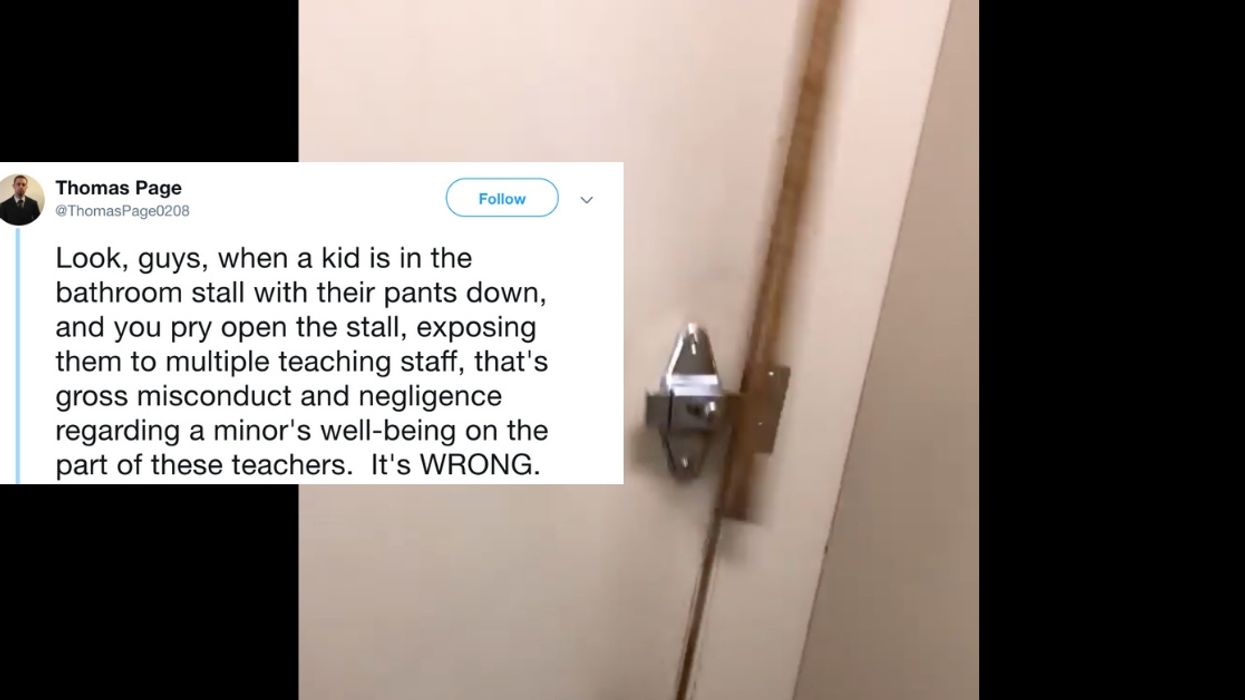
On Wednesday, Cece posted two videos, one of which is very disturbing, to her Facebook regarding an incident she experienced.
While Cece was using the bathroom at school, staff forced their way into the stall she was in.
Again, Cece is 16 years old.
Her post reads:
"SCHOOL OSSEO SEINOR HIGH 🚨
I Guess I Can't Use The Girls Bathroom Just Because I'm Transgender 😔 Share This & MAKE IT GO VIRAL ‼️ I Been Violating By Principal and Admin and Hallmonters
This Was Today 11/28/18 🕚 Ms Smith Had Nothing To Do With This"
One video showed all of the school officials she wanted to publicly name who participated in the incident.
The other showed the actual incident.
Cece's self-recorded video shows her sitting on the toilet with her pants down while a school official uses a makeshift device to reach over the stall to unlock the door.
A spokesperson for Osseo Schools stated:
"Social media posts are significantly misrepresenting the incident and that staff works very hard every day to help ensure an inclusive school where all students feel welcome, respected and safe."
They refused to comment further saying:
"We wish we could provide additional details about this incident but are committed to protecting the student's right to data privacy."
Some reports claim that Cece had previously been told not to use the women's restroom.
However, in 2017 the Minnesota Department of Education (MDOE) ruled in favor of students like Cece.
MDOE guidance states:
"Transgender and gender nonconforming students should be afforded the opportunity to use the restroom of their choice."
People also can not help but note the fact that at age 16, Cece is a minor.
Adults forcing themselves into her stall while she used the bathroom is even more appalling.
 Moriah Skai Kiskaden (Facebook)
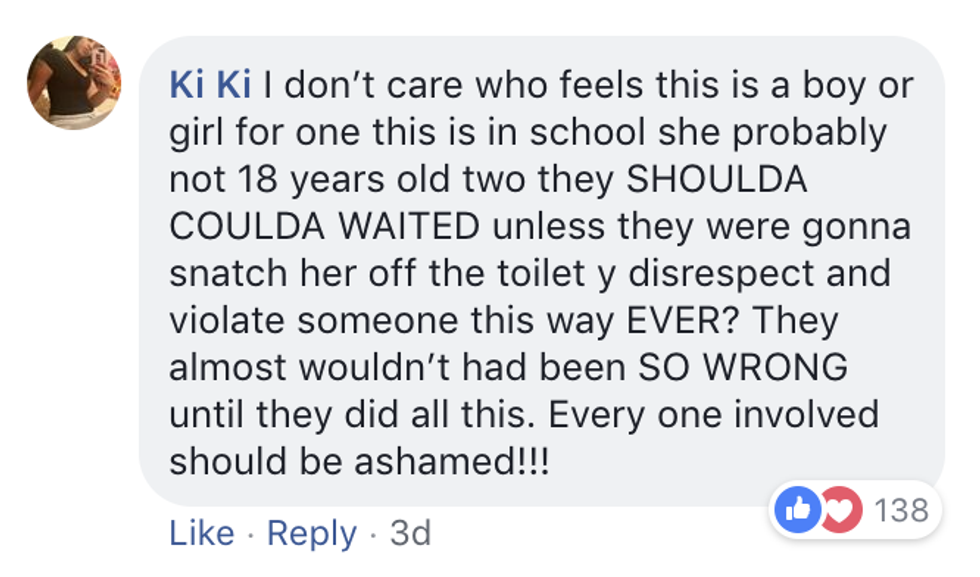 Ki Ki (Facebook)
Regardless of the unknown circumstances, the internet is outraged over the adult school staff's actions.
Cece's video and story has indeed gone viral. But what happens now remains to be seen.
H/T: Pink News, Facebook, Daily Dot, Bring Me The News
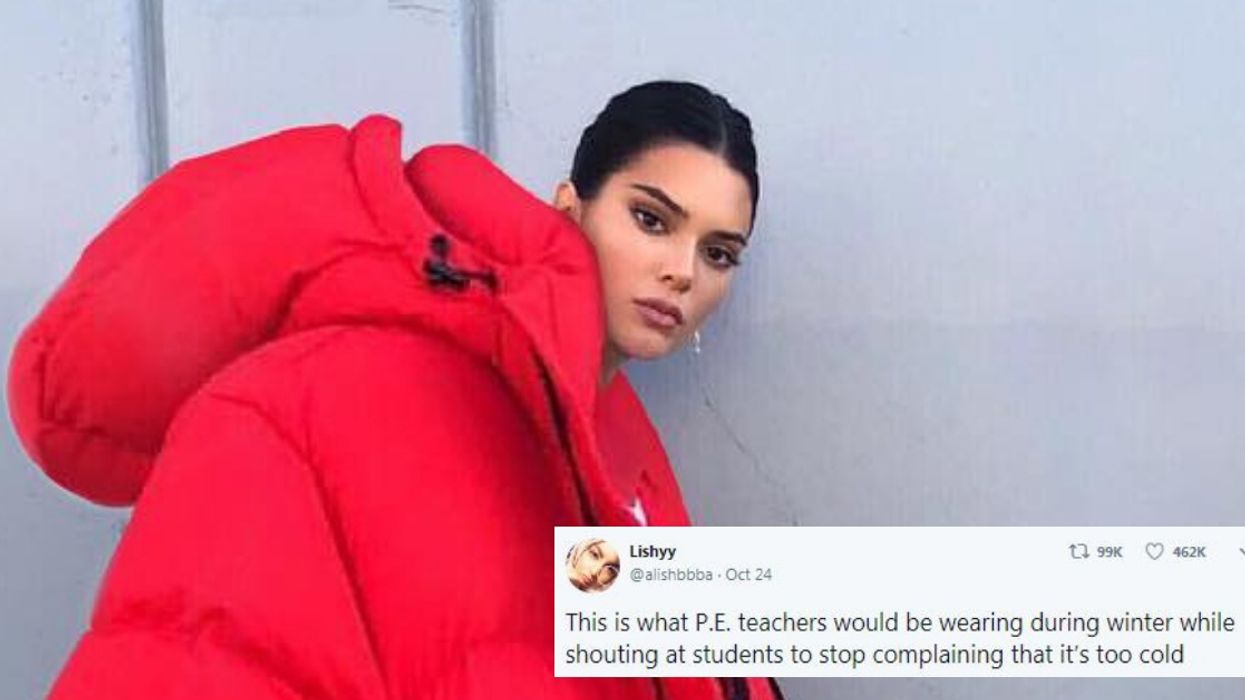
We all love a good meme, and the best memes often imitate life. Model Kendall Jenner is the latest target of the Instagram account @itsmaysmemes, which photoshops celebrities in hilariously oversized outerwear.
At least it looks cozy...
Soon, Vogue France tweeted the image and all hell broke loose.
The caption reads:
"Winter is coming !"
Indeed.

People made their own versions.
Some compared it to other strange fashion choices we've seen over the years.
And there were those who had some pretty interesting ideas about what this looked like.
Perhaps we loved it because it did seem just avant garde enough for Jenner to actually wear. Turns out we all can! Well, sort of. The jacket is a digitally enlarged version of The Super Puff jacket at Aritzia. Even the non-Photoshopped version looks pretty cozy!
H/T: Huffington Post, Twitter
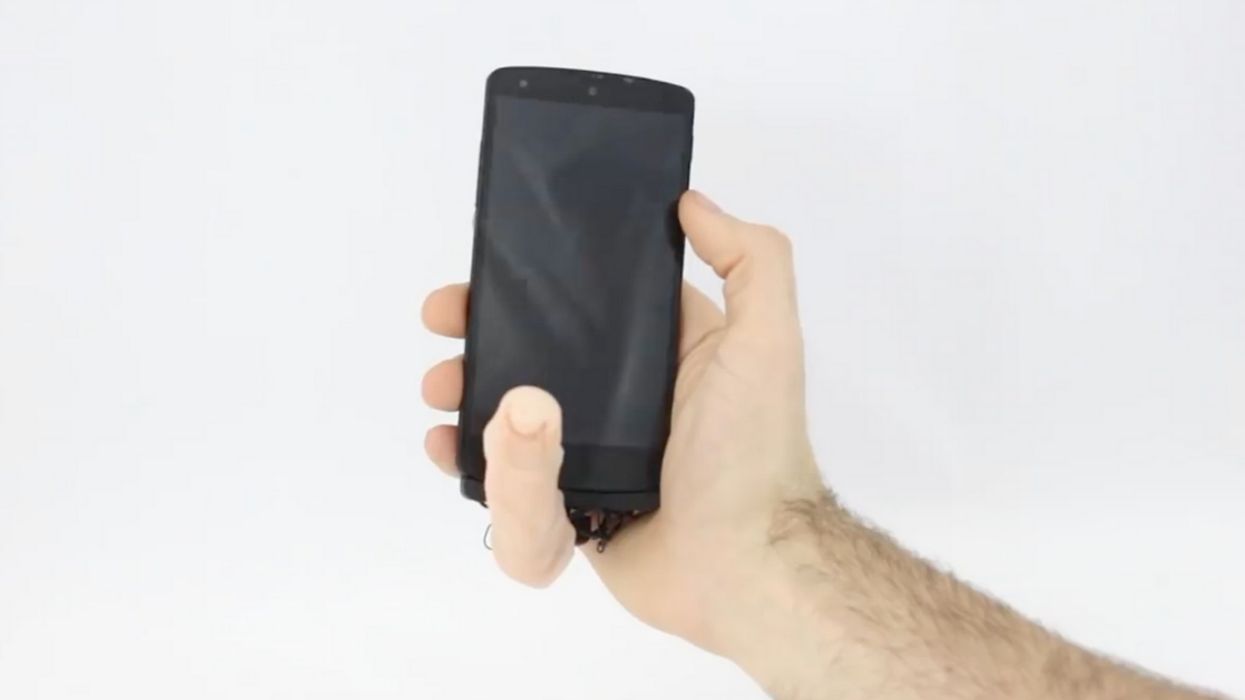
The MobiLimb was created by researchers in France and is made up of "five servo motors, an Arduino microcontroller and a sensor, and it can do a number of unsettling things that are straight out of nightmares," according to Engadget.
Marc Teyssier, a PhD student and one of the researchers behind the project for the dismembered limb, legitimized its existence.
"In the spirit of human augmentation, which aims at overcoming human body limitations by using robotic devices, our approach aims at overcoming mobile device limitations (static, passive, motionless) by using a robotic limb."
Th MobiLimb can prop itself up so you can watch a video, or provide an alternate way to grip your device.
But there's one function that is really disturbing.
The articulated digit can be skinned to resemble a human finger, and it can stroke your wrist while you're using your phone.

Someone implied that single people could benefit from this invention as a companion.
What would the next-generation MobiLimb offer consumers?
The attachment could come in handy should an unfortunate life-changing incident were to occur.
But the gadget is still giving people goosebumps.
Others saw a more erotic potential.
Now here's a function not advertised by MobiLimb's creators.
Feelings are mixed. But the jury is in.
As to why such a creepy gadget was invented, we can't quite put our finger on it. But then, when it comes to consumers' needs, these guys may be out of touch.
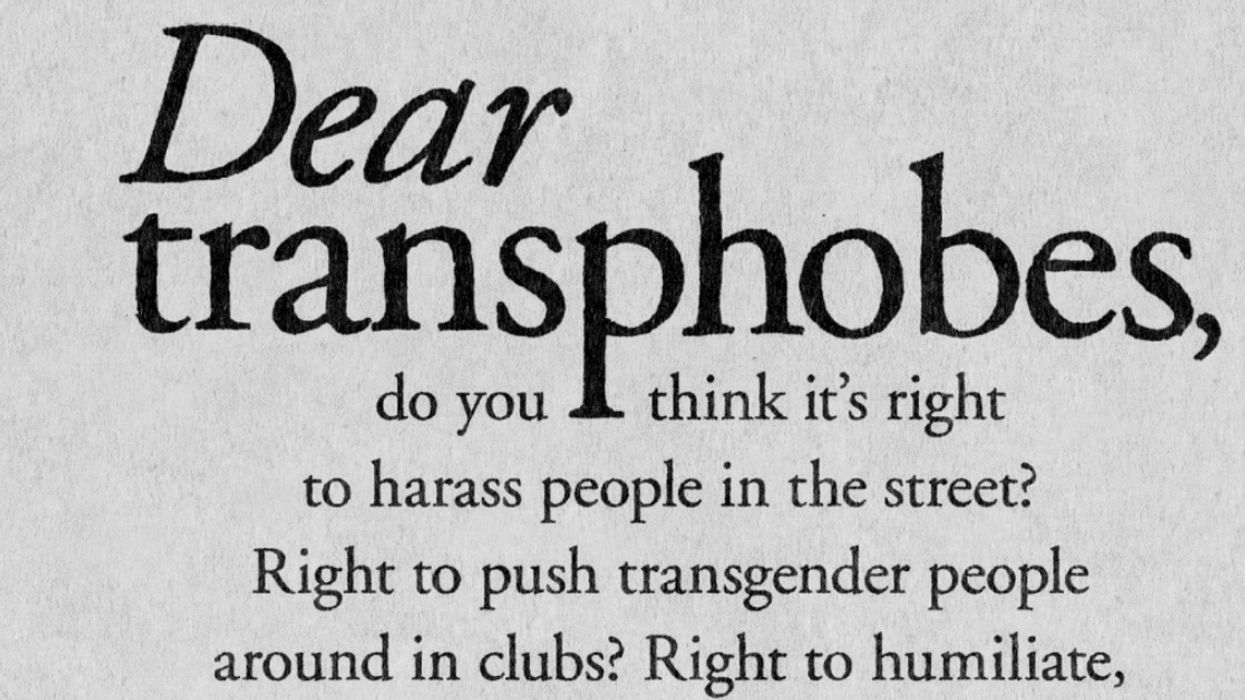
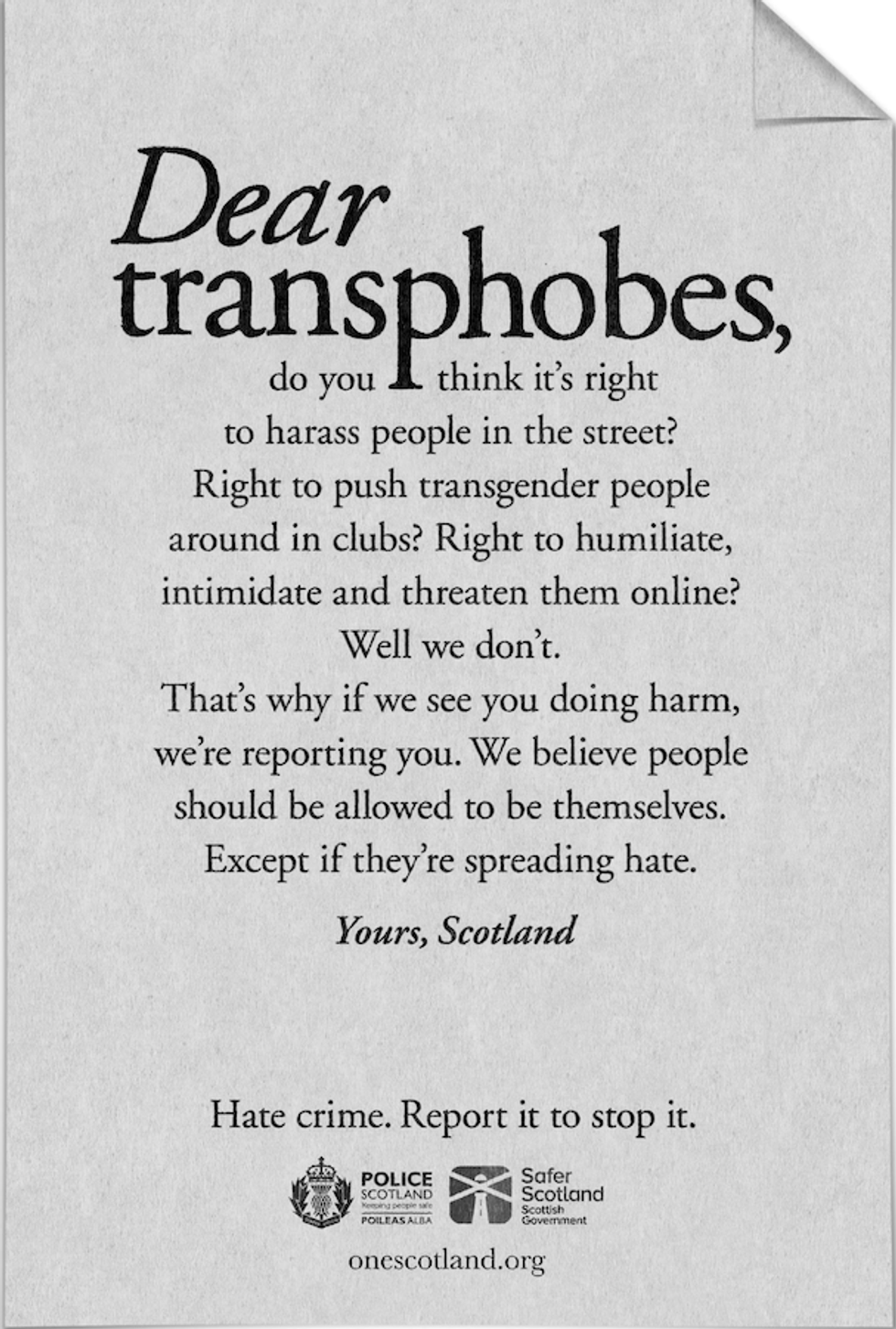
The campaign is part of the Scottish government's One Scotland project in an effort to reduce hate crime.
One letter reads:
"Dear transphobes, do you think it's right to harass people in the street? Right to push transgender people around in clubs? Right to humiliate, intimidate and threaten them online? Well we don't."
"That's why if we see you doing harm, we're reporting you. We believe people should be allowed to be themselves. Except if they're spreading hate."
"Yours, Scotland."
 (
(In another letter, the country says it has a "phobia" of homophobic behavior.
"If you torment people because of who they love, shout word that we are not going to write, or use violence because you don't like who someone is holding hands with, you should be worried."
"If we see or hear your abuse, we're calling the police. That's because love lives in this country, not hate."
"Yours, Scotland."
 (
(One Scotland's website describes the organization as one that aims to continue building an inclusive society while recognizing the significant strides made so far towards equality.
"One Scotland embodies the inclusive society we want in Scotland, where equality and human rights are respected and every individual and minority group feels valued."
The website defines hate crimes as abuse that "can be verbal or physical and has hugely damaging effects on the victims, their families and communities, and we all must play our part to challenge it."
"Police Scotland takes hate crime very seriously. In the last year there were over 5,300 charges of hate crime reported to the Procurator Fiscal in Scotland1."
"However, there are many more incidents that go unreported. We all have a responsibility to report hate crime if we witness it – it's the only way we can challenge it, and put an end to it for good."
Justice minister Humza Yousaf is familiar with being a victim of a bigotry and is encouraging people to call out and report any incidents involving harassment.
"As somebody who has faced Islamaphobic and racial abuse over the years, I know how upsetting being a victim of hate can be. Hate crime and prejudice are completely unacceptable and we are absolutely committed to tackling it."
"We all have a role to play in stamping out prejudice and I would ask anyone who witnesses a hate crime to play their part and report it. Justice agencies such the police and Crown Office will deal sensitively with reports made and people should have confidence in how they will be treated. Last year there were over 5,300 charges of hate crime reported to the Procurator Fiscal in Scotland but there are still many incidents that are going unreported."
Henrietta Mochrie identifies as transgender and has been the victim of repeated harassment and abuse. She emphasized the importance of speaking out against the hatred.
"I'll often get street harassment, sometimes this has escalated to the point where I've been followed by people shouting abuse at me, just because of who I am."
"It makes me feel really down and scared to leave the house. It's important that if you witness hate crime that you report it to take a stand against hate."
One Scotland's ad campaign officially launched on Wednesday.
Hopefully, it won't take too long before other nations follow suit in this bold, yet necessary fight for equality.
H/T - OneScotland, PinkNews, Twitter