





February, 2001, LOS ANGELES - I continue to be captivated by the popularity and the longevity of the Star Trek phenomenon. It remains a pervasive factor in my life, whether professionally, personally or in my public service activities. And this gift has serendipitously expanded my horizon and enriched my life.
A direct professional tie-in can be viewed on February 18th when an episode of "V.I.P." starring Pamela Anderson is aired on the Fox network. I play the voice of an omniscient super computer that was programmed by a brilliant techno-genius who is a fervent Captain Sulu fan. Hence, my casting as the voice of the computer.
The Star Trek conventions, of course, keep on trekking. My first convention of this year was in the charming city of Portland, Oregon. It was a lively gathering on a cold, damp weekend. Long-time fans mingled with a growing number of young, first-time conventioneers. And, as well, the con gave me the chance to indulge my preservationist interest and again explore the imaginatively restored turn-of-the-century historic district of Portland.
I did voice work last week on a feature film project, cryptically titled, "Noon Blue Apple." I play a mysterious voice that haunts the mind of the lead character. No direct Star Trek connection here other than the fact that the director knew of my work from the original series.
But Star Trek has also afforded me the opportunity to contribute more effectively in a myriad of other areas not related to my professional career. This month, I was honored to serve as the star of a fund-raising dinner to help build a planetarium on the campus of Long Beach City College. With this facility, young students will be able to expand their study of the heavens and let their imaginations soar to the stars. Clearly, without the Star Trek association, I would not have been able to support this important cause as effectively as I was able.
On another occasion this month, I addressed a group of young interns at the Japanese American National Museum on volunteerism. Here again, I was able to connect with them more successfully as Captain Sulu of Star Trek than as the Chairman of the Board of the Museum.
We have a mayoral election coming up this spring in the city of Los Angeles, my hometown. I am supporting the former Speaker of the California Assembly, Antonio Villaraigosa. I know that I was asked to speak at his press conference largely because of the draw of my Star Trek linkage. As well, when I spoke at the Japanese seniors' intermediate care facility, Keiro Services, Star Trek combined with my association with the Japanese American National Museum, were the factors that attracted the large audience of seniors. I chatted with one lady who was 104 years old. She was born in 1896 - having lived in three centuries! In so many unexpected ways, my association with Star Trek creator Gene Roddenberry's visionary creation has opened doors that have expanded my life horizon.
But when any hint of self-importance might begin to creep into me and I start believing that my Star Trek association is free entrée to anything, a humbling reminder always seems to bring me back to reality.
This month, my niece, Akemi Takei, sportscaster for KING-TV in Seattle, got married to David Louchheim, a radio sportscaster, on a beautiful beach in Maui, Hawaii. It was a singularly romantic affair, the bride and groom barefoot, with waves crashing in on lava rock outcroppings behind them. The reception was held at a hilltop restaurant overlooking the Wailea Country Club and the turquoise blue Pacific beyond. As we sipped cocktails, nibbled hors d'oeuvres and waited for the sun to set, I slowly became aware of a generational divide. The parents of my niece and David's friends were thrilled to meet me. They were eager to have their pictures taken with me. They told me they were long-time Star Trek fans from back in their college days. The young people, however -- Akemi and David's friends -- were gracious and friendly but rather blasé. In fact, some weren't really that familiar with Star Trek. They, I realized, were the post-Star Trek generation. The passage of time brings with it the larger context of life.
 I was forcefully reminded again of the larger context of life on a hike into the crater of the now-dormant volcano, Haleakala on Maui. The crater is vast. And it is heart-stoppingly beautiful. There is a narrow, lava gravel trail that leads down to the bottom. It was irresistible. I had to go down into it. As I tramped down the sere landscape, rich with the burnt colors of inert lava, I imagined what this scene must have been like millennia ago. It was, we were told by a ranger, an inferno of blasting, bubbling, molten red lava. For centuries it spewed up flaming magma from the belly of the earth forming the island of Maui. This place was a hellhole of exploding liquid fire. But now, it was dead calm. Only this scorched and arid crater of unearthly colors remains.
As I huffed and puffed my way back up to the volcano's rim - 10,000-feet above sea level -- I thought of the ardent excitement of the middle-aged Star Trek fans of the evening before, and, in contrast, the nonchalant affability of their children. Intense fire and cool, youthful calm. There didn't seem to be that much difference between the human generations and geologic time.

Twitter user @Rich_Cooper stated:
"Dear feminists. You either get equality or chivalry. You can't have both."
One user responded:
"I'll take equality. I don't need special treatment."
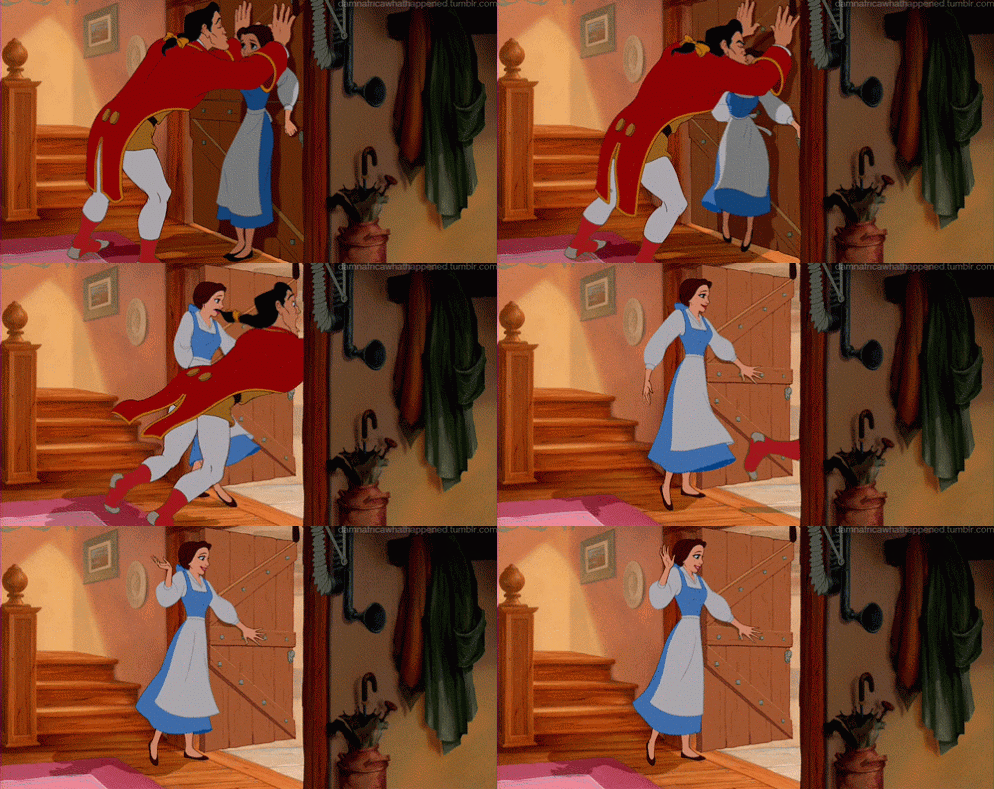
Cooper's rhetorical question did not go over so well. Both women and men expressed their disdain for his message.
One male user observed that chivalry was irrelevant and treating everyone with kindness and respect was compulsory.
"What people care about is caring, empathic [sic], considerate, thoughtful people, NOT whether THEIR door is held for them or THEIR meal is paid for them."
"Are there gender stereotypes in het[erosexual] dating? Sure. But that's separate from being a warm, giving, caring, grounded person."
Some women got right down to the point.
The notion of chivalry and equality are mutually exclusive and not a lot of people thought it was a major priority for feminists.
Common courtesy is not chivalry.
This user pointed out the fact that chivalry stems from a history of men outdoing other men. The concept had very little to do with women.
"Chivalry is a medieval concept of men dressing to impress other men. It has little to do with equality."
"Some men were on top, other men were beneath them. Historically, women were rarely invited into the process."
Neil Bradley described the outdated concept of chivalry as one that implies men being superior to women in a September 8, 2017, article for Medium publications.
"Examples: opening the door for a woman, paying for a woman's meal, gesturing for a woman to go first. The justification is either that women are not physically as strong (to open the door), able to provide (pay for their own meal), or are more deserving of compassion than men (allowing women to go first)."
Bradley also added that he wants to treat others the way he wants to be treated and asked if that approach should be motivated by chivalry or equality.
"If the genders are to be considered equal and treated equally, how a man treats a woman will essentially be the same as how a man treats a man."
"The obligation to open the door, pay for the meal, and let women go first vanishes. Men do not do this to other men, therefore why do it for women?"
His final take was that the two concepts can't co-exist. Either one is chivalrous or treats everyone as equals.
At the end of the day, people were happy to show chivalry the door.
H/T - GettyImages, Twitter, Indy100, Medium

Hundreds of artists have signed a letter threatening a boycott if SiriusXM's parent company, Liberty Media, doesn't back down from opposing the Music Modernization Act.
The act, which was expected to pass through Congress, streamlines royalty payments in the new age of digital technology, but it seems SiriusXM is objecting to a small section that would have the satellite radio company paying royalties on recordings dating before 1972.
That's a whole lot of songs and a whole lot of money the company is hoping to skip out on paying, but not if stars like Paul McCartney, P!nk, Stevie Nicks, Sia, Carly Simon, Gloria Estefan, Mick Fleetwood, Don Henley, Max Martin, and Katy Perry can help it.
The letter read, in part:
I'm writing you with grave concern about SiriusXM's opposition to the Music Modernization Act (Classics Act included).
We are all aware of your company's objections and trepidation but let me say that this is an opportunity for SiriusXM to take a leadership position. As you are aware, 415 Representatives and 76 Senators have already cosponsored the MMA along with industry consensus. It's SiriusXM vs all of us. We can either fight to the bitter end or celebrate this victory together. Rather than watch bad press and ill will pile up against SiriusXM, why not come out supporting the most consequential music legislation in 109 years? We do not want to fight and boycott your company but we will as we have other opponents. Stand with us! Be brave and take credit for being the heroes who helped the MMA become historic law! Momentum is building against SiriusXM and you still have an opportunity to come out on the right side of history. We look forward to your endorsement but the fire is burning and only you can put this out.
SiriusXM resoponded with a letter of their own:
Over the past several weeks, we have been the subject of some stinging attacks from the music community and artists regarding our views on the Music Modernization Act. Contrary to new reports and letters, this is really not about a SiriusXM victory, but implementing some simple, reasonable and straightforward amendments to MMA. There is nothing in our "asks" that gut the MMA or kills the Act. So let's talk about the substance of the amendments we propose, because we truly do not understand the objections or why these concepts have incited such a holy war.ontrary to the accusations, SiriusXM has proposed three simple amendments to the MMA.
First, SiriusXM has asked that the CLASSICS Act recognize that it has already licensed all of the pre-1972 works it uses. This amendment would ensure that artists – the people who are supposed to be at the heart of the MMA – receive 50% of the monies under those existing licenses. Is that unfair? Just today, Neil Diamond wrote in the LA Times that: "I receive a small amount of songwriting royalties, but no royalties as the recording artist." How can that happen? To date, SiriusXM has paid nearly $250 million dollars in pre-'72 royalties to the record labels. We want to make sure that a fair share of the monies we have paid, and will pay, under these licenses gets to performers. Without this provision, artists may never see any of the money SiriusXM paid, and will pay, for the use of pre-1972 works. Artists not getting paid hurts our business!
Second, Sirius XM thinks that the fair standard to use in rate setting proceedings is the standard that Congress chose in 1995 and confirmed again in 1998 – which is called the 801(b) standard. However, we are willing to move the "willing buyer/willing seller" standard contained in the MMA. In exchange, we have asked for the same concession that the MMA grants to other digital music services, but we were left out of — simply that the rates that were set last year for five years now apply for ten years. We thought this was a fair compromise when we read the "new" MMA that was released this weekend by the Senate, and are willing to live by that compromise.
Third, SiriusXM is asking the simple question: "Why are we changing the rate court evidence standard for musical compositions in this legislation so that it gives another advantage to broadcasters over satellite radio and streaming services?" There is no policy rationale for this change to tilt the playing field further in their favor, and frankly no one has been able to explain it to us. It is only fair that we debate why the change to Section 114(i) is in the MMA.
Did you all catch that? It sounds like lawyer speak for "we don't really want to say where we stand."

It seems all the letters were for naught. The Music Modernization Act passed in the U.S. Senate.
It was time to celebrate and dance in the streets.
As the saying goes, honest pay for honest work.