




August, 2001, LOS ANGELES - I grew up listening to radio dramas. As a child, I memorized and recited the cheery jingles from children's shows like "Happy Theater." As I grew older, I thrilled to the adventure on shows like "Bobby Benson and the B-Bar-B Riders" and "Sergeant Preston and His Yukon King." The big city kid in Los Angeles listening only to the sound of actors' voices coming out of a box was transported to the dusty excitement of the old West by "The Lone Ranger" and "The Cisco Kid." I listened to film dramatizations on "Lux Radio Theater" to relive movies that I had enjoyed before or to "see" those that I had missed. Radio was my magic transporter. And my conjurors were the actors that brought the stories to life - with only their voices, accompanied by sound effects, they magically took me to another place, another time and new sensations. I loved radio.
Radio was wonderful story telling. It was the ancient tradition of sharing a tale around the campfire - except that my campfire was a radio in our living room. It was the technological campfire of the times. The whole family gathered around the radio to be chilled by thrillers like "The Shadow."
Vocal storytelling still exists today. But it's not all on radio anymore. It's called "books on tape." There are superb readings of novels on audio tape. For those who commute long distances in their cars, it's a great way to "read" a novel as they drive. People taking public transportation can listen to them on their way to work. Hospitalized people can listen as they recuperate. I love audio tapes as I used to love radio dramas. They keep alive the wonder of spoken storytelling. And now that I am a professional actor, I am among those storytellers. I've enjoyed reading many novels onto audio tape. Of course, there are the Star Trek novelizations, but I've also read onto tape such classics as the "Sherlock Holmes" novels. I particularly enjoyed reading my own autobiography, "To The Stars," on tape. I'm happy that there is a medium where the simple sound of an actor's voice can stimulate the imagination and vicariously take the listener on fictional as well as autobiographical journeys.
After the cancellation of the "Star Trek" television series, we worked on the voices of our characters on the animated version of "Star Trek." It became another unexpected extension of the "Star Trek" phenomenon. I must confess, however, that working on the cartoon version was not as satisfying as acting in the television version because the scenes weren't read with the other actors. I did the voice of Sulu solo without my colleagues to bounce off of. It wasn't as much fun. But it was still using our vocal tool to give life to our characters. Actually, voice acting could be more challenging because that tool alone -- with only the rather stiff animation as the visuals -- had to tell the story. I'd like to think that the voice of the actor is still essential to the recounting of a good story.
 Indeed, accelerating advances in technology have shot up the use of the vocal tool for Star Trek storytelling to amazing heights. For the last few years, I've been working with Interplay Entertainment Corp. on a series of Star Trek CD Rom games called Starfleet Command and another called Klingon Academy. This is no longer sitting around the old campfire merely listening to a story as it is told. CD Rom games suck the listener directly into the narrative as active participants in Star Trek adventures. And there I am as Captain Sulu, blazing across astoundingly real galaxies blasting away at Klingons - and the "listeners" are right there engaged with me as wily adversaries or full, decision making partners. My next one for Interplay, "Star Trek: Shattered Universe," will have Captain Sulu on the USS Excelsior caught in the mirror universe from the television episode, "Mirror, Mirror." My vocal chords are already aching to become the viciously scarred Sulu and then the heroic Sulu that we all know and love. The vocal challenges will be bracing.
This medium of work also provides the relief of greater scheduling flexibility than does acting on film or television. Voice work has granted me the blessing of maintaining my career, and, at the same time, managing the unpredictable needs of my mother's continuing illness. If problems should crop up at home, recording calls could be rescheduled without causing too much inconvenience to too many others. With film or television work, rearranging shooting schedules would be well nigh impossible. So, over the past month, I've been able to do voice work on Disney's new CD Rom game, "Freelancers," and animated shows such as "Team Atlantis" and "Samurai Jack." Yet to air are such animated shows as "Jackie Chan" and another episode of "The Simpsons."
From the kid listening to that radio so long ago in Los Angeles and transported to adventures in the old West to the professional actor who now transports fans soaring into galactic explorations, the sound of the human voice has always been my charmed vehicle of transport.
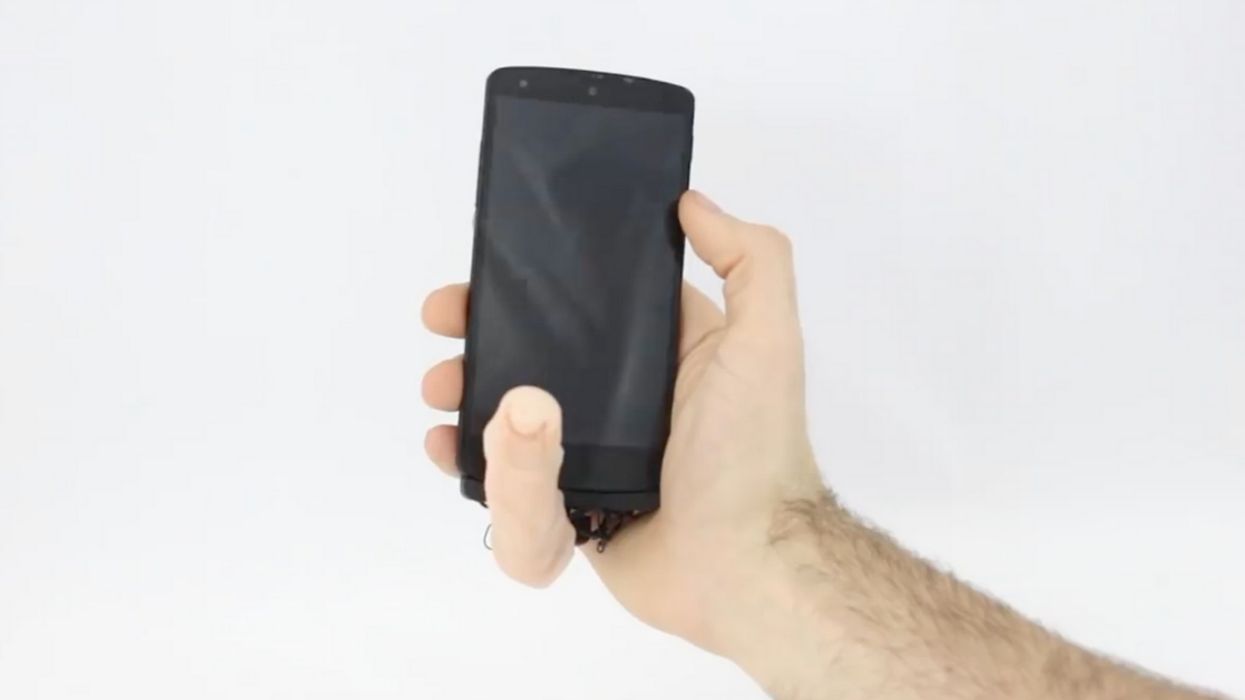
The MobiLimb was created by researchers in France and is made up of "five servo motors, an Arduino microcontroller and a sensor, and it can do a number of unsettling things that are straight out of nightmares," according to Engadget.
Marc Teyssier, a PhD student and one of the researchers behind the project for the dismembered limb, legitimized its existence.
"In the spirit of human augmentation, which aims at overcoming human body limitations by using robotic devices, our approach aims at overcoming mobile device limitations (static, passive, motionless) by using a robotic limb."
Th MobiLimb can prop itself up so you can watch a video, or provide an alternate way to grip your device.
But there's one function that is really disturbing.
The articulated digit can be skinned to resemble a human finger, and it can stroke your wrist while you're using your phone.

Someone implied that single people could benefit from this invention as a companion.
What would the next-generation MobiLimb offer consumers?
The attachment could come in handy should an unfortunate life-changing incident were to occur.
But the gadget is still giving people goosebumps.
Others saw a more erotic potential.
Now here's a function not advertised by MobiLimb's creators.
Feelings are mixed. But the jury is in.
As to why such a creepy gadget was invented, we can't quite put our finger on it. But then, when it comes to consumers' needs, these guys may be out of touch.

Hundreds of artists have signed a letter threatening a boycott if SiriusXM's parent company, Liberty Media, doesn't back down from opposing the Music Modernization Act.
The act, which was expected to pass through Congress, streamlines royalty payments in the new age of digital technology, but it seems SiriusXM is objecting to a small section that would have the satellite radio company paying royalties on recordings dating before 1972.
That's a whole lot of songs and a whole lot of money the company is hoping to skip out on paying, but not if stars like Paul McCartney, P!nk, Stevie Nicks, Sia, Carly Simon, Gloria Estefan, Mick Fleetwood, Don Henley, Max Martin, and Katy Perry can help it.
The letter read, in part:
I'm writing you with grave concern about SiriusXM's opposition to the Music Modernization Act (Classics Act included).
We are all aware of your company's objections and trepidation but let me say that this is an opportunity for SiriusXM to take a leadership position. As you are aware, 415 Representatives and 76 Senators have already cosponsored the MMA along with industry consensus. It's SiriusXM vs all of us. We can either fight to the bitter end or celebrate this victory together. Rather than watch bad press and ill will pile up against SiriusXM, why not come out supporting the most consequential music legislation in 109 years? We do not want to fight and boycott your company but we will as we have other opponents. Stand with us! Be brave and take credit for being the heroes who helped the MMA become historic law! Momentum is building against SiriusXM and you still have an opportunity to come out on the right side of history. We look forward to your endorsement but the fire is burning and only you can put this out.
SiriusXM resoponded with a letter of their own:
Over the past several weeks, we have been the subject of some stinging attacks from the music community and artists regarding our views on the Music Modernization Act. Contrary to new reports and letters, this is really not about a SiriusXM victory, but implementing some simple, reasonable and straightforward amendments to MMA. There is nothing in our "asks" that gut the MMA or kills the Act. So let's talk about the substance of the amendments we propose, because we truly do not understand the objections or why these concepts have incited such a holy war.ontrary to the accusations, SiriusXM has proposed three simple amendments to the MMA.
First, SiriusXM has asked that the CLASSICS Act recognize that it has already licensed all of the pre-1972 works it uses. This amendment would ensure that artists – the people who are supposed to be at the heart of the MMA – receive 50% of the monies under those existing licenses. Is that unfair? Just today, Neil Diamond wrote in the LA Times that: "I receive a small amount of songwriting royalties, but no royalties as the recording artist." How can that happen? To date, SiriusXM has paid nearly $250 million dollars in pre-'72 royalties to the record labels. We want to make sure that a fair share of the monies we have paid, and will pay, under these licenses gets to performers. Without this provision, artists may never see any of the money SiriusXM paid, and will pay, for the use of pre-1972 works. Artists not getting paid hurts our business!
Second, Sirius XM thinks that the fair standard to use in rate setting proceedings is the standard that Congress chose in 1995 and confirmed again in 1998 – which is called the 801(b) standard. However, we are willing to move the "willing buyer/willing seller" standard contained in the MMA. In exchange, we have asked for the same concession that the MMA grants to other digital music services, but we were left out of — simply that the rates that were set last year for five years now apply for ten years. We thought this was a fair compromise when we read the "new" MMA that was released this weekend by the Senate, and are willing to live by that compromise.
Third, SiriusXM is asking the simple question: "Why are we changing the rate court evidence standard for musical compositions in this legislation so that it gives another advantage to broadcasters over satellite radio and streaming services?" There is no policy rationale for this change to tilt the playing field further in their favor, and frankly no one has been able to explain it to us. It is only fair that we debate why the change to Section 114(i) is in the MMA.
Did you all catch that? It sounds like lawyer speak for "we don't really want to say where we stand."
It seems all the letters were for naught. The Music Modernization Act passed in the U.S. Senate.
It was time to celebrate and dance in the streets.
As the saying goes, honest pay for honest work.