


September, 1999, ATLANTA — Last month I marveled at the myriad ways in which we are now interconnected technologically -- satellite communication, supersonic transportation and the internet (see "What's New" for August). On a recent trip to Atlanta I experienced the substance of our human interconnectedness more profoundly than I have ever felt before.
As a trustee of the Japanese American National Museum, I flew to Atlanta for the opening of two of our traveling exhibits, "America's Concentration Camps" and "Witness: Our Brothers' Keepers."
"America's Concentration Camps" is an exhibit on a dark chapter of American history that is also a story of my early boyhood. When I was 4 years old, Japan bombed Pearl Harbor and the U.S. was plunged into the fires of World War II. Our nation -- despite its ideals -- failed to draw the distinction between the imperialism of Japan and the citizenship of Americans of Japanese ancestry. With no charges and no trial, but simply based on race, Japanese Americans were forcibly rounded up from our homes on the West Coast and herded into 10 barbed wire camps in some of the most god-forsaken parts of the country.
As detailed in my autobiography To the Stars, I was taken with my family from our home in Los Angeles to a camp in the swamps of Arkansas. A year later we were moved to a desolate, wind-swept dry lakebed in northern California near the Oregon border. Four years of my childhood were spent confined behind the barbed wire fences of American concentration camps. Not until the end of the war did we return to Los Angeles.
For my parents, it was the most horrific experience of their lives. Everything was lost — property, business and, most of all, freedom. As astonishing as this story may seem to many Americans, it did happen right here in this country. The "America's Concentration Camps" exhibit had closed at the Ellis Island Museum in New York after a year-long run and opened in August at Atlanta's William Breman Jewish Heritage Museum.
A second exhibit, "Witness: Our Brothers' Keepers," is another extraordinary story with an ironic linkage with the Jewish community. Despite the incarceration of their families, an amazing number of young Japanese American men and women put on the uniforms of the U.S. military and fought with uncommon valor in both the European and Pacific theaters of the war. The all-Japanese American, 442nd Regimental Combat Team returned from the battlefields of Europe as the single most decorated American military outfit.
A strange irony of this war, however, is that another Japanese American outfit, the 522nd Field Artillery Battalion, forced open the gates to Dachau, the Nazi death camp that held Jewish, Gypsy and homosexual inmates from throughout Europe. While their own families were confined behind American barbed wire fences, these Japanese American soldiers were liberating the prisoners of the Nazis from their barbed wire incarceration. Certainly, the American concentration camps came nowhere close to the grotesque horrors the Japanese American soldiers found in the Nazi death camps. Providentially, there was no American policy of systematic elimination of people. But these Japanese American soldiers undoubtedly felt some poignancy in their linkage with the Jewish prisoners.
I certainly felt this linkage as I mingled among the people gathered for the opening of the exhibits at the Breman Jewish Heritage Museum. After the formal program where I shared the stage with Daniel Inouye, the war hero and U.S. Senator from Hawaii, my duty was to informally impart some of my childhood memories with the people in attendance as I moved among the exhibits. I found myself in turn deeply moved and enlightened by the stories that the Jewish people there shared with me of relatives lost to the Nazi holocaust. There is a horrific difference of degree in our stories but the lesson to be learned from both our histories is a common one. Bigotry combined with hysteria is the hideous ingredient of massive injustice.
This very same lesson was underscored the following day on a visit to the Dr. Martin Luther King Jr. Memorial in Atlanta, an important landmark of the American civil rights movement. Dr. King's birthplace is there, as is the Ebinezer Baptist Church where he, his father and his grandfather preached. His marble tomb rests on an island in the middle of a calm reflecting pool. Across the street is a museum of Dr. King's life and the civil rights movement.
As I moved through the exhibits, I was struck again by our interconnectedness. Bigotry takes on many forms. It manifests itself in different ways. Dr. King and the civil rights movement challenged the stony face of institutionalized bigotry. But he also confronted the bigotry and violence of his own people -- the rage that rises out of abject despair. His courage in facing down both the Black Panthers as well as a Sheriff "Bull" Connors, the personifications of racism in both races, was profoundly inspiring. He refused to be lowered to the depths of any bigot -- black or white. He was a firm apostle of non-violent social change.
I remembered a long ago day in the 60s, when I met Dr. King. I was performing in a civil rights musical titled "Fly Blackbird" in Los Angeles. The cast was asked to sing a few numbers from the show at a huge rally where Dr. King was to be the main speaker. It was a massive gathering at the L. A. Sports Arena. When he spoke, Dr. King's words connected mightily. He transported the crowd with his soaring eloquence. It was after this speech that we were escorted to Dr. King's dressing room. I will never forget this meeting. I remember taking his proffered hand. I remember the thrill of the human connection with an extraordinary man. Through his touch, I felt somehow linked to his ideals, his vision and his courage. It was this linkage that surely strengthened my participation in the civil rights movement. It was certainly this inspiration that galvanized me toward the movement to gain redress for Japanese Americans for our incarceration during World War II. It was his faith in the power of the American system and its ideals that invigorated me. And in 1988 -- more than four decades late, but ultimately nevertheless, this nation acknowledged its terrible mistake and Congress passed the redress bill for the wartime incarceration of Japanese Americans. Dr. King's spirit was there with me in this struggle as well.
Our lives and our communities are not separate. We are inextricably interlinked. What happens to one group impacts another. Yes, we may live in an amazing technologically interconnected world. But ultimately, what gives substance to the technology is our human interconnection.
Scotland Tackles Transphobia and Homophobia In Brilliant New Billboard Ads ❤️
The Scottish government has had enough of hate crimes and is moving forward with a gutsy campaign.
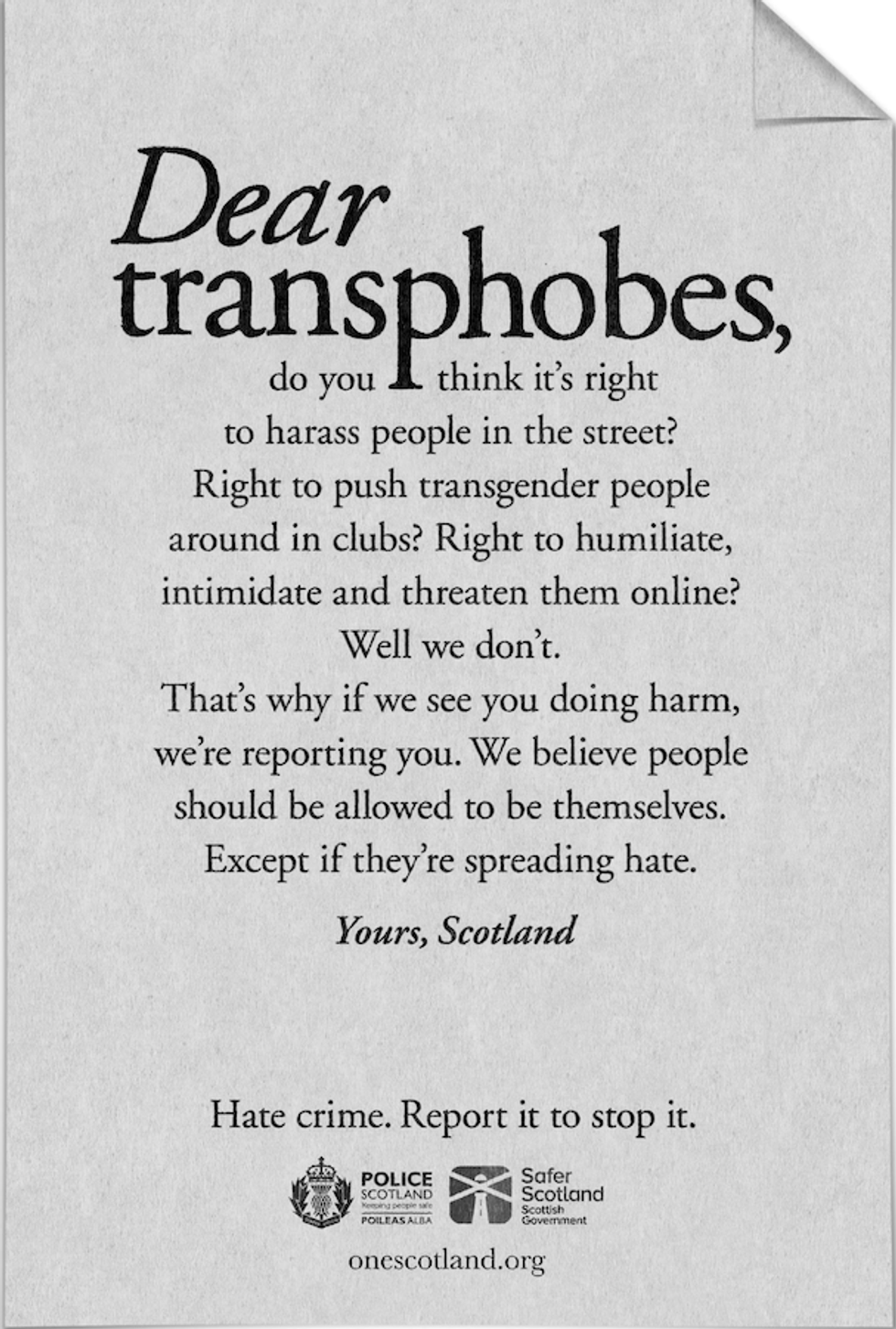
According to Pink News, Scotland is launching a new initiative to combat intolerance with messages respectively addressing "bigots," "disablists," "homophobes," "racists," and "transphobes" in a series of ads circulating across the country.
Each message is signed on behalf of Scotland.
The campaign is part of the Scottish government's One Scotland project in an effort to reduce hate crime.
One letter reads:
"Dear transphobes, do you think it's right to harass people in the street? Right to push transgender people around in clubs? Right to humiliate, intimidate and threaten them online? Well we don't."
"That's why if we see you doing harm, we're reporting you. We believe people should be allowed to be themselves. Except if they're spreading hate."
"Yours, Scotland."
In another letter, the country says it has a "phobia" of homophobic behavior.
"If you torment people because of who they love, shout word that we are not going to write, or use violence because you don't like who someone is holding hands with, you should be worried."
"If we see or hear your abuse, we're calling the police. That's because love lives in this country, not hate."
"Yours, Scotland."
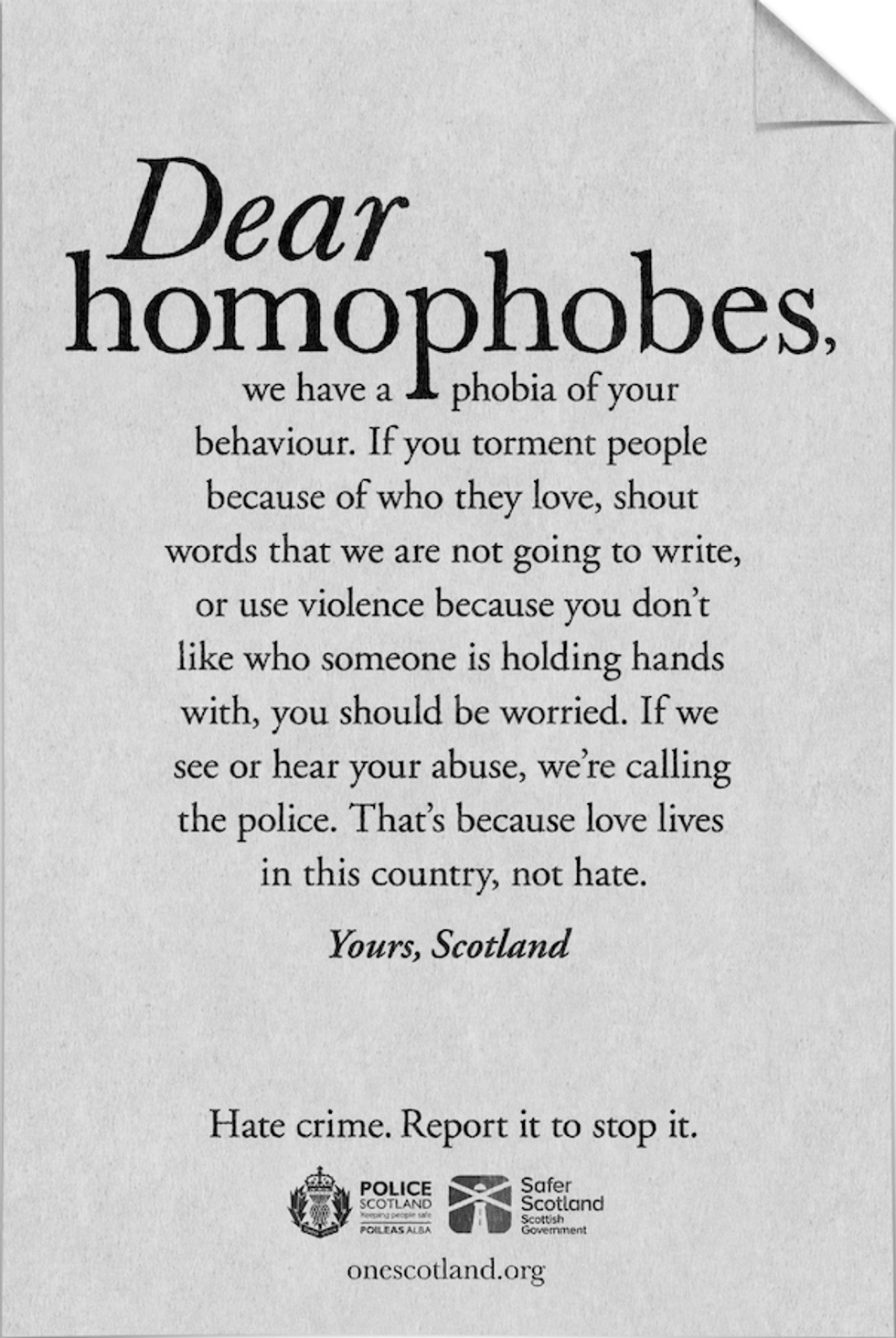
One Scotland's website describes the organization as one that aims to continue building an inclusive society while recognizing the significant strides made so far towards equality.
"One Scotland embodies the inclusive society we want in Scotland, where equality and human rights are respected and every individual and minority group feels valued."
The website defines hate crimes as abuse that "can be verbal or physical and has hugely damaging effects on the victims, their families and communities, and we all must play our part to challenge it."
"Police Scotland takes hate crime very seriously. In the last year there were over 5,300 charges of hate crime reported to the Procurator Fiscal in Scotland1."
"However, there are many more incidents that go unreported. We all have a responsibility to report hate crime if we witness it – it's the only way we can challenge it, and put an end to it for good."
Justice minister Humza Yousaf is familiar with being a victim of a bigotry and is encouraging people to call out and report any incidents involving harassment.
"As somebody who has faced Islamaphobic and racial abuse over the years, I know how upsetting being a victim of hate can be. Hate crime and prejudice are completely unacceptable and we are absolutely committed to tackling it."
"We all have a role to play in stamping out prejudice and I would ask anyone who witnesses a hate crime to play their part and report it. Justice agencies such the police and Crown Office will deal sensitively with reports made and people should have confidence in how they will be treated. Last year there were over 5,300 charges of hate crime reported to the Procurator Fiscal in Scotland but there are still many incidents that are going unreported."
Henrietta Mochrie identifies as transgender and has been the victim of repeated harassment and abuse. She emphasized the importance of speaking out against the hatred.
"I'll often get street harassment, sometimes this has escalated to the point where I've been followed by people shouting abuse at me, just because of who I am."
"It makes me feel really down and scared to leave the house. It's important that if you witness hate crime that you report it to take a stand against hate."
One Scotland's ad campaign officially launched on Wednesday.
Hopefully, it won't take too long before other nations follow suit in this bold, yet necessary fight for equality.
H/T - OneScotland, PinkNews, Twitter
Feminists Slam Man Telling Them They Can't Have Both Chivalry And Equality
A man on Twitter informed feminists they had to choose between chivalry and equality.
He was promptly raked over the coals for even assuming an antiquated concept would be considered as a viable option.
Twitter user @Rich_Cooper stated:
"Dear feminists. You either get equality or chivalry. You can't have both."
One user responded:
"I'll take equality. I don't need special treatment."
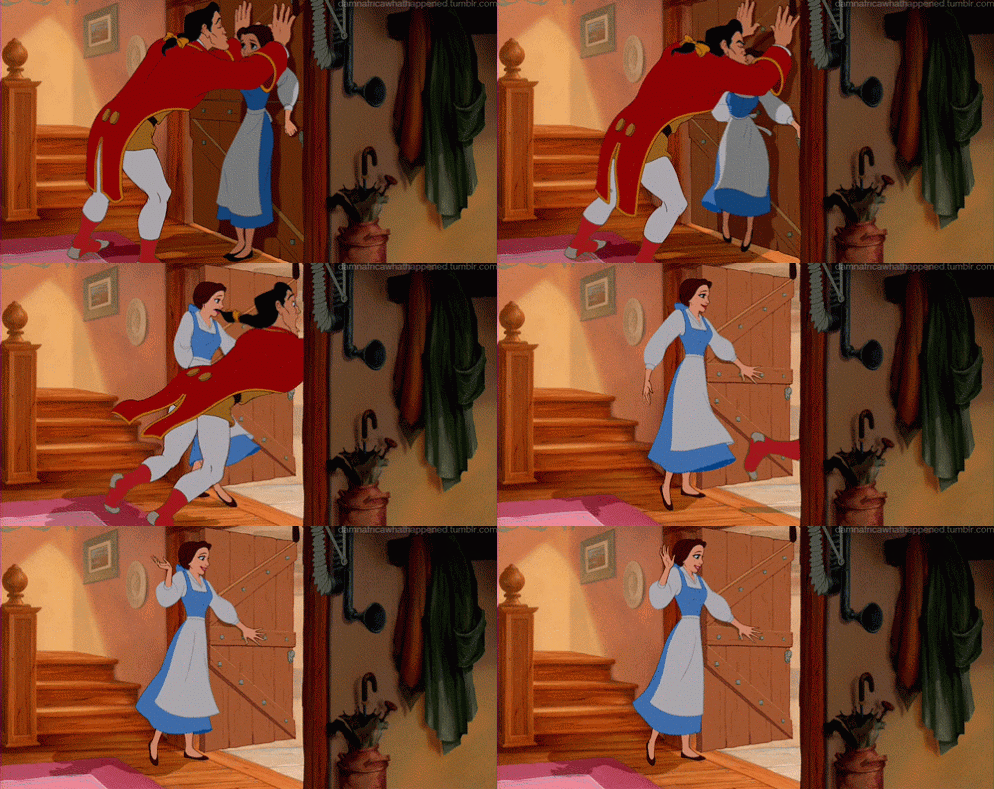
Cooper's rhetorical question did not go over so well. Both women and men expressed their disdain for his message.
One male user observed that chivalry was irrelevant and treating everyone with kindness and respect was compulsory.
"What people care about is caring, empathic [sic], considerate, thoughtful people, NOT whether THEIR door is held for them or THEIR meal is paid for them."
"Are there gender stereotypes in het[erosexual] dating? Sure. But that's separate from being a warm, giving, caring, grounded person."
Some women got right down to the point.
The notion of chivalry and equality are mutually exclusive and not a lot of people thought it was a major priority for feminists.
Common courtesy is not chivalry.
This user pointed out the fact that chivalry stems from a history of men outdoing other men. The concept had very little to do with women.
"Chivalry is a medieval concept of men dressing to impress other men. It has little to do with equality."
"Some men were on top, other men were beneath them. Historically, women were rarely invited into the process."
Neil Bradley described the outdated concept of chivalry as one that implies men being superior to women in a September 8, 2017, article for Medium publications.
"Examples: opening the door for a woman, paying for a woman's meal, gesturing for a woman to go first. The justification is either that women are not physically as strong (to open the door), able to provide (pay for their own meal), or are more deserving of compassion than men (allowing women to go first)."
Bradley also added that he wants to treat others the way he wants to be treated and asked if that approach should be motivated by chivalry or equality.
"If the genders are to be considered equal and treated equally, how a man treats a woman will essentially be the same as how a man treats a man."
"The obligation to open the door, pay for the meal, and let women go first vanishes. Men do not do this to other men, therefore why do it for women?"
His final take was that the two concepts can't co-exist. Either one is chivalrous or treats everyone as equals.
At the end of the day, people were happy to show chivalry the door.
H/T - GettyImages, Twitter, Indy100, Medium
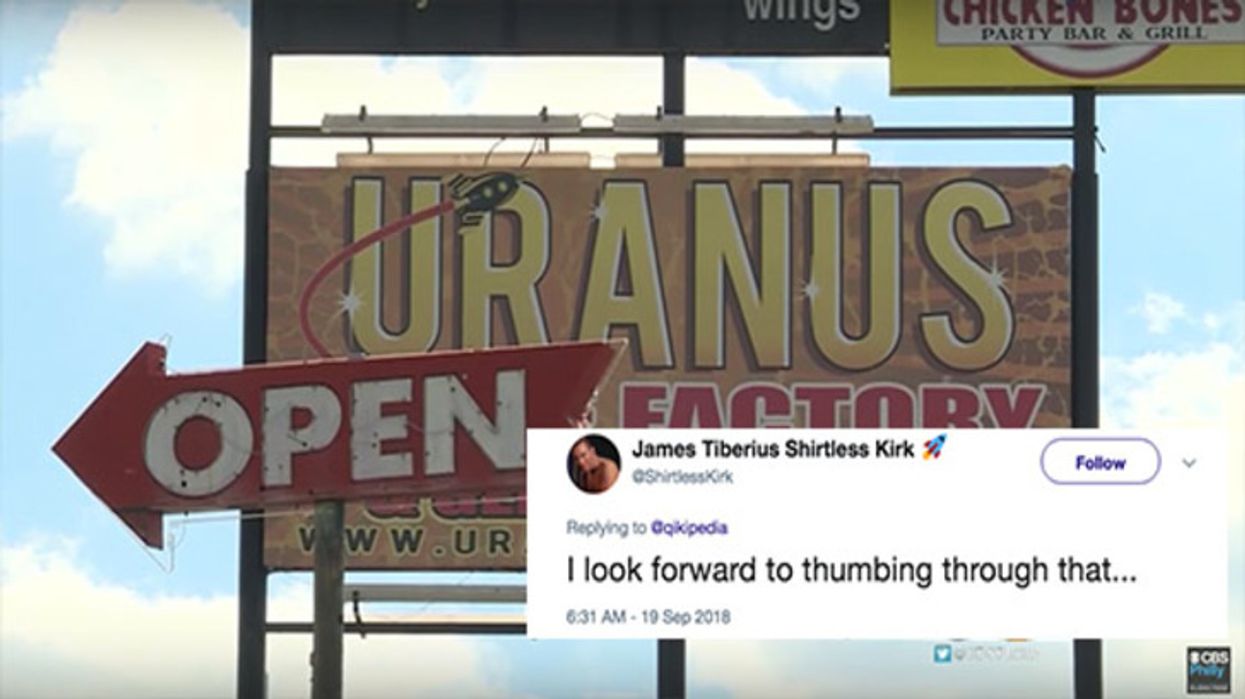
Some Residents Of Uranus, Missouri Are Not Happy About The Name Of Their New Local Newspaper 😆
There's nothing like a good pun about human anatomy. Really gets the juices flowing!
Owners of the new Uranus Examiner must have been snickering as they announced the paper's name. Apparently, it's caused quite the controversy in the small town of Uranus, Missouri, over the last few days.
Residents are divided over whether the pun is an embarrassment or perfectly snarky:
Folks on the internet responded with maturity and composure after learning about the Uranus Examiner.
Oh, wait. No they didn't.
If you think about it... there might actually be a method to the madness here. The brand new paper's name has received widespread media coverage over this past week. Simply put... everyone's talking about Uranus.
In terms of publicizing their new venture, the owners of the Uranus Examiner have actually done a pretty sweet job!
In the video above, a woman suggests the paper should have been called "The Pulaski County Examiner."
If you ask me, that's TOTALLY BORING, and wouldn't have generated as much interest and publicity for the paper. So while the name might be cringeworthy to some, you can bet Uranus that it'll stick around. Who knows, Uranus might even grow as a result!
H/T: Indy100, The Kansas City Star
Woman Was Fired For Refusing To Wear A Bra At Work—And Now She's Suing
Christina Schell, from Alberta, Canada, stopped wearing bras three years ago citing health reasons.
While Schell did not specify the health reasons, she did state she finds them to be "horrible."
But after her refusal to sign or adhere to a new enforced dress code policy to wear a bra or tank top under her work shirt at a golf course grill where she worked, Schell was promptly fired.
Now, the 25-year-old has filed a human rights violation against the Osoyoos Golf Club, Osoyoos, in British Columbia, Canada.
Schell said:
"I don't think any other human being should be able to dictate another person's undergarments."
When she asked the general manager, Doug Robb, why she had to comply, the manager told her the mandate was for her protection.
Robb allegedly said:
"I know what happens in golf clubs when alcohol's involved."
After losing her job, she brought the case to the British Columbia Human Rights Tribunal and told them the club's dress code was discriminatory because the rule didn't apply towards male employees.
Schell told CBC:
"It's gender-based and that's why it's a human rights issue. I have nipples and so do the men."
David Brown, an employment lawyer in Kelowna, BC, said gender-specific dress codes could be viewed as discriminatory under the BC Human Rights Code.
He stated:
"It's an interesting question as to whether or not an employer can dictate the underwear that women can wear, but they don't say anything about the underwear that men can wear, and does that create an adverse impact on the individual?"
Brown added:
"If this policy is found to be discrimination, the next question is does the employer have a bonafide occupational requirement to essentially impose this on the individual?"
"I'm kind of scratching my head as to what that occupational requirement would be."
As for the tank top option, due to working under oftentimes extreme heat serving tables outsides, Schell did not want to wear another layer of clothes just because of her gender.
Schell said:
"It was absurd. Why do you get to dictate what's underneath my clothes?"
Employment lawyer Nadia Zaman told CBC that the club can enforce a gender-specific policy as they deem necessary as long as the establishment can prove it is for the occupational safety of its workers.
But the attorney questioned if forcing female employees to wear a bra was applicable in this case.
Zaman stated:
"If they simply require that female employees wear a bra but then they don't have a similar requirement for males, and they can't really justify that … then there is a risk that their policy's going to be deemed to be discriminatory."
Under British Columbia's discrimination law, it is illegal for employers:
'to discriminate against any individual because of his race, color, religion, sex, or national origin'.
McDonald's employee Kate Gosek, 19, agrees with Schell in that the dress code is "unnecessary." She too was harassed by her employers at a McDonald's in Selkirk, Manitoba, over refusing to wear a bra.
"She just told me that I should put on a bra because, McDonald's—we are a polite restaurant and no one needs to see that."
Schell's case sparked plenty of debates on Twitter.
Schell is not alone in her disdain for bras.
Schell is still waiting to hear from the Human Rights Commission about her claim.
H/T - GettyImages, Twitter, Indy100, CBC


(
(