







December, 2000, OSAKA, Japan - A trip to Japan is like a continuous time warp back and forth through history, from the past to the cutting-edge present, then back to the ancient. My mission was history based. The international opening of the Japanese American National Museum's traveling exhibit on the history of the Japanese Americans of Hawaii at the Okinawa Prefectural Museum in Okinawa, Japan.
My arrival in Japan was at Kansai International Airport, a stunningly contemporary facility built on a vast man-made island in Osaka Bay. The Japanese flair for efficiency and design, rationality melded with style, made the normally punishing process of an international transit a smooth, in fact, pleasurable, experience. We sailed through customs, exchanged our dollars for yen, had a tasty light snack of buckwheat noodles all in stylish comfort, and we were on our way to our destination, Okinawa.
 The opening of the museum's exhibit was a great success. A large contingent of museum supporters and staff were in attendance, including Irene Hirano, the museum's president and executive director. U.S. Ambassador to Japan, Thomas Foley, U.S. Senator from Hawaii, Daniel Inouye, Lt. Governor of Hawaii, Mazie Hirono, and Governor Inamine of Okinawa were our honored guests together with more than 250 other Americans who had traveled to be with us for the opening. As the only American to speak at the ceremony in both Japanese and English, I became something of the bridge to mutual understanding that is the point of our exhibit.
The following day was back to the future. The museum sponsored a special educational program at the National Okinawa Youth Center on Tokashiki Island, a fast jetfoil ride away from the main island. The program featured two astronauts from NASA, Daniel Tani, a Japanese American from Chicago, and Mamoru Mohri, a Japanese astronaut who has flown two NASA space missions in the past two years. The program had the eyes and imagination of the young people of Okinawa soaring to the stars.
 From Okinawa, I flew to the southern Japan city of Fukuoka because of my personal interest in architecture. I had read that American architect Jon Jerde had designed a remarkable project in Fukuoka called Canal City. Remarkable it is! Jerde has designed a fancifully futuristic commercial complex incorporating one of the many canals of Fukuoka. There are restaurants and shops galore, offices and educational facilities and a dazzling multiplex cinema and a grand theater for Broadway musicals - indeed a traveling production of Disney's "Lion King" was the next production booked. Whimsically geometric structures snake and undulate following the curves of the canal. The canal itself spouted jets of water five stories up. Lights bubbled and flickered or glowed and subtly illuminated the contours of the fanciful buildings. There were performers on little peninsulas out on the canal. But the cascade of people flowing up and down the escalators and stairways made simple people watching just as entertaining. Jerde's creation is an architectural Broadway musical. And my actor's instincts led me to book my hotel reservation at the Hyatt Grand right smack center stage in the middle of the whole colorful production. I lived for two days and two nights in an architect's theatrical fantasy.
Then a super-fast bullet train sped me right back into history. When it stopped, we transferred to an old-fashioned ferry that sailed leisurely toward the legendary shrine island of Miyajima shrouded in the mist of history. As a matter of fact, there was a light mist in the air as we approached the famous floating torii gate to Itsukushima Shrine that seems to mystically rest on water. Legend has it that because the island is considered sacred, there were no births or deaths allowed on it. That all had to take place on the mainland. Even today, there is no hospital on the island. However, at the ferry station, we did take a taxi, instead of the rickshaw, to our lodging. As we were driven through the narrow passageways of the village of Miyajima, it felt as though we were passing through the set of a samurai movie. A short way up the hillside and we arrived at a magnificent Japanese villa. This was the historic Iwaso Inn, one of the great lodges of Japan. We were gracefully ushered by a charming kimono-clad chambermaid to a classically formal Japanese room. Beyond the veranda lay a serene view of a maple forest. I could have sat meditating on that veranda all day. But we had so much we wanted to do.
 It was autumn and the forest had turned a spectacular palette of reds, oranges, and yellows as well as the deep greens of the evergreens. We took a cable ride high over the spectacularly painted forest to the topmost point of the island. We fed the famously hungry tame deers that roam the island of Miyajima. We trooped through the shrine with the day-tripping tourist horde. Exhausted, we returned to our inn. I soaked in the hot Japanese bath gazing up at the steam wafting through the pine branches. Every tired muscle in my body seemed to melt into blessed relaxation.
Shortly after I had changed into my formal kimono provided by the inn, a gentle knock came on our sliding door. Our chambermaid was ready to serve us dinner. The low, spacious lacquered table in our room became the stage for a seemingly endless parade of small, artfully arranged dishes presented with elegance and grace. This was the renowned "kaiseki" dinner of ancient Japan. When the last delicious morsel had been served, the chambermaid suggested that we go for an after dinner stroll on the island. Miyajima at night, she urged, is something quite special.
She was so right. The island was magically transformed. The hurly burly of the day-trippers had disappeared and in its place was a tranquil scene of kimono-clad people quietly admiring the illuminated shrine and pagoda. The reflection of the shrine on the calm, dark water made it seem almost supernatural. On our way back, we ambled past the detached villa of our inn that was reserved for the emperor. Emperor Hirohito himself, we were told, had regularly stayed there. When we returned to our room, the lacquered table had vanished and in its place futon beds had neatly been arranged. That night, I slept deeply dreaming the dream of some past emperor.
Another quick bullet train ride the next day and we were in the shining new metropolis of Hiroshima. This city, flattened by the devastation of the atomic bomb over half a century ago, has rebuilt itself into a modern urban center of broad, tree-lined boulevards, tall glassy buildings and, at its focal point, a leafy park dedicated to international peace, the center of which is the Peace Museum. The exhibit there is a deeply moving chronicle of the human suffering as a result of the dropping of the bomb.
In Hiroshima, I was back to wearing my hat as the chairman of the Japanese American National Museum. After Okinawa, we want to tour our exhibit throughout Japan. It is currently set for Osaka in March of 2001. Because a large number of Japanese immigrants came from Hiroshima, as indeed my maternal grandparents did, we would very much like to see our exhibit visit there. I had met Governor Yuzan Fujita of Hiroshima on a previous visit and so had arranged to meet with him again to gain his support and guidance finding a way to get our exhibit to Hiroshima. The Governor greeted me warmly and, after I made my request, he immediately had ideas of a venue to be considered. He called for his personal car and driver and promptly dispatched me to examine his suggested site. Transported in the luxurious comfort of the Governor's car, I toured a handsome new exhibition hall. I now feel rather confident that the people of Hiroshima will be viewing our exhibit.
After visits with relatives in Hiroshima, I was back on the bullet train for my final stop on this trip, Osaka. The Second City of Japan is an overwhelming metropolis of congested traffic, bustling commerce and energetic people. And this is where the popularity of Star Trek in Japan is enormous. Through Russ Haslage of the Excelsior campaign, fans in Osaka had contacted me, and a charming young lady, Sachie Kubo, had made arrangements, to show me their city.
When I checked into my hotel room, the view that greeted me through my window was of the great Osaka Castle, the most spectacular historic structure in Japan. Circled by a wide moat protecting a lush park-like area, then looming up on a base of gigantic boulders amazingly fitted together, the castle sparkled in the sun with its golden embellishments. I had to go across immediately to tour it.
Crossing the arched bridge over the moat felt like the prelude to entry into the past. This was the very place where great battles were fought by the most powerful shogun in Japan's history, Toyotomi Hideyoshi. Stepping into this storied precinct, I felt as though I were going back in time. That illusion was immediately smashed when a trendy young runner jogged by wearing a shiny spandex running outfit, then another wearing earphones with a thin metallic antenna bobbing over his head. I learned that the park inside the moat was one of the popular running paths of Osaka. As I walked through the outer entrance of the castle and the gigantic wood gate studded with black iron braces, I recognized it immediately from the television mini-epic, "Shogun." I remembered that this was where it was filmed on location. We trudged up a seemingly endless series of gray granite steps to the castle's main entrance. As we huffed and puffed, our straining muscles let us know how impregnable this castle must have been to the warlords who attacked it. We paid our admission and walked in. I stood there stunned. In front of us was a bank of elevators! There were video displays on the history of the castle built right into the walls! And I felt the comforting warmth of forced air heating in this ancient castle! I learned from a brochure that this historic castle had been completely rebuilt just a few years ago -- with all modern conveniences to boot. With a slight sense of disillusionment, we took the elevator to the top of the castle. The view was great. We were taking in the panoramic vista of modern day Osaka from the highest point of the castle, when I heard an American accented voice shout at me, "My god! You're Mr. Sulu, aren't you?" With one excited exclamation, I was brought from my fantasies at the pinnacle of this recently rebuilt ancient castle, back to my very own present day reality. The cameras flashed as I posed for pictures with American Star Trek fans touring in Osaka.
 I spent the following day with Japanese Star Trek fans in Osaka. Four beaming faces were waiting in the hotel lobby that morning to show me the sights of this city. Sachie Kubo and Masanori Mizuumi were from Osaka but I was both flattered and moved to discover that Yoshimitsu Murata and Youichi Nieda, whom I had met on a previous trip to Tokyo earlier this year, had traveled all the way down from Tokyo to share the day with me.
It was a fun-filled day of roaming through a vibrant and engaging metropolis of busy marketplaces and elegant shops, raucous entertainment quarters and traditional bunraku theater and temples and shrines. We even saw a traditional wedding ceremony taking place at one of the temples. That evening, about a dozen more fans joined us at a restaurant for a lovely dinner of Japanese hot pot and conversations about the Excelsior campaign. The savory steam that wafted up from the bubbling pot of vegetables, seafood, noodles and other delicious morsels seemed to warm new friendships and enhance old ones.
All to soon, our 10-day trip to Japan was coming to an end. The next afternoon, we were on the express train to Kansai International Airport for our flight to Los Angeles - home to prepare for the holidays. As I write this on my laptop in the airport lounge in Osaka, I'm reminded of the many events of this past year. Much has happened, great and small. We have much to be thankful for. And much we need to do in the future. May I wish you all the joys and blessings of this holiday season.
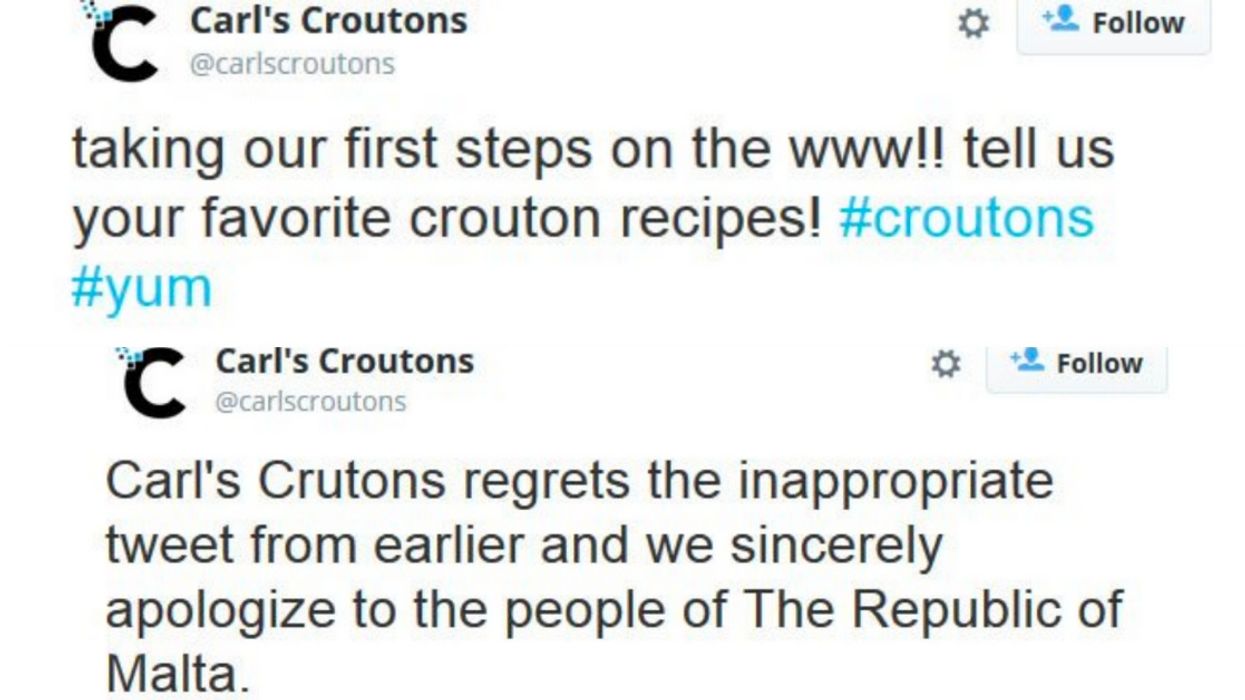
@topherflorence captured highlights from the thread that received over three thousand retweets for its zaniness alone.
Can you follow?
The bread crumbs company endeavored to stir excitement for the brand by encouraging participation with the following tweet:
"Taking our first steps on the www!! tell us your favorite crouton recipes! #croutons #yum"
Harmless, right?

But somewhere along the way, the brand mixed business with politics. @religiousgames noticed that Carl's Croutons issued a one-word directive: vote.
The Twitter user asked, "What does it mean?"
Did the Carl's Croutons account manager get his social media account wires crossed? Possibly. But then we're not sure.
@topherflorence responded by saying, "lol that wasn't me i would posted something way dumber."
The following tweet from Carl's Croutons attempted damage control:
"Carl's Crutons [sic] regrets the inappropriate tweet from earlier and we sincerely apologize to the people of The Republic of Malta."
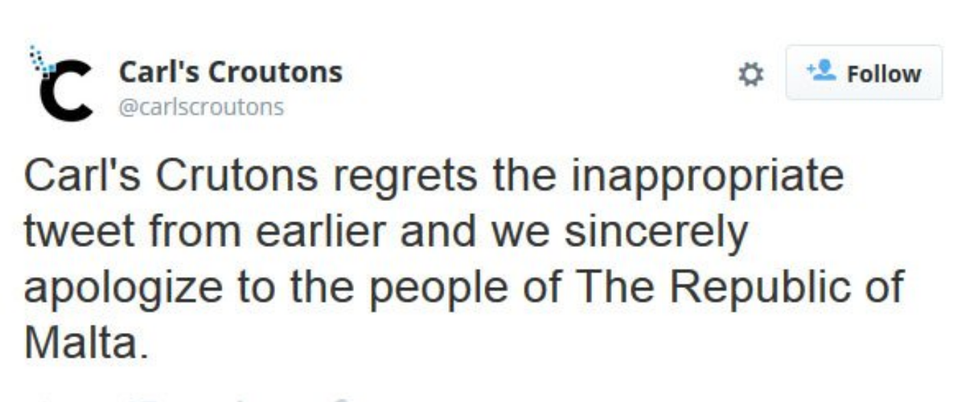
So how did Carl's Croutons insult the Republic of Malta?
@Bestorb shed some light on why the Southern European island country may have been insulted by sharing a YouTube clip of episode 1008, "Final Justice," from Mystery Science Theater 3000.
Did it have something to do with the country's dominant population of women?
The thread spun off in all different directions.

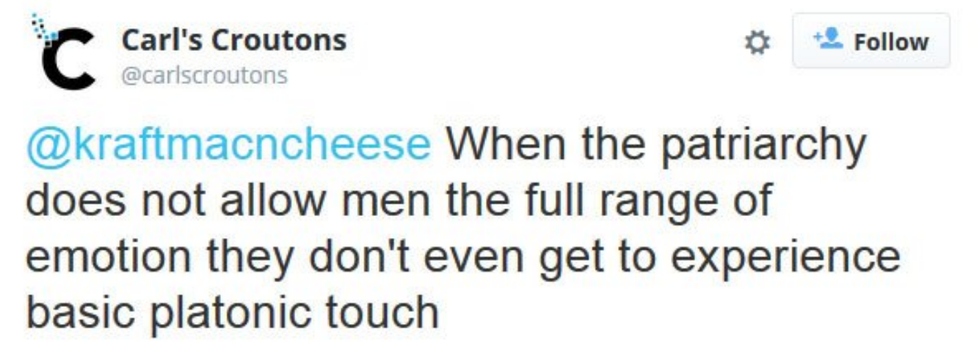
There were many takeaways from the esoteric thread, but the one directive really stood out.
There's still an unanswered question.
So who is Carl's Croutons anyway? Nobody knows. Just vote.
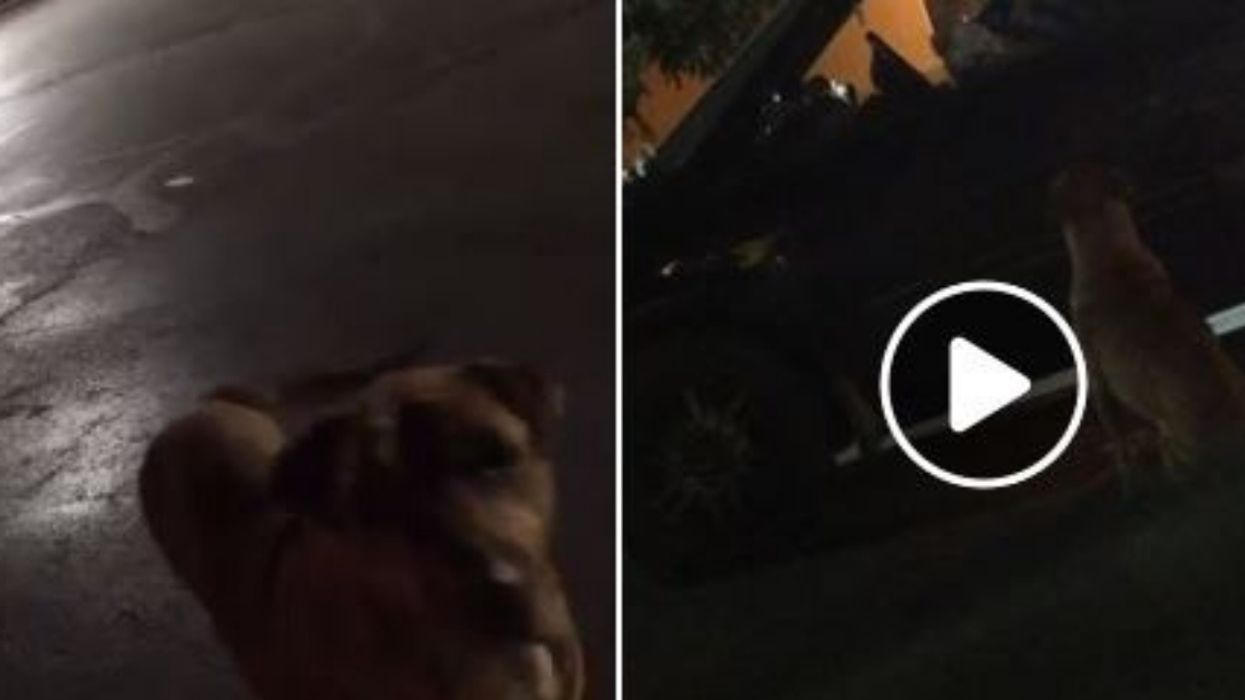
Facebook user Betsy Reyes busted her dog Princess who was out moonlighting as a stray in order to play on the sympathies of strangers. It seems Princess likes to wander off to her favorite hangout, the local McDonald's, and work the drive through lane like a pro.
And that's what she did right up until Reyes busted her scam. Reyes, who lives in Oklahoma City, took to Facebook and outed Princess in the most hysterical way, saying:
"If you see my dog @ the McDonald's on shields, quit feeding her fat ass bc she don't know how to act & be leaving the house all the time to go walking to McDonald's at night. She's not even a stray dog. She's just a gold diggin ass bitch that be acting like she's a stray so people will feel bad for her & feed her burgers."

Lots of scammers out there.
It's an adorable story, but maybe get the dog a collar with identification?
Not everyone thought the story was cute.
Of course, when a girl's gotta eat, a girl's gotta eat.
Let's hope Princess has learned her lesson and stays home.
H/T: Huffington Post, Mashable
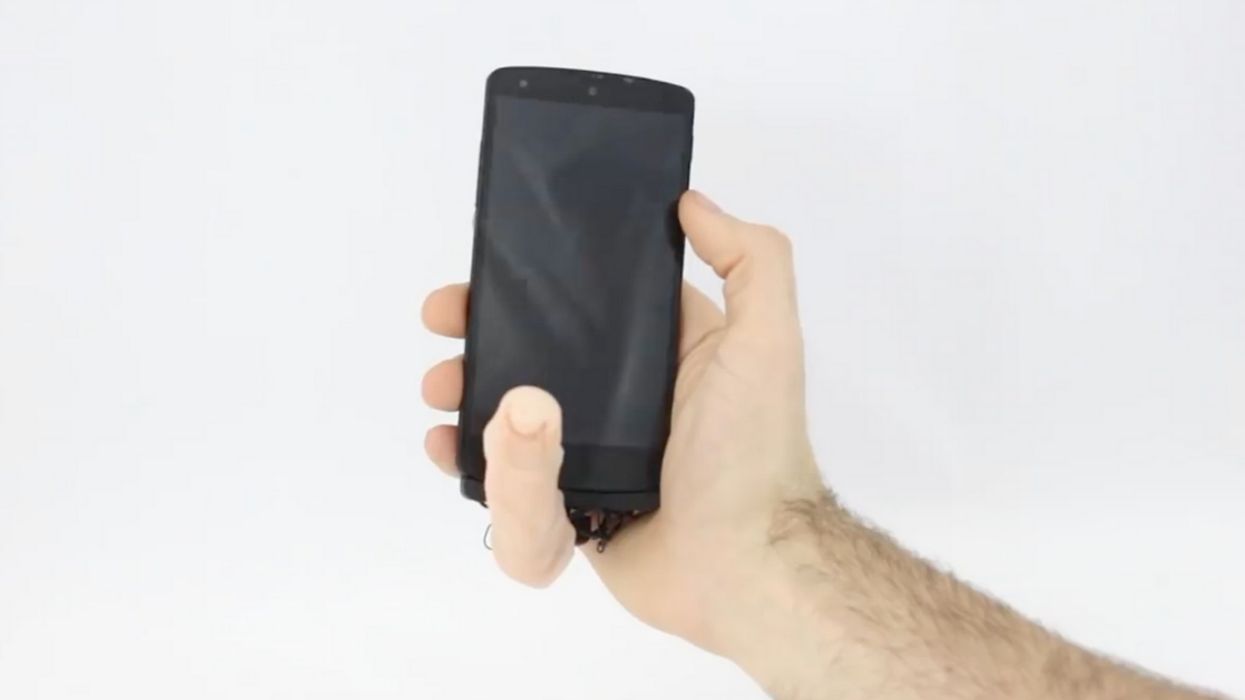
The MobiLimb was created by researchers in France and is made up of "five servo motors, an Arduino microcontroller and a sensor, and it can do a number of unsettling things that are straight out of nightmares," according to Engadget.
Marc Teyssier, a PhD student and one of the researchers behind the project for the dismembered limb, legitimized its existence.
"In the spirit of human augmentation, which aims at overcoming human body limitations by using robotic devices, our approach aims at overcoming mobile device limitations (static, passive, motionless) by using a robotic limb."
Th MobiLimb can prop itself up so you can watch a video, or provide an alternate way to grip your device.
But there's one function that is really disturbing.
The articulated digit can be skinned to resemble a human finger, and it can stroke your wrist while you're using your phone.

Someone implied that single people could benefit from this invention as a companion.
What would the next-generation MobiLimb offer consumers?
The attachment could come in handy should an unfortunate life-changing incident were to occur.
But the gadget is still giving people goosebumps.
Others saw a more erotic potential.
Now here's a function not advertised by MobiLimb's creators.
Feelings are mixed. But the jury is in.
As to why such a creepy gadget was invented, we can't quite put our finger on it. But then, when it comes to consumers' needs, these guys may be out of touch.
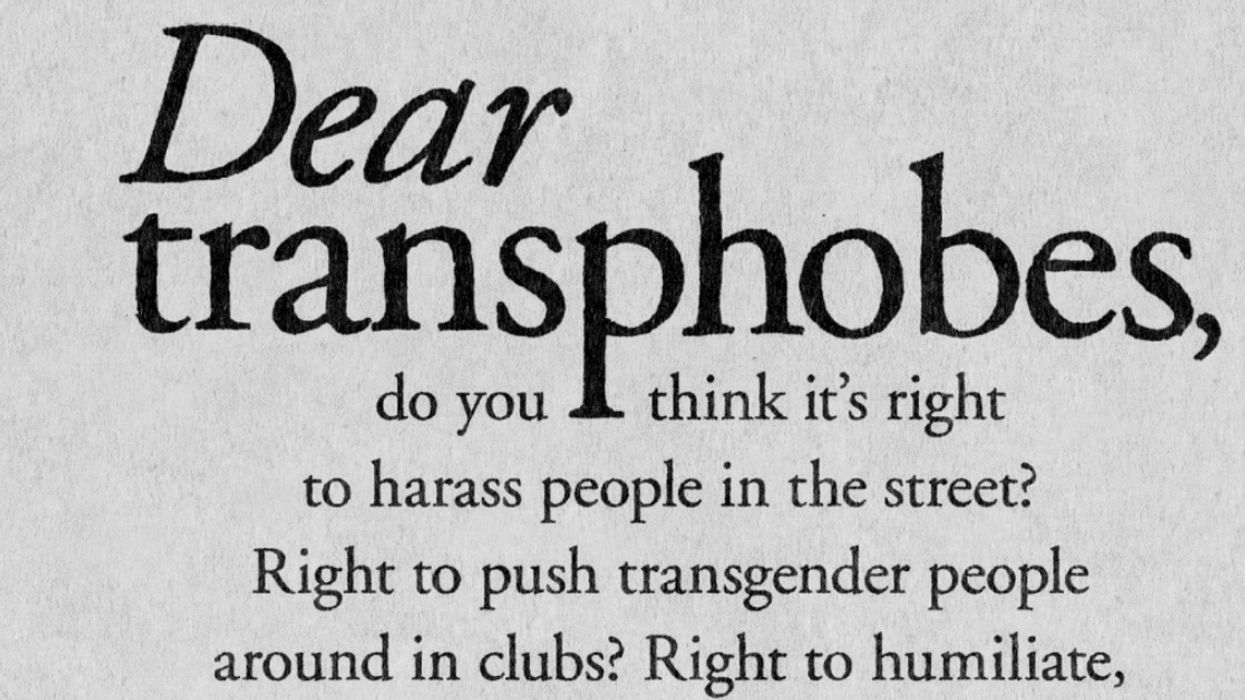
The campaign is part of the Scottish government's One Scotland project in an effort to reduce hate crime.
One letter reads:
"Dear transphobes, do you think it's right to harass people in the street? Right to push transgender people around in clubs? Right to humiliate, intimidate and threaten them online? Well we don't."
"That's why if we see you doing harm, we're reporting you. We believe people should be allowed to be themselves. Except if they're spreading hate."
"Yours, Scotland."
 (
(In another letter, the country says it has a "phobia" of homophobic behavior.
"If you torment people because of who they love, shout word that we are not going to write, or use violence because you don't like who someone is holding hands with, you should be worried."
"If we see or hear your abuse, we're calling the police. That's because love lives in this country, not hate."
"Yours, Scotland."
 (
(One Scotland's website describes the organization as one that aims to continue building an inclusive society while recognizing the significant strides made so far towards equality.
"One Scotland embodies the inclusive society we want in Scotland, where equality and human rights are respected and every individual and minority group feels valued."
The website defines hate crimes as abuse that "can be verbal or physical and has hugely damaging effects on the victims, their families and communities, and we all must play our part to challenge it."
"Police Scotland takes hate crime very seriously. In the last year there were over 5,300 charges of hate crime reported to the Procurator Fiscal in Scotland1."
"However, there are many more incidents that go unreported. We all have a responsibility to report hate crime if we witness it – it's the only way we can challenge it, and put an end to it for good."
Justice minister Humza Yousaf is familiar with being a victim of a bigotry and is encouraging people to call out and report any incidents involving harassment.
"As somebody who has faced Islamaphobic and racial abuse over the years, I know how upsetting being a victim of hate can be. Hate crime and prejudice are completely unacceptable and we are absolutely committed to tackling it."
"We all have a role to play in stamping out prejudice and I would ask anyone who witnesses a hate crime to play their part and report it. Justice agencies such the police and Crown Office will deal sensitively with reports made and people should have confidence in how they will be treated. Last year there were over 5,300 charges of hate crime reported to the Procurator Fiscal in Scotland but there are still many incidents that are going unreported."
Henrietta Mochrie identifies as transgender and has been the victim of repeated harassment and abuse. She emphasized the importance of speaking out against the hatred.
"I'll often get street harassment, sometimes this has escalated to the point where I've been followed by people shouting abuse at me, just because of who I am."
"It makes me feel really down and scared to leave the house. It's important that if you witness hate crime that you report it to take a stand against hate."
One Scotland's ad campaign officially launched on Wednesday.
Hopefully, it won't take too long before other nations follow suit in this bold, yet necessary fight for equality.
H/T - OneScotland, PinkNews, Twitter