Arkansas High School Suspends Student Paper For Publishing 'Disruptive' Investigation Into Shady Football Transfers
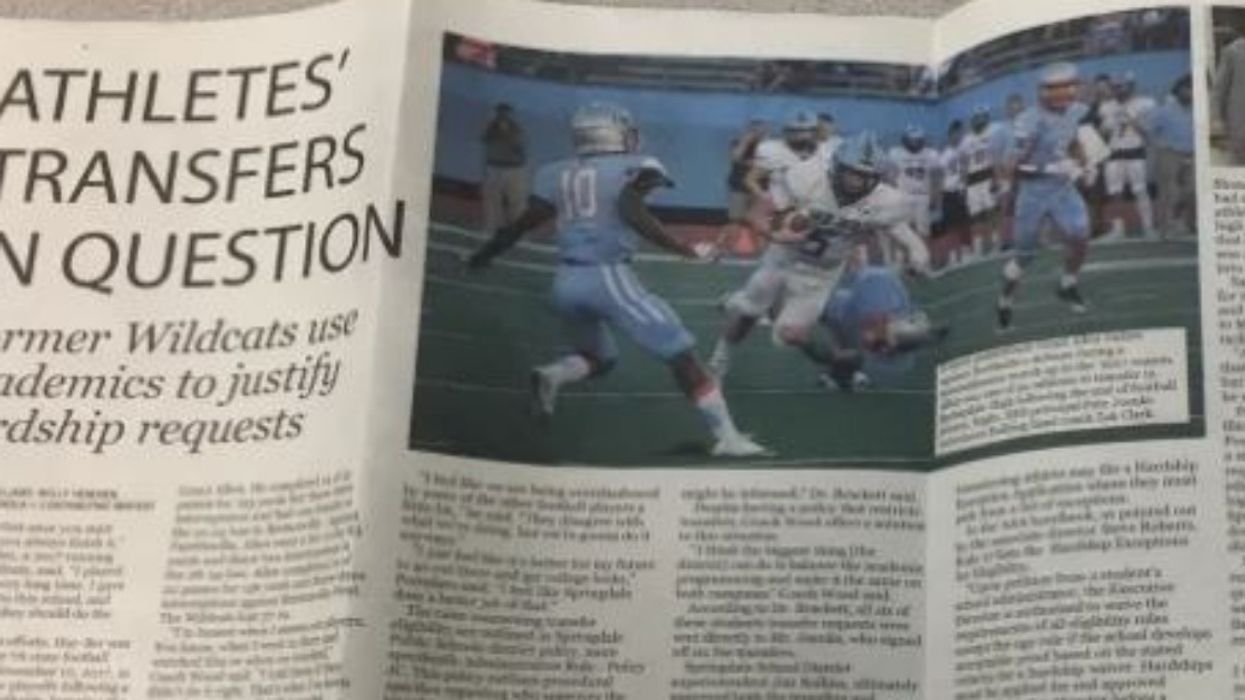
Halle Roberts is the editor-in-chief of the Har-Ber Herald, the school newspaper for Springdale High School in Arkansas. The 17-year-old student was suspended after she wrote an investigative piece criticizing the transfer of five football players to a rival school.
Players are not allowed to be transferred to a different school because they would like to play for a different team. They are allowed to transfer only for academic reasons. So Roberts got to digging. Her paper filed FOIA requests and received official information from the Arkansas Activities Association saying that the students were transferred for academic reasons. However, the students themselves said otherwise.
Roberts quoted one student in her paper saying:
"We just want to go over there because we have a better chance of getting scholarships and playing at D1."
Another student told Roberts:
"I just feel like it's better for my future to go out there and get college looks."
Soon after the report was published, the superintendent of the district, Jim Rollins, asked the teacher advisor for the school paper, Karla Sprague, to take the story down. She obliged.
Rollins wrote a letter stating that the piece was:
"intentionally negative, demeaning, derogatory, hurtful and potentially harmful to the students addressed in those articles."
Roberts, undeterred, is still working on a new edition of the story that includes the school's censorship.
Mike Hiestand of the Student Press Law Center had this to say:
And Halle Roberts, who dreams of being an ESPN reporter, stated:
People were impressed with Roberts.
Some had harsh words for the school's administration.
And most had high praise for Roberts and the other student journalists working on this piece.
And Halle Roberts herself closed by saying:
Fight on, Halle!
Feminists Slam Man Telling Them They Can't Have Both Chivalry And Equality
A man on Twitter informed feminists they had to choose between chivalry and equality.
He was promptly raked over the coals for even assuming an antiquated concept would be considered as a viable option.
Twitter user @Rich_Cooper stated:
"Dear feminists. You either get equality or chivalry. You can't have both."
One user responded:
"I'll take equality. I don't need special treatment."
Cooper's rhetorical question did not go over so well. Both women and men expressed their disdain for his message.
One male user observed that chivalry was irrelevant and treating everyone with kindness and respect was compulsory.
"What people care about is caring, empathic [sic], considerate, thoughtful people, NOT whether THEIR door is held for them or THEIR meal is paid for them."
"Are there gender stereotypes in het[erosexual] dating? Sure. But that's separate from being a warm, giving, caring, grounded person."
Some women got right down to the point.
The notion of chivalry and equality are mutually exclusive and not a lot of people thought it was a major priority for feminists.
Common courtesy is not chivalry.
This user pointed out the fact that chivalry stems from a history of men outdoing other men. The concept had very little to do with women.
"Chivalry is a medieval concept of men dressing to impress other men. It has little to do with equality."
"Some men were on top, other men were beneath them. Historically, women were rarely invited into the process."
Neil Bradley described the outdated concept of chivalry as one that implies men being superior to women in a September 8, 2017, article for Medium publications.
"Examples: opening the door for a woman, paying for a woman's meal, gesturing for a woman to go first. The justification is either that women are not physically as strong (to open the door), able to provide (pay for their own meal), or are more deserving of compassion than men (allowing women to go first)."
Bradley also added that he wants to treat others the way he wants to be treated and asked if that approach should be motivated by chivalry or equality.
"If the genders are to be considered equal and treated equally, how a man treats a woman will essentially be the same as how a man treats a man."
"The obligation to open the door, pay for the meal, and let women go first vanishes. Men do not do this to other men, therefore why do it for women?"
His final take was that the two concepts can't co-exist. Either one is chivalrous or treats everyone as equals.
At the end of the day, people were happy to show chivalry the door.
H/T - GettyImages, Twitter, Indy100, Medium
Some Residents Of Uranus, Missouri Are Not Happy About The Name Of Their New Local Newspaper 😆
There's nothing like a good pun about human anatomy. Really gets the juices flowing!
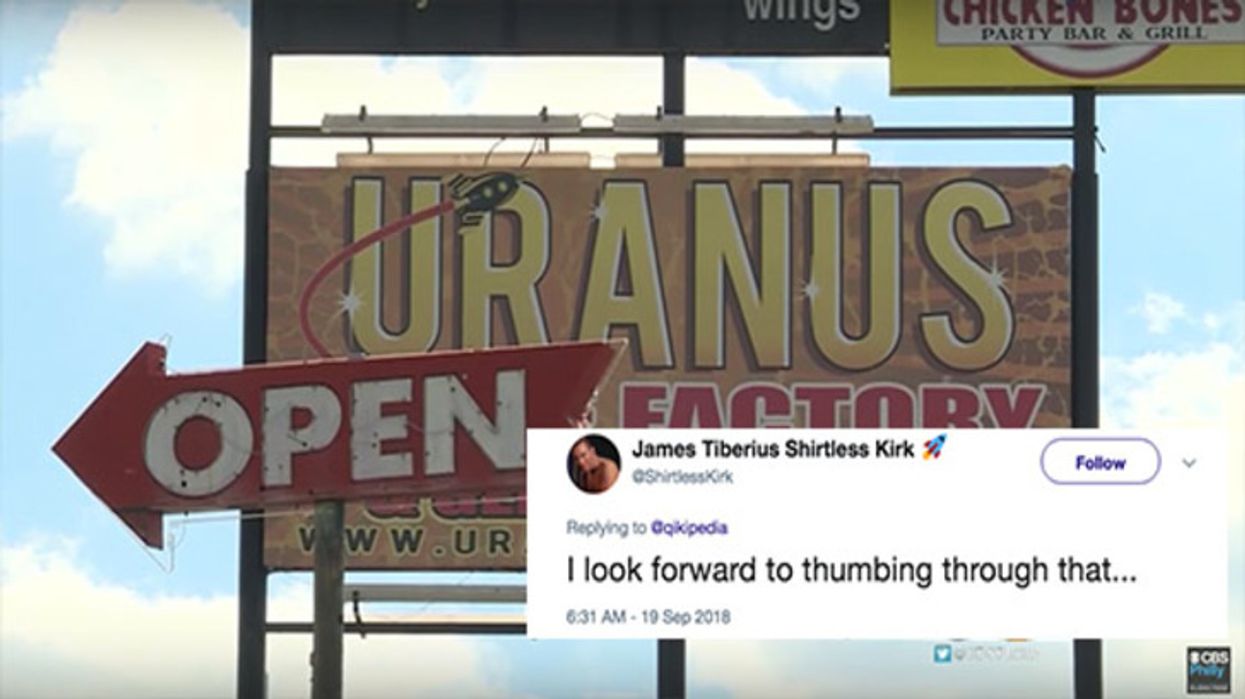
Owners of the new Uranus Examiner must have been snickering as they announced the paper's name. Apparently, it's caused quite the controversy in the small town of Uranus, Missouri, over the last few days.
Residents are divided over whether the pun is an embarrassment or perfectly snarky:
Folks on the internet responded with maturity and composure after learning about the Uranus Examiner.
Oh, wait. No they didn't.
If you think about it... there might actually be a method to the madness here. The brand new paper's name has received widespread media coverage over this past week. Simply put... everyone's talking about Uranus.
In terms of publicizing their new venture, the owners of the Uranus Examiner have actually done a pretty sweet job!
In the video above, a woman suggests the paper should have been called "The Pulaski County Examiner."
If you ask me, that's TOTALLY BORING, and wouldn't have generated as much interest and publicity for the paper. So while the name might be cringeworthy to some, you can bet Uranus that it'll stick around. Who knows, Uranus might even grow as a result!
H/T: Indy100, The Kansas City Star
Woman Was Fired For Refusing To Wear A Bra At Work—And Now She's Suing
Christina Schell, from Alberta, Canada, stopped wearing bras three years ago citing health reasons.
While Schell did not specify the health reasons, she did state she finds them to be "horrible."
But after her refusal to sign or adhere to a new enforced dress code policy to wear a bra or tank top under her work shirt at a golf course grill where she worked, Schell was promptly fired.
Now, the 25-year-old has filed a human rights violation against the Osoyoos Golf Club, Osoyoos, in British Columbia, Canada.
Schell said:
"I don't think any other human being should be able to dictate another person's undergarments."
When she asked the general manager, Doug Robb, why she had to comply, the manager told her the mandate was for her protection.
Robb allegedly said:
"I know what happens in golf clubs when alcohol's involved."
After losing her job, she brought the case to the British Columbia Human Rights Tribunal and told them the club's dress code was discriminatory because the rule didn't apply towards male employees.
Schell told CBC:
"It's gender-based and that's why it's a human rights issue. I have nipples and so do the men."
David Brown, an employment lawyer in Kelowna, BC, said gender-specific dress codes could be viewed as discriminatory under the BC Human Rights Code.
He stated:
"It's an interesting question as to whether or not an employer can dictate the underwear that women can wear, but they don't say anything about the underwear that men can wear, and does that create an adverse impact on the individual?"
Brown added:
"If this policy is found to be discrimination, the next question is does the employer have a bonafide occupational requirement to essentially impose this on the individual?"
"I'm kind of scratching my head as to what that occupational requirement would be."
As for the tank top option, due to working under oftentimes extreme heat serving tables outsides, Schell did not want to wear another layer of clothes just because of her gender.
Schell said:
"It was absurd. Why do you get to dictate what's underneath my clothes?"
Employment lawyer Nadia Zaman told CBC that the club can enforce a gender-specific policy as they deem necessary as long as the establishment can prove it is for the occupational safety of its workers.
But the attorney questioned if forcing female employees to wear a bra was applicable in this case.
Zaman stated:
"If they simply require that female employees wear a bra but then they don't have a similar requirement for males, and they can't really justify that … then there is a risk that their policy's going to be deemed to be discriminatory."
Under British Columbia's discrimination law, it is illegal for employers:
'to discriminate against any individual because of his race, color, religion, sex, or national origin'.
McDonald's employee Kate Gosek, 19, agrees with Schell in that the dress code is "unnecessary." She too was harassed by her employers at a McDonald's in Selkirk, Manitoba, over refusing to wear a bra.
"She just told me that I should put on a bra because, McDonald's—we are a polite restaurant and no one needs to see that."
Schell's case sparked plenty of debates on Twitter.
Schell is not alone in her disdain for bras.
Schell is still waiting to hear from the Human Rights Commission about her claim.
H/T - GettyImages, Twitter, Indy100, CBC