



January, 2000, CANCUN, Mexico - Six days ago, we were living in the 1900's. That really sounds historic now, doesn't it? 1900's. Then we woke up on a Saturday morning, not only in a new century, but also a new millennium. It was January 1, the year 2000! Just the sight of those three zeros in a row looked so elegantly futuristic. Never have we had the same sense of history and the future in such close proximity.
It is six days later and I am now in Cancun, Mexico for a corporate speaking engagement with a biotechnology firm called Bio-Rad. Lounging on my hotel room balcony, gazing out at the waves gently rolling in on the beach at this paradisiacal resort on the Yucatan peninsula, my thoughts range philosophically.
Mindful of our rich but turbulent history, we as a civilization have managed to make notable advances. Our Star Trek communication device, imaginative science fiction thirty-five years ago, is today a necessary nuisance -- the cell-phone. Fifteen years ago, in the whimsical time travel film, "Star Trek IV, The Voyage Home," 23rd century Scotty had a comic scene where he attempted to talk to a 20th-century computer. Today, such a device, a voice-command computer that answers back audibly, is not only reality, it is a commercial product that a number of Star Trek actors have endorsed. Most astounding is the transformation of our geo-political landscape. When "Star Trek" first went on the air in 1966, the world was locked in the grips of the coldest of cold wars. Two great powers, the Soviet Union and the Western Alliance, were glaring at each other threatening mutual nuclear annihilation. Yet, on "Star Trek," we had a valued member of the Enterprise crew who spoke with a Russian accent and took pride in his Russian heritage. Back then, this character, Pavel Chekov, was pure fiction, a wistful hope for mankind's future. Today, we have had in fact, a space station called Mir up in the sky on which we heard not only Russian and American accents, but crew members speaking in the Russian language and English that worked together in concert. The grotesque presence of the Berlin Wall is gone. The Soviet Union is broken and in economic shambles while the United States has enjoyed the longest economic prosperity in its history. Despite the concern for irrational terrorist attacks that tempered our new year's celebration, looking back, our recent history has been good.
Turning from the past to our future and gazing out at a seeming infinity of tomorrows, all we can see is a vast unknown. We know that there are some certainties that serve as the benchmarks of time. The zero that punctuates the end of the year 2000 reminds us that this will be another census year. The political debates that have already begun in earnest tell us that there will be another presidential election. And the surest verity of any year -- we will be paying taxes. But the rest is a great mystery. We hope we will enjoy success. We expect there will be challenges. We pray we will not have setbacks. But we don't know.
All we can do to shape the course of what is to come can be determined by what we do and how we do it. And all we have to guide us in our actions are the values and ideals that have successfully brought us to this point. We have managed to build the most vibrantly pluralistic nation in history, still mindful of the inequities and conflicts that exist. We have made our free capitalist system the exemplar of the global economy while aware of the challenges that the deterioration of our environment industrial development brings. We have a dynamic peoples' democracy, as good as -- and as fallible as -- the people who participate in it.
As I gaze out on the waves on the beach of Cancun, rolling in with the same rhythmic regularity that it has maintained through countless millennia, I get a humbling sense of our small part in a great force. Whatever we do, let us give it our very best, acting with confidence in our problem-solving ability, our innovative talent and our creative imagination.
This Creepy Robot Phone Attachment Moves Just Like A Real Human Finger
Tapping on and swiping your mobile device just got a whole lot creepier thanks to an unnecessary invention. But there's clearly a market for these kinds of things, amirite?.
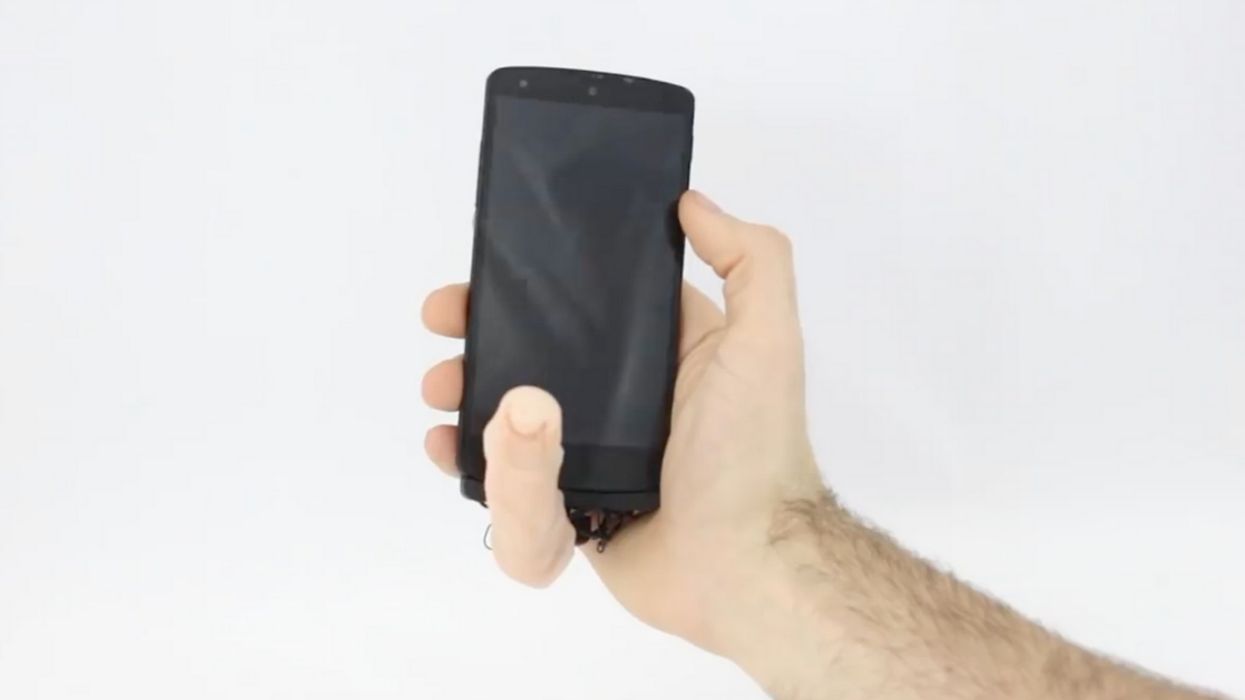
Introducing – MobiLimb, a finger-like attachment to your phone or tablet that aims to make your life easier and give you nightmares in the process.
The MobiLimb was created by researchers in France and is made up of "five servo motors, an Arduino microcontroller and a sensor, and it can do a number of unsettling things that are straight out of nightmares," according to Engadget.
Marc Teyssier, a PhD student and one of the researchers behind the project for the dismembered limb, legitimized its existence.
"In the spirit of human augmentation, which aims at overcoming human body limitations by using robotic devices, our approach aims at overcoming mobile device limitations (static, passive, motionless) by using a robotic limb."
Th MobiLimb can prop itself up so you can watch a video, or provide an alternate way to grip your device.
But there's one function that is really disturbing.
The articulated digit can be skinned to resemble a human finger, and it can stroke your wrist while you're using your phone.

Someone implied that single people could benefit from this invention as a companion.
What would the next-generation MobiLimb offer consumers?
The attachment could come in handy should an unfortunate life-changing incident were to occur.
But the gadget is still giving people goosebumps.
Others saw a more erotic potential.
Now here's a function not advertised by MobiLimb's creators.
Feelings are mixed. But the jury is in.
As to why such a creepy gadget was invented, we can't quite put our finger on it. But then, when it comes to consumers' needs, these guys may be out of touch.
Scotland Tackles Transphobia and Homophobia In Brilliant New Billboard Ads ❤️
The Scottish government has had enough of hate crimes and is moving forward with a gutsy campaign.
According to Pink News, Scotland is launching a new initiative to combat intolerance with messages respectively addressing "bigots," "disablists," "homophobes," "racists," and "transphobes" in a series of ads circulating across the country.
Each message is signed on behalf of Scotland.
The campaign is part of the Scottish government's One Scotland project in an effort to reduce hate crime.
One letter reads:
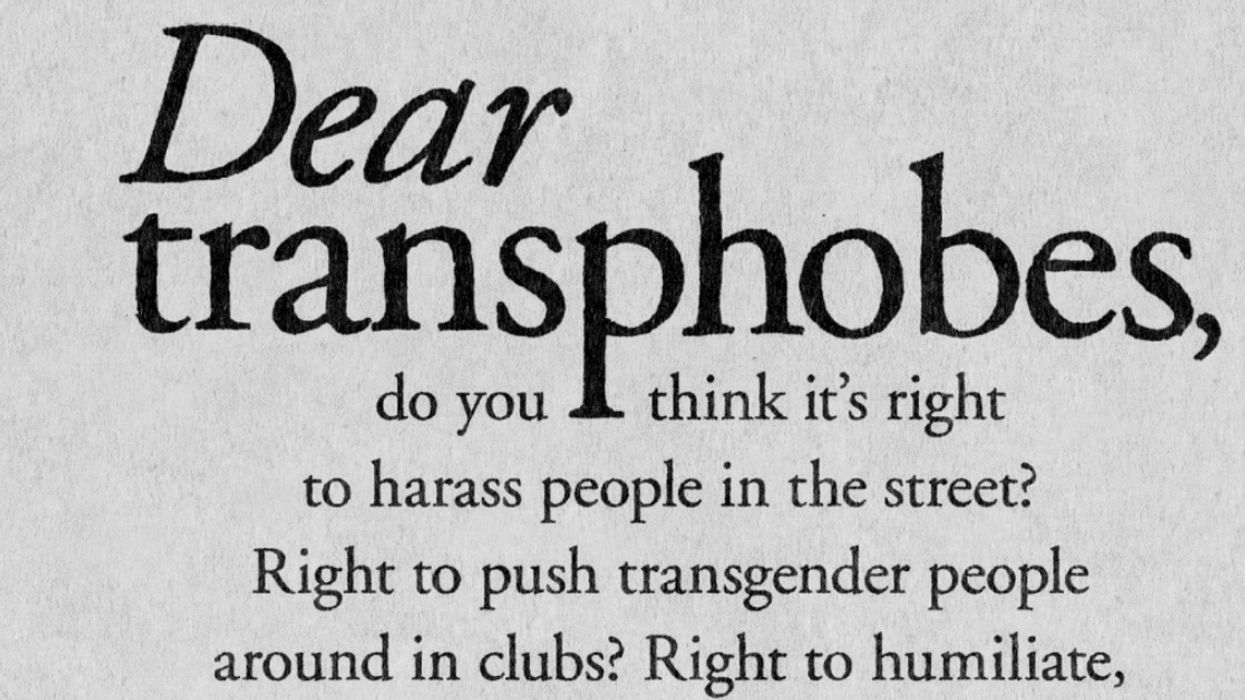
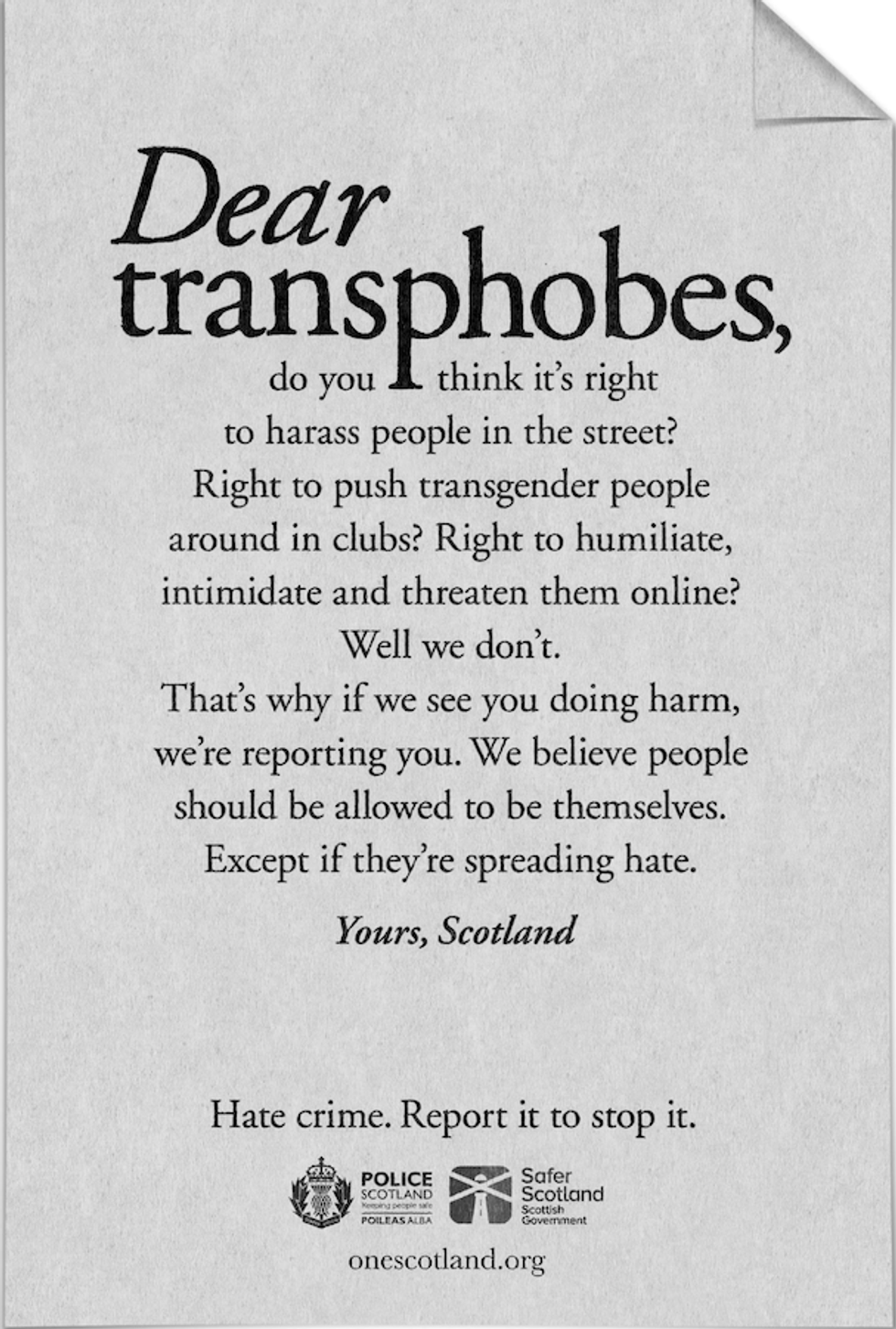
"Dear transphobes, do you think it's right to harass people in the street? Right to push transgender people around in clubs? Right to humiliate, intimidate and threaten them online? Well we don't."
"That's why if we see you doing harm, we're reporting you. We believe people should be allowed to be themselves. Except if they're spreading hate."
"Yours, Scotland."
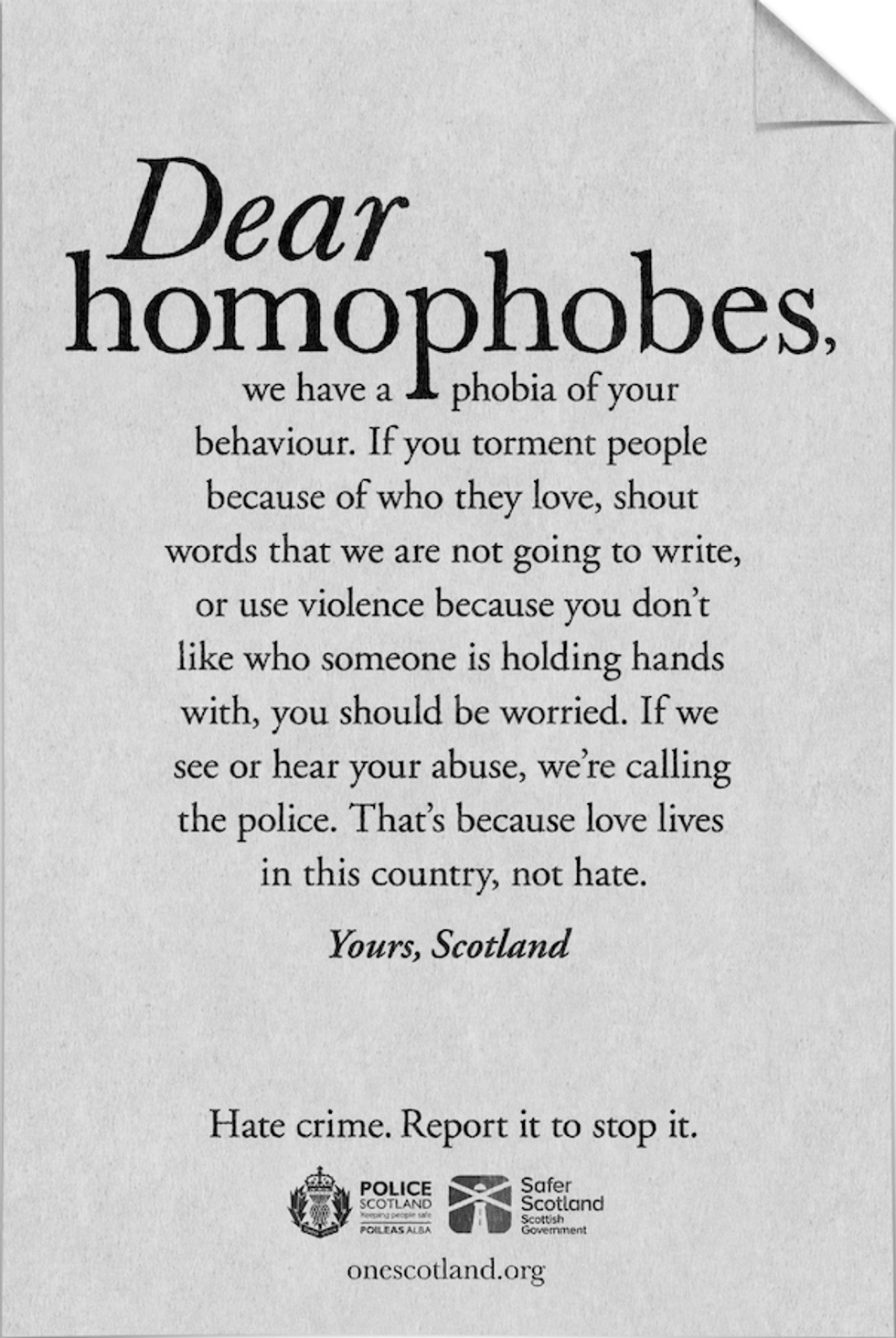
In another letter, the country says it has a "phobia" of homophobic behavior.
"If you torment people because of who they love, shout word that we are not going to write, or use violence because you don't like who someone is holding hands with, you should be worried."
"If we see or hear your abuse, we're calling the police. That's because love lives in this country, not hate."
"Yours, Scotland."
One Scotland's website describes the organization as one that aims to continue building an inclusive society while recognizing the significant strides made so far towards equality.
"One Scotland embodies the inclusive society we want in Scotland, where equality and human rights are respected and every individual and minority group feels valued."
The website defines hate crimes as abuse that "can be verbal or physical and has hugely damaging effects on the victims, their families and communities, and we all must play our part to challenge it."
"Police Scotland takes hate crime very seriously. In the last year there were over 5,300 charges of hate crime reported to the Procurator Fiscal in Scotland1."
"However, there are many more incidents that go unreported. We all have a responsibility to report hate crime if we witness it – it's the only way we can challenge it, and put an end to it for good."
Justice minister Humza Yousaf is familiar with being a victim of a bigotry and is encouraging people to call out and report any incidents involving harassment.
"As somebody who has faced Islamaphobic and racial abuse over the years, I know how upsetting being a victim of hate can be. Hate crime and prejudice are completely unacceptable and we are absolutely committed to tackling it."
"We all have a role to play in stamping out prejudice and I would ask anyone who witnesses a hate crime to play their part and report it. Justice agencies such the police and Crown Office will deal sensitively with reports made and people should have confidence in how they will be treated. Last year there were over 5,300 charges of hate crime reported to the Procurator Fiscal in Scotland but there are still many incidents that are going unreported."
Henrietta Mochrie identifies as transgender and has been the victim of repeated harassment and abuse. She emphasized the importance of speaking out against the hatred.
"I'll often get street harassment, sometimes this has escalated to the point where I've been followed by people shouting abuse at me, just because of who I am."
"It makes me feel really down and scared to leave the house. It's important that if you witness hate crime that you report it to take a stand against hate."
One Scotland's ad campaign officially launched on Wednesday.
Hopefully, it won't take too long before other nations follow suit in this bold, yet necessary fight for equality.
H/T - OneScotland, PinkNews, Twitter
Feminists Slam Man Telling Them They Can't Have Both Chivalry And Equality
A man on Twitter informed feminists they had to choose between chivalry and equality.
He was promptly raked over the coals for even assuming an antiquated concept would be considered as a viable option.
Twitter user @Rich_Cooper stated:
"Dear feminists. You either get equality or chivalry. You can't have both."
One user responded:
"I'll take equality. I don't need special treatment."
Cooper's rhetorical question did not go over so well. Both women and men expressed their disdain for his message.
One male user observed that chivalry was irrelevant and treating everyone with kindness and respect was compulsory.
"What people care about is caring, empathic [sic], considerate, thoughtful people, NOT whether THEIR door is held for them or THEIR meal is paid for them."
"Are there gender stereotypes in het[erosexual] dating? Sure. But that's separate from being a warm, giving, caring, grounded person."
Some women got right down to the point.
The notion of chivalry and equality are mutually exclusive and not a lot of people thought it was a major priority for feminists.
Common courtesy is not chivalry.
This user pointed out the fact that chivalry stems from a history of men outdoing other men. The concept had very little to do with women.
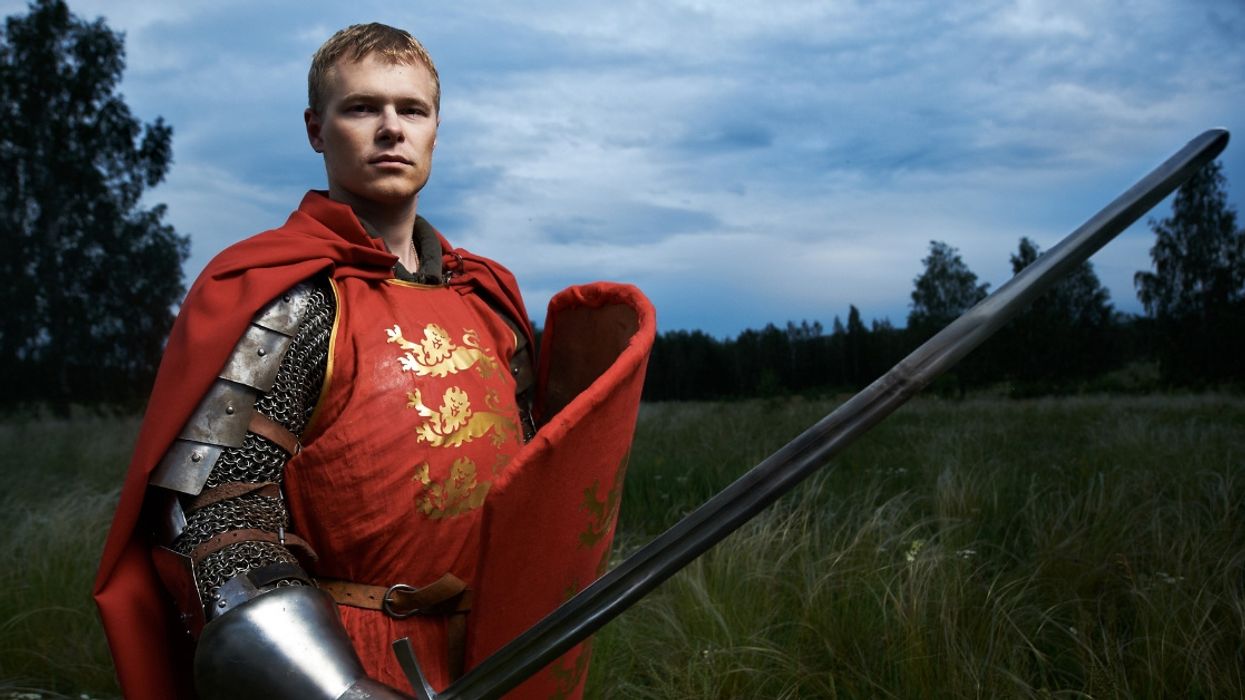
"Chivalry is a medieval concept of men dressing to impress other men. It has little to do with equality."
"Some men were on top, other men were beneath them. Historically, women were rarely invited into the process."
Neil Bradley described the outdated concept of chivalry as one that implies men being superior to women in a September 8, 2017, article for Medium publications.
"Examples: opening the door for a woman, paying for a woman's meal, gesturing for a woman to go first. The justification is either that women are not physically as strong (to open the door), able to provide (pay for their own meal), or are more deserving of compassion than men (allowing women to go first)."
Bradley also added that he wants to treat others the way he wants to be treated and asked if that approach should be motivated by chivalry or equality.
"If the genders are to be considered equal and treated equally, how a man treats a woman will essentially be the same as how a man treats a man."
"The obligation to open the door, pay for the meal, and let women go first vanishes. Men do not do this to other men, therefore why do it for women?"
His final take was that the two concepts can't co-exist. Either one is chivalrous or treats everyone as equals.
At the end of the day, people were happy to show chivalry the door.
H/T - GettyImages, Twitter, Indy100, Medium

Woman Was Fired For Refusing To Wear A Bra At Work—And Now She's Suing
Christina Schell, from Alberta, Canada, stopped wearing bras three years ago citing health reasons.
While Schell did not specify the health reasons, she did state she finds them to be "horrible."
But after her refusal to sign or adhere to a new enforced dress code policy to wear a bra or tank top under her work shirt at a golf course grill where she worked, Schell was promptly fired.
Now, the 25-year-old has filed a human rights violation against the Osoyoos Golf Club, Osoyoos, in British Columbia, Canada.
Schell said:
"I don't think any other human being should be able to dictate another person's undergarments."
When she asked the general manager, Doug Robb, why she had to comply, the manager told her the mandate was for her protection.
Robb allegedly said:
"I know what happens in golf clubs when alcohol's involved."
After losing her job, she brought the case to the British Columbia Human Rights Tribunal and told them the club's dress code was discriminatory because the rule didn't apply towards male employees.
Schell told CBC:
"It's gender-based and that's why it's a human rights issue. I have nipples and so do the men."
David Brown, an employment lawyer in Kelowna, BC, said gender-specific dress codes could be viewed as discriminatory under the BC Human Rights Code.
He stated:
"It's an interesting question as to whether or not an employer can dictate the underwear that women can wear, but they don't say anything about the underwear that men can wear, and does that create an adverse impact on the individual?"
Brown added:
"If this policy is found to be discrimination, the next question is does the employer have a bonafide occupational requirement to essentially impose this on the individual?"
"I'm kind of scratching my head as to what that occupational requirement would be."
As for the tank top option, due to working under oftentimes extreme heat serving tables outsides, Schell did not want to wear another layer of clothes just because of her gender.
Schell said:
"It was absurd. Why do you get to dictate what's underneath my clothes?"
Employment lawyer Nadia Zaman told CBC that the club can enforce a gender-specific policy as they deem necessary as long as the establishment can prove it is for the occupational safety of its workers.
But the attorney questioned if forcing female employees to wear a bra was applicable in this case.
Zaman stated:
"If they simply require that female employees wear a bra but then they don't have a similar requirement for males, and they can't really justify that … then there is a risk that their policy's going to be deemed to be discriminatory."
Under British Columbia's discrimination law, it is illegal for employers:
'to discriminate against any individual because of his race, color, religion, sex, or national origin'.
McDonald's employee Kate Gosek, 19, agrees with Schell in that the dress code is "unnecessary." She too was harassed by her employers at a McDonald's in Selkirk, Manitoba, over refusing to wear a bra.
"She just told me that I should put on a bra because, McDonald's—we are a polite restaurant and no one needs to see that."
Schell's case sparked plenty of debates on Twitter.
Schell is not alone in her disdain for bras.
Schell is still waiting to hear from the Human Rights Commission about her claim.
H/T - GettyImages, Twitter, Indy100, CBC


(
(

