








September, 2002, LOS ANGELES - Movies are historic documents. They chronicle the times in which they were filmed. Oscar-winning movies in particular, beyond their acknowledged cinema artistry and box office popularity, can illuminate the temper of the country at a point in time. They capture the styles, the social values, and a sense of the political climate of the year in which they won the Academy Award.
This year is the 75th anniversary of the Oscars. The Academy of Motion Picture Arts and Sciences has been celebrating this Diamond Anniversary by screening all of the Academy Award winning Best Pictures in sequence most Monday nights at its Samuel Goldwyn Theater in Beverly Hills. This past month, the Oscar winners from the 1940s have been screened. These award-winning films gave me a good sense of the spirit of this country during those turbulent times.
The 1940 winner was director Alfred Hitchcock's "Rebecca," starring Laurence Olivier, Joan Fontaine, and Judith Anderson. The country was just emerging from the Great Depression and hungering for escape. The people wanted a break from the lingering gloom. Their romantic fantasy was the notion of happiness prevailing over adversity, come what may. Joan Fontaine played a beautiful but poor young housekeeper in a great manorial estate owned by Laurence Olivier, whose wife had recently died. She falls in love with the dashing young owner in spite of the relentless intrusions of a stern and mysterious head housekeeper played by Judith Anderson.
The film would be seen today as a piece of high-class soap opera. But it well captured the escapist appetite of a nation just shaking off the dreary dust of economic hard times. "Rebecca" is an entertaining, but transparently corny gauge of the period. This movie won for Best Picture over a much more substantial film that depicted the true hardships of the period with powerful realism, "The Grapes of Wrath." If I were voting then, this would have been my pick. The Best Direction award, aptly, went to the director of "The Grapes of Wrath," the great master, John Ford.
An added bit of fun with "Rebecca," on the other hand, was watching a young Judith Anderson as the sinister head housekeeper. Her career-capping movie was "Star Trek III: The Search for Spock" in which she portrayed the stern ancient Vulcan priestess. She seemed pretty stern in real life as well when we worked on that film. For her role in "Rebecca" she won the Best Supporting Actress Oscar.
 The 14th Best Picture Academy Award winner, "How Green Was My Valley," was released in 1941. The Oscar ceremony honoring it was nearly canceled. The award presentation took place on February 26, 1942 - two months after Pearl Harbor. The governors had been thinking of canceling the show after the surprise attack. But, after much debate, they decided to go ahead with a modified version. The tone was subdued, formal attire was banned, and there were no searchlights fanning the skies outside Los Angeles' Biltmore Hotel, where the ceremony was held.
The winning film still reflected the economic struggles of the nation rather than the now-raging world conflict. "How Green Was My Valley" is about the struggles of a Welsh coal mining family at the turn of the century. Parallel to the trials and tribulations of a tight-knit family gradually breaking up were the economic issues of unionization, labor versus capital, and class divisions. It was still a "fighting through hard times" movie. The film's director, John Ford, won his second Oscar, thus becoming the first director to win two in a row. He had won the previous year for "The Grapes of Wrath."
The Fifteenth Oscar presentation was on March 3, 1943, in the Coconut Grove of the Ambassador Hotel. This time, the Academy Awards ceremony radiated patriotism. Jeannette MacDonald sang the National Anthem. Marine private Tyrone Power and Air Force private Alan Ladd unfurled an industry flag announcing that over 26,000 members of the motion picture business were in uniform. For the first time, the bronze-filled, gold-plated Oscar statuettes were made of plaster due to wartime shortages. And the Best Picture of the year award went to "Mrs. Miniver," a film unabashedly glorifying the courage of an English family under wartime Nazi assault.
 The Mrs. Miniver character, played by Greer Garson, personified heroic British spirit and resilience. The downed German pilot spouted Hitler's master race slogans like a robot. The devastation of war was heartbreakingly depicted. British Prime Minister Winston Churchill called the film "propaganda worth a hundred battleships." I noted an interesting bit of the moral code of the times in the separate beds occupied by the loving wife and husband in their own bedroom. Greer Garson received the Best Actress and Teresa Wright the Best Supporting Actress Oscars. The director, William Wyler, won for his work on the film but could not attend the ceremony because he was stationed in England at the time. The world was engulfed in war and so, too, was the Academy Awards ceremony.
The Oscar ceremony of 1945 was moved back onto Hollywood Boulevard to the legendary Grauman's Chinese Theater. The news from Europe was looking hopeful
Within two months, Germany would surrender. The Japanese would follow suit in August. The country was feeling optimistic.
The Best Picture Oscar winner was the bright and sentimental Paramount Studios film, "Going My Way," starring Bing Crosby. It was also the first Best Picture to include the Best Song. Crosby, as the idealistic, easy going, crooner priest Father O'Malley, won as Best Actor and Barry Fitzgerald as the charmingly cantankerous Father Fitzgibbon, won as Best Supporting Actor. America had struggled through more than a decade of economic misery and now seemed victorious in a world conflict. We were feeling good. We felt upbeat about the future. "Going My Way" was a precise picture of the country.
This Academy series on the Best Picture Oscar winners set me to thinking on the films that might reflect the temper of our times.
 Today, we could be said to be living in a time prickly with uncertainty. The air is filled with insecurity whether it is in the wild gyrations of the stock market or the fear of some startling terrorism in our land. News of rising unemployment is accompanied by conflicting reports of possible attack on Iraq. The air is tense with a vague anxiety. I saw a film earlier this year at the Sundance Film Festival that I think brilliantly captures this societal unease. It is "One Hour Photo" starring Robin Williams in a chillingly fine performance. The film was recently released nationwide. "One Hour Photo" is one of the best pictures I have seen this year and a good candidate for Best Picture consideration.

Twitter user @Rich_Cooper stated:
"Dear feminists. You either get equality or chivalry. You can't have both."
One user responded:
"I'll take equality. I don't need special treatment."
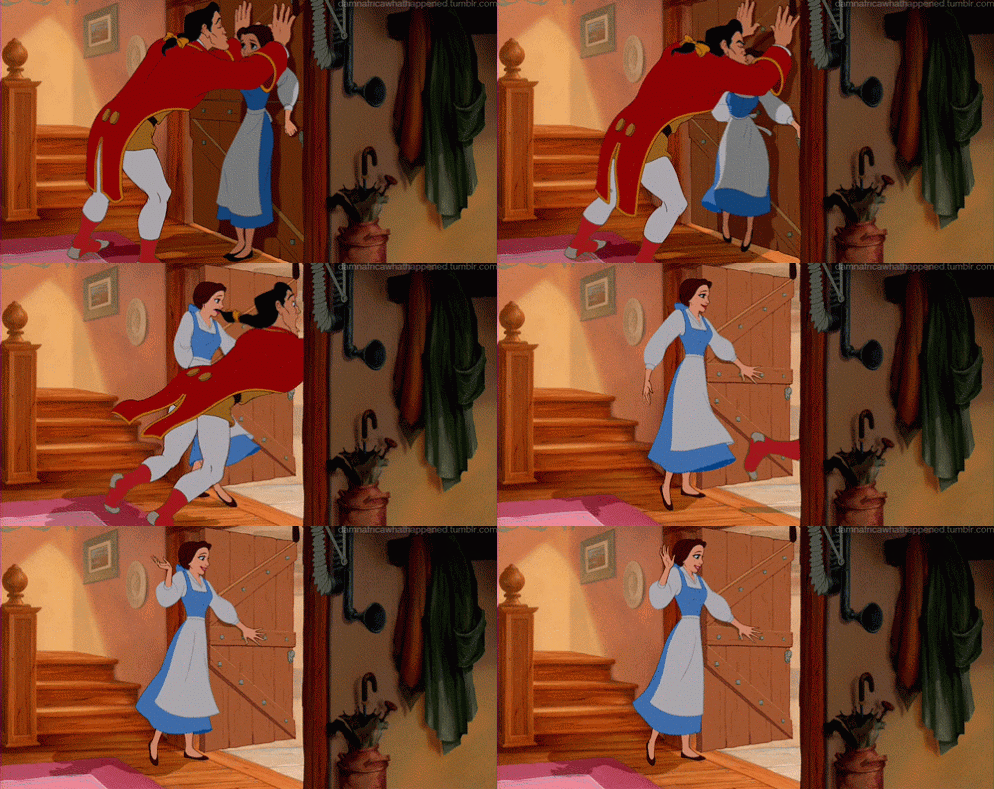
Cooper's rhetorical question did not go over so well. Both women and men expressed their disdain for his message.
One male user observed that chivalry was irrelevant and treating everyone with kindness and respect was compulsory.
"What people care about is caring, empathic [sic], considerate, thoughtful people, NOT whether THEIR door is held for them or THEIR meal is paid for them."
"Are there gender stereotypes in het[erosexual] dating? Sure. But that's separate from being a warm, giving, caring, grounded person."
Some women got right down to the point.
The notion of chivalry and equality are mutually exclusive and not a lot of people thought it was a major priority for feminists.
Common courtesy is not chivalry.
This user pointed out the fact that chivalry stems from a history of men outdoing other men. The concept had very little to do with women.
"Chivalry is a medieval concept of men dressing to impress other men. It has little to do with equality."
"Some men were on top, other men were beneath them. Historically, women were rarely invited into the process."
Neil Bradley described the outdated concept of chivalry as one that implies men being superior to women in a September 8, 2017, article for Medium publications.
"Examples: opening the door for a woman, paying for a woman's meal, gesturing for a woman to go first. The justification is either that women are not physically as strong (to open the door), able to provide (pay for their own meal), or are more deserving of compassion than men (allowing women to go first)."
Bradley also added that he wants to treat others the way he wants to be treated and asked if that approach should be motivated by chivalry or equality.
"If the genders are to be considered equal and treated equally, how a man treats a woman will essentially be the same as how a man treats a man."
"The obligation to open the door, pay for the meal, and let women go first vanishes. Men do not do this to other men, therefore why do it for women?"
His final take was that the two concepts can't co-exist. Either one is chivalrous or treats everyone as equals.
At the end of the day, people were happy to show chivalry the door.
H/T - GettyImages, Twitter, Indy100, Medium
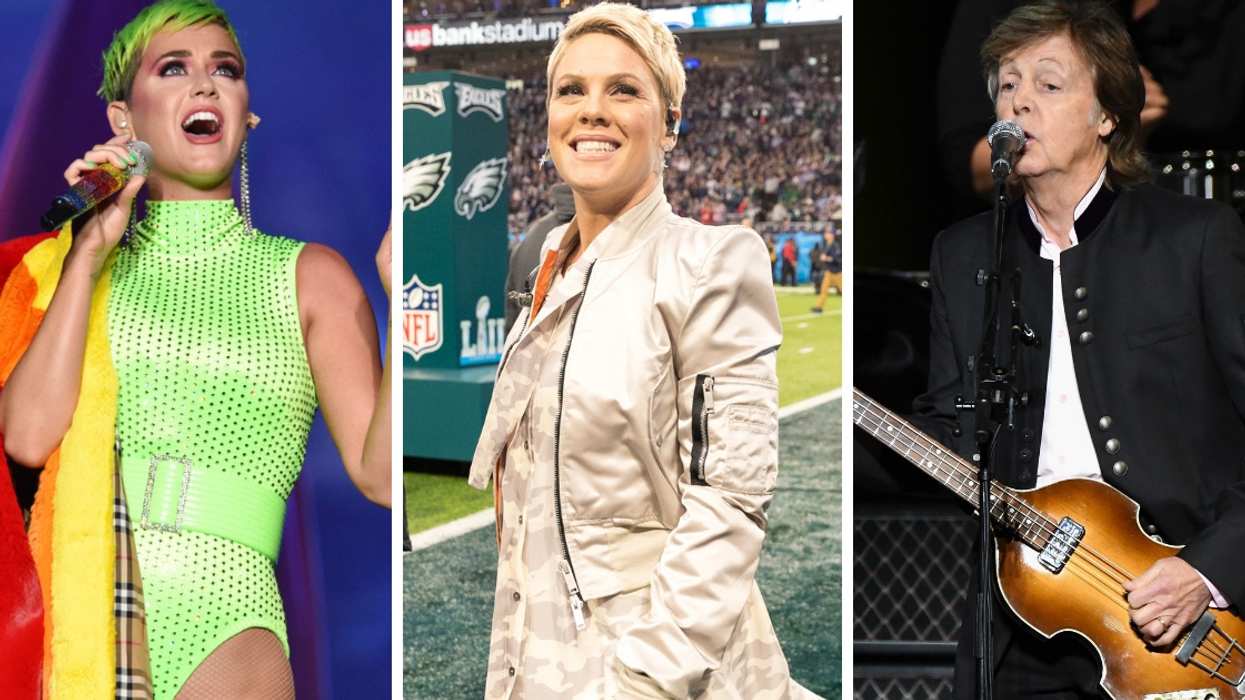
Hundreds of artists have signed a letter threatening a boycott if SiriusXM's parent company, Liberty Media, doesn't back down from opposing the Music Modernization Act.
The act, which was expected to pass through Congress, streamlines royalty payments in the new age of digital technology, but it seems SiriusXM is objecting to a small section that would have the satellite radio company paying royalties on recordings dating before 1972.
That's a whole lot of songs and a whole lot of money the company is hoping to skip out on paying, but not if stars like Paul McCartney, P!nk, Stevie Nicks, Sia, Carly Simon, Gloria Estefan, Mick Fleetwood, Don Henley, Max Martin, and Katy Perry can help it.
The letter read, in part:
I'm writing you with grave concern about SiriusXM's opposition to the Music Modernization Act (Classics Act included).
We are all aware of your company's objections and trepidation but let me say that this is an opportunity for SiriusXM to take a leadership position. As you are aware, 415 Representatives and 76 Senators have already cosponsored the MMA along with industry consensus. It's SiriusXM vs all of us. We can either fight to the bitter end or celebrate this victory together. Rather than watch bad press and ill will pile up against SiriusXM, why not come out supporting the most consequential music legislation in 109 years? We do not want to fight and boycott your company but we will as we have other opponents. Stand with us! Be brave and take credit for being the heroes who helped the MMA become historic law! Momentum is building against SiriusXM and you still have an opportunity to come out on the right side of history. We look forward to your endorsement but the fire is burning and only you can put this out.
SiriusXM resoponded with a letter of their own:
Over the past several weeks, we have been the subject of some stinging attacks from the music community and artists regarding our views on the Music Modernization Act. Contrary to new reports and letters, this is really not about a SiriusXM victory, but implementing some simple, reasonable and straightforward amendments to MMA. There is nothing in our "asks" that gut the MMA or kills the Act. So let's talk about the substance of the amendments we propose, because we truly do not understand the objections or why these concepts have incited such a holy war.ontrary to the accusations, SiriusXM has proposed three simple amendments to the MMA.
First, SiriusXM has asked that the CLASSICS Act recognize that it has already licensed all of the pre-1972 works it uses. This amendment would ensure that artists – the people who are supposed to be at the heart of the MMA – receive 50% of the monies under those existing licenses. Is that unfair? Just today, Neil Diamond wrote in the LA Times that: "I receive a small amount of songwriting royalties, but no royalties as the recording artist." How can that happen? To date, SiriusXM has paid nearly $250 million dollars in pre-'72 royalties to the record labels. We want to make sure that a fair share of the monies we have paid, and will pay, under these licenses gets to performers. Without this provision, artists may never see any of the money SiriusXM paid, and will pay, for the use of pre-1972 works. Artists not getting paid hurts our business!
Second, Sirius XM thinks that the fair standard to use in rate setting proceedings is the standard that Congress chose in 1995 and confirmed again in 1998 – which is called the 801(b) standard. However, we are willing to move the "willing buyer/willing seller" standard contained in the MMA. In exchange, we have asked for the same concession that the MMA grants to other digital music services, but we were left out of — simply that the rates that were set last year for five years now apply for ten years. We thought this was a fair compromise when we read the "new" MMA that was released this weekend by the Senate, and are willing to live by that compromise.
Third, SiriusXM is asking the simple question: "Why are we changing the rate court evidence standard for musical compositions in this legislation so that it gives another advantage to broadcasters over satellite radio and streaming services?" There is no policy rationale for this change to tilt the playing field further in their favor, and frankly no one has been able to explain it to us. It is only fair that we debate why the change to Section 114(i) is in the MMA.
Did you all catch that? It sounds like lawyer speak for "we don't really want to say where we stand."

It seems all the letters were for naught. The Music Modernization Act passed in the U.S. Senate.
It was time to celebrate and dance in the streets.
As the saying goes, honest pay for honest work.