






August, 2003, LOS ANGELES - Winston Churchill said of history, "the farther back I look, the farther forward I can see." He believed that the lessons learned from history could prepare us to meet the challenges that we face in the future. Last month, I literally lived the value of Churchill's wisdom with a trip to Williamsburg, Virginia.
As if the 'transporter' from Star Trek had 'beamed' me back in time, I was living in the year 1774, just before the War for Independence from the onerous rule of the English King, George III. As a historic preservationist, I'd always wanted to visit Williamsburg, the colonial capital of Virginia, famous for its historic buildings that had been preserved, restored or recreated to pre-revolutionary times. I'd read that there would be guides authentically dressed to the period. However, I didn't realize how complete that experience back in time would be.
 The buildings were magnificently restored. What was truly impressive was the recreation of the context of the times. At the very center of Williamsburg was the Governor's Palace - as it was called. It was a substantial mansion but certainly not a palace in the grand European sense. But to the colonists, this imposing residence was the very symbol of opulence and the King's might. The houses of even the wealthy colonials seemed modest in contrast. Anchoring both ends of the main street, Duke of Gloucester, were the two significant structures of the capital, the Wren Building of the College of William and Mary, the seat of learning, at one end and the Capitol with the House of Burgesses, the seat of governance, at the other end. In the House of Burgesses, we sat in the seats that the Virginia representatives sat as we listened to the authentically clad historic interpreter recount all that transpired in this great hall. She pointed to a youngster and said that he may be sitting in the very seat from which Patrick Henry thundered against the King's taxes. He giggled self-consciously. She pointed to another teen-ager and said that she could be seated where Thomas Jefferson sat. She touched the wood of her seat with renewed awe. The docent personalized the past. She made history vibrantly real to a group of twenty-first century tourists. As the crowd moved on, I lingered in the great hall admiring the architecture. The docent approached me smiling. This faithful representative of history clad in colonial garb then, unexpectedly, broke the time barrier. Very discreetly, she whispered, "I have been a life-long Star Trek fans and was delighted to see you in the group. Would it be possible to get your autograph?" It was charming. I, who had depicted the future in fiction, connected with this wonderful spokesperson for the past. Arleen Donikowsky is a woman who spans the centuries with equal devotion to the past and the future.
There were no cars in the historic district. If one didn't walk, there were horse drawn carriages for those who were willing to pay. Most people walked - as did most people then. When one talked to the people dressed in colonial garb, they talked as people of their time. The shocking news that they shared with us was the report of some up in Boston who had dressed up as Indians and dumped English tea into Boston Harbor as a protest against the King's unjust tax. The people of Williamsburg certainly shared the sense of outrage against the tax. However, dumping the tea into the harbor, they thought, was rather "extreme." At noon, there was a fife and drum parade down Duke of Gloucester Street and we got a good sense of the martial spirit of the colonists. There were people dressed as colonials who spoke with Scottish or Hungarian accents because they had recently arrived as immigrants to America - as indeed there were immigrants back then. When we toured the houses of the wealthy, there were black slaves that did the cooking and cleaning. But they told us of others who had been freed and worked as blacksmiths or craftsmen. We visited a carpenter's workshop where furniture for the town was made in the traditional way. In this city of many races, backgrounds and social station, there was warmth, civility, graciousness, and a sense of community. We had dinner in historic eating establishments like the 18th century chophouse, King's Arm Tavern or Christiana Campbell's Tavern, which was George Washington's favorite, where menus offered traditional fare of the time. Costumed musicians playing the lute or other quaint period instruments provided the entertainment as we dined.
 The three day visit was truly "beaming back" into history. The sights, sounds, tastes, and spirit of colonial Williamsburg surrounded us completely. We got a real sense of the colonial spirit of mutual caring when we were caught in a sudden summer storm one evening just as we were leaving the historic district. Sopping wet, we were dashing back to our hotel when suddenly a lone s.u.v. came driving down the road. The driver opened the car window and shouted, "Here, use these," threw out umbrellas and drove off - no charge, no request for their return, just a simple gesture of kindness. We accepted the umbrellas with drenched gratitude. The colonial spirit of mutual help carried over into the 21st century.
From my visit to Williamsburg, I got a renewed understanding of the daily struggles and challenges faced by the Virginia colonists. Whatever their station, everyone had a role to fulfill and a responsibility to the community. There was a spirit of interdependence and mutual assistance and, at the same time, a pressing hunger for justice. The leaders then were extraordinary men of principal and vision. American democracy was born out of this mix. The ringing words, "We hold these truths to be self evident, that all men are created equal" were articulated out of the fusion of the spirit and events of these times. Yes, they lived with slavery. Yes, only educated landowners could vote. Yes, the women had no role in leadership. Yes, there were inconsistencies with the realities of the times. Yet, out of those societal discrepancies rose the vision of a nation of shining ideals, the framework for America. Our democracy is a continuing work in progress - and through the years, we have been making progress.
 So, as a Californian, I am troubled by the mockery that is being made of our democratic electoral procedure by the irresponsibility of the recall of a recently re-elected governor. The recall is an important citizens' tool in a democracy to be used, as the constitution states, in cases of "malfeasance in office." It is not a tool to be used by bad losers of a legitimate election. I did not vote for the governor. I do not like him despite the fact that he and I are of the same political party. However, in a democracy, we accept the will of the majority and prepare for the next election to get rid of a bad politician. Just because you lost an election, that does not mean the losing minority has the right to recall him eight months later. I do not like President George Bush. I didn't vote for him. I feel he has been a disaster for the nation and the economy. He didn't even win the popular vote. However, the Supreme Court in a lawful procedure appointed him. Therefore, I have accepted that fact as part of the process and have waited to work for his replacement with the next election.
It is rather ironic that I am advocating the replacement of President Bush because last April I played a member of his cabinet, Secretary of Transportation Norman Mineta, in a television film which will be aired on Showtime cable channel on Sunday evening, September 7. It is titled, "DC 9/11: Time of Crisis," and is about the Bush administration during the days immediately following the horrors of September 11, 2001. My friend, Timothy Bottoms, plays President Bush. It is a tense drama of the response of the Bush administration to the trauma of horrific events. I hope you will all be able to catch it.
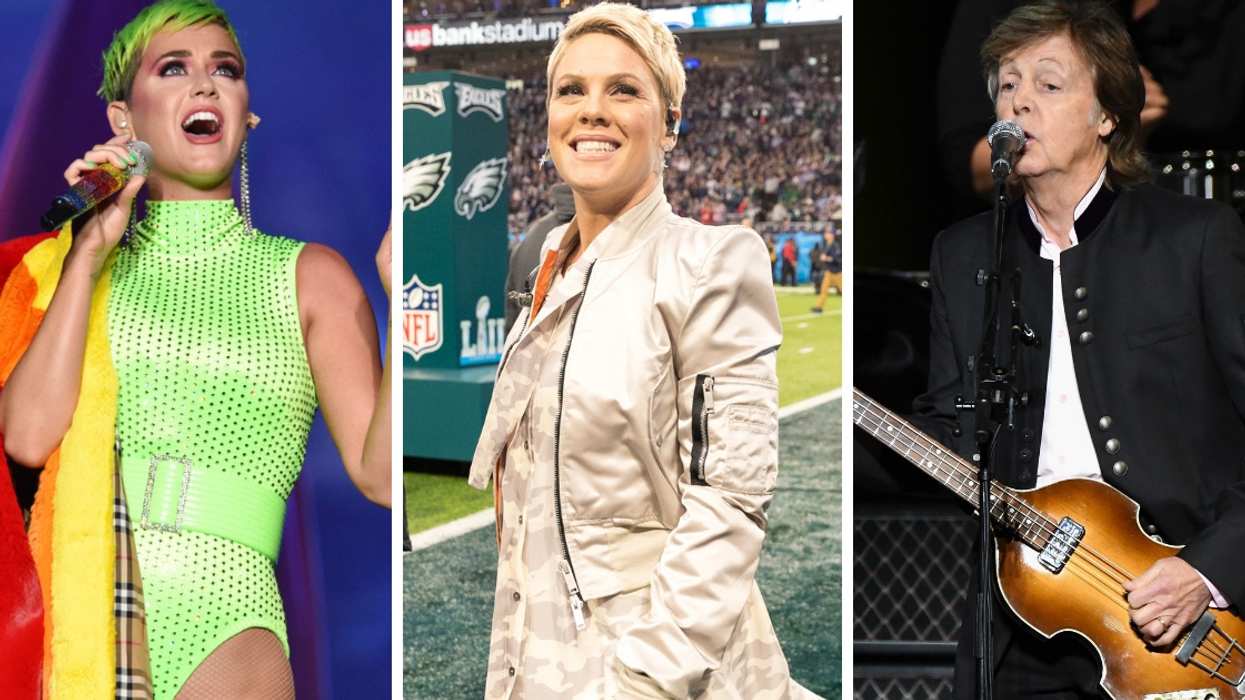
Hundreds of artists have signed a letter threatening a boycott if SiriusXM's parent company, Liberty Media, doesn't back down from opposing the Music Modernization Act.
The act, which was expected to pass through Congress, streamlines royalty payments in the new age of digital technology, but it seems SiriusXM is objecting to a small section that would have the satellite radio company paying royalties on recordings dating before 1972.
That's a whole lot of songs and a whole lot of money the company is hoping to skip out on paying, but not if stars like Paul McCartney, P!nk, Stevie Nicks, Sia, Carly Simon, Gloria Estefan, Mick Fleetwood, Don Henley, Max Martin, and Katy Perry can help it.
The letter read, in part:
I'm writing you with grave concern about SiriusXM's opposition to the Music Modernization Act (Classics Act included).
We are all aware of your company's objections and trepidation but let me say that this is an opportunity for SiriusXM to take a leadership position. As you are aware, 415 Representatives and 76 Senators have already cosponsored the MMA along with industry consensus. It's SiriusXM vs all of us. We can either fight to the bitter end or celebrate this victory together. Rather than watch bad press and ill will pile up against SiriusXM, why not come out supporting the most consequential music legislation in 109 years? We do not want to fight and boycott your company but we will as we have other opponents. Stand with us! Be brave and take credit for being the heroes who helped the MMA become historic law! Momentum is building against SiriusXM and you still have an opportunity to come out on the right side of history. We look forward to your endorsement but the fire is burning and only you can put this out.
SiriusXM resoponded with a letter of their own:
Over the past several weeks, we have been the subject of some stinging attacks from the music community and artists regarding our views on the Music Modernization Act. Contrary to new reports and letters, this is really not about a SiriusXM victory, but implementing some simple, reasonable and straightforward amendments to MMA. There is nothing in our "asks" that gut the MMA or kills the Act. So let's talk about the substance of the amendments we propose, because we truly do not understand the objections or why these concepts have incited such a holy war.ontrary to the accusations, SiriusXM has proposed three simple amendments to the MMA.
First, SiriusXM has asked that the CLASSICS Act recognize that it has already licensed all of the pre-1972 works it uses. This amendment would ensure that artists – the people who are supposed to be at the heart of the MMA – receive 50% of the monies under those existing licenses. Is that unfair? Just today, Neil Diamond wrote in the LA Times that: "I receive a small amount of songwriting royalties, but no royalties as the recording artist." How can that happen? To date, SiriusXM has paid nearly $250 million dollars in pre-'72 royalties to the record labels. We want to make sure that a fair share of the monies we have paid, and will pay, under these licenses gets to performers. Without this provision, artists may never see any of the money SiriusXM paid, and will pay, for the use of pre-1972 works. Artists not getting paid hurts our business!
Second, Sirius XM thinks that the fair standard to use in rate setting proceedings is the standard that Congress chose in 1995 and confirmed again in 1998 – which is called the 801(b) standard. However, we are willing to move the "willing buyer/willing seller" standard contained in the MMA. In exchange, we have asked for the same concession that the MMA grants to other digital music services, but we were left out of — simply that the rates that were set last year for five years now apply for ten years. We thought this was a fair compromise when we read the "new" MMA that was released this weekend by the Senate, and are willing to live by that compromise.
Third, SiriusXM is asking the simple question: "Why are we changing the rate court evidence standard for musical compositions in this legislation so that it gives another advantage to broadcasters over satellite radio and streaming services?" There is no policy rationale for this change to tilt the playing field further in their favor, and frankly no one has been able to explain it to us. It is only fair that we debate why the change to Section 114(i) is in the MMA.
Did you all catch that? It sounds like lawyer speak for "we don't really want to say where we stand."

It seems all the letters were for naught. The Music Modernization Act passed in the U.S. Senate.
It was time to celebrate and dance in the streets.
As the saying goes, honest pay for honest work.